
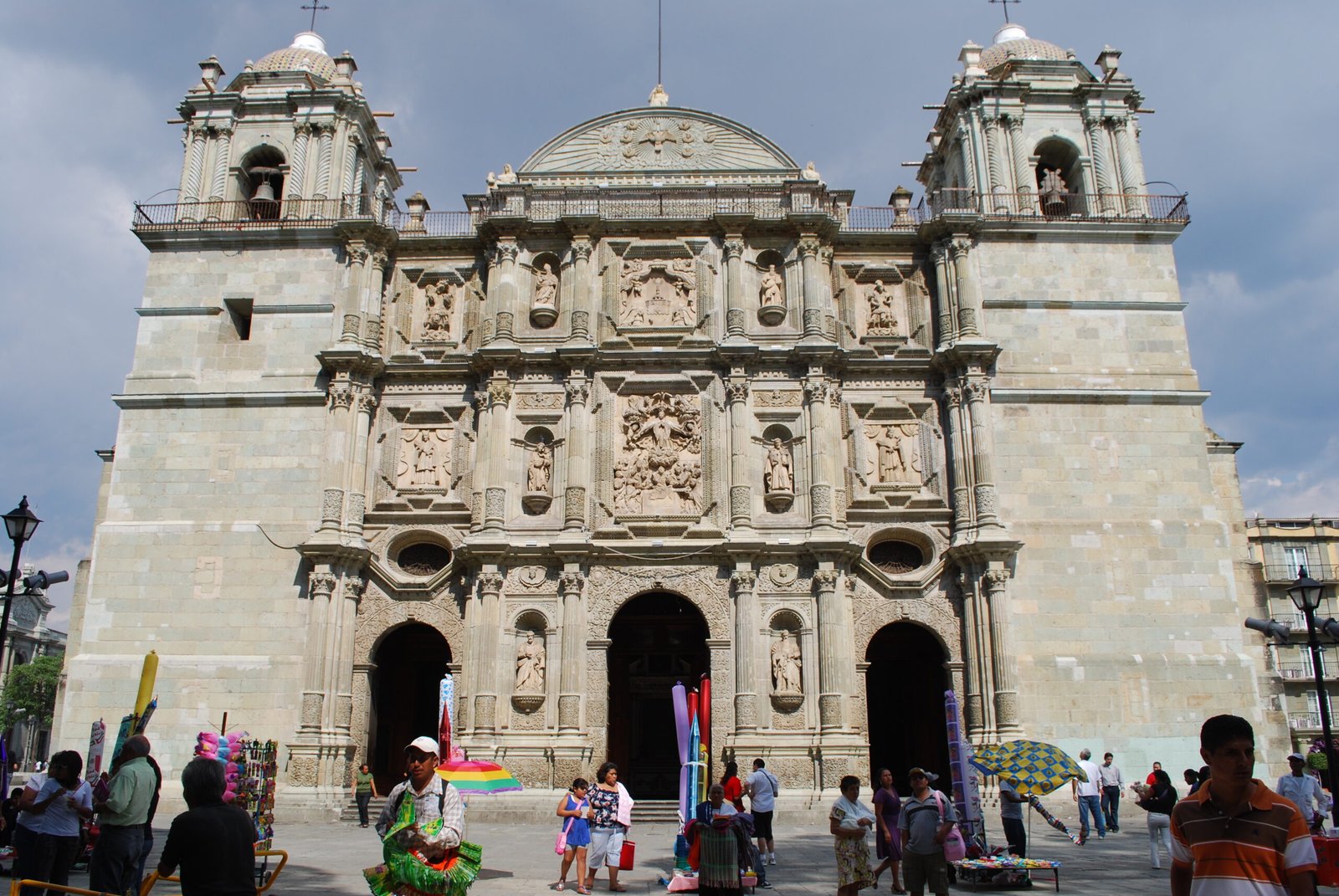
The metropolitan cathedral of Our Lady of the Assumption faces the north side of the Zócalo of Oaxaca de Juárez, beside the Alameda de León. Its chronology needs care, because the official sources distinguish two buildings. Construction began around 1535, when Antequera became a bishop’s seat, with a first fabric of three naves roofed in straw. The building seen today, however, is in substance the reconstruction entrusted in 1724 to Miguel de Sanabria — the only architect the sources name with certainty — and finished in 1733, after the earthquakes so frequent here had compromised the earlier fabric. The most damaging tremor is put by the Centro Virtual Cervantes in 1714. The consecration took place in 1733 at the hands of Bishop Francisco de Santiago y Calderón: some sources give 12 July, but the exact day has no institutional confirmation, and here we stop at the year. The main front, completed around 1752, is in green cantera — the local volcanic stone that the INAH names as a distinguishing feature of the city — with three Baroque storeys, three arched doorways and, in the central bay, the carved relief of the Assumption of Mary. As the official record of the Sistema de Información Cultural notes, the building is deliberately low, massive and thick-walled, like the other churches of the city: an anti-seismic strategy that the UNESCO description of the site extends to the whole of Oaxacan architecture. The earthquake of 14 January 1931, the most devastating in the city’s history, left the bell towers on the point of collapse — so the local chronicles describe them. Some English-language sources speak of towers «destroyed», but that version finds no support in the accounts consulted, and the present low towers are in any case the result of twentieth-century redesigns. Inside are the Baroque organ of 1711-1712 by Matías de Chávez of Puebla — according to the Instituto de Órganos Históricos de Oaxaca the oldest securely dated organ in the state, restored in 1996-97 and still in use at the Baroque pitch of 392 Hz — the chapel of the Señor del Rayo, an image venerated as miraculous, and the relics of the Cross of Huatulco. On the high altar stands a bronze statue of the Virgin of the Assumption cast in Italy: the sculptor’s name varies between sources and is not asserted here. A clock in the south wing is traditionally said to be a gift of Ferdinand VII of Spain, but the report has no institutional confirmation. The cathedral is not inscribed by UNESCO on its own: it is one of the monuments that guard the Zócalo of the Historic Centre of Oaxaca, inscribed in 1987 together with the archaeological zone of Monte Albán under criteria (i), (ii), (iii) and (iv).
About the Cathedral
The Metropolitan Cathedral of Our Lady of the Assumption stands on the north side of Oaxaca’s Zócalo, beside the Alameda de León. Begun around 1535, the building visible today is essentially the reconstruction directed by Miguel de Sanabria between 1724 and 1733, its Baroque facade of local green cantera stone completed around 1752. Deliberately low, thick-walled and massive as a response to the region’s constant earthquakes, it anchors the Historic Centre of Oaxaca, a UNESCO World Heritage Site since 1987 together with Monte Albán.
Key facts
- c. 1535: first cathedral fabric begun after Antequera (Oaxaca) became a bishopric — three naves under a thatched roof.
- 1714: earthquake damage so serious the church had to be rebuilt, according to the Centro Virtual Cervantes.
- 1724–1733: reconstruction under Miguel de Sanabria; consecrated in 1733 by Bishop Francisco de Santiago y Calderón.
- c. 1752: the green cantera main facade completed, with its carved relief of the Assumption.
- 1711–1712: date of the Baroque organ by Matías de Chávez, the oldest firmly dated organ in Oaxaca, restored 1996–97 and still played.
- 14 January 1931: the Miahuatlán earthquake leaves the bell towers on the verge of collapse; the present squat towers reflect 20th-century redesigns.
- 1987: Historic Centre of Oaxaca and Archaeological Site of Monte Albán inscribed by UNESCO, criteria (i)–(iv).
History
Few cathedrals wear their seismic history as openly as Oaxaca’s. The first church on the site, begun around 1535, was austere and provisional; chapels and vaults were added through the late 17th century, but the earthquakes that punctuate the region’s life — above all the one of 1714 — forced a full reconstruction. Miguel de Sanabria took charge of the works in 1724 and delivered the present building in 1733; the facade followed around 1752, after screens brought from Europe and Florentine chandeliers had furnished the interior. While the works dragged on, cathedral functions were held at the nearby church of San Juan de Dios.
The building’s proportions are the point: as the official cultural record notes, it is deliberately heavy and low, like the other churches of the city — a survival strategy that UNESCO’s own description generalizes to all of Oaxaca’s architecture, with its “thick walls and low buildings” in a highly seismic zone. The strategy was tested again on 14 January 1931, when the strongest earthquake in the city’s recorded history left the bell towers near collapse.
What you see
A three-body Baroque facade in green cantera — the volcanic stone INAH singles out as the signature of Oaxaca’s builders — with three round-arched portals, flanking saints, the Holy Spirit as a dove, and at its centre the carved relief of the Assumption of Mary. Inside are the 1711–12 Matías de Chávez organ, still played from the centre of the choir gallery at the low Baroque pitch of 392 Hz; the chapel of the Señor del Rayo, an image venerated for miracles; relics of the Cross of Huatulco; and, on the main altar, a bronze statue of the Virgin of the Assumption cast in Italy.
Practical information
- Opening hours: open daily, with a regular mass schedule; check locally before visiting.
- Location: Av. Independencia 700, Centro, 68000 Oaxaca de Juárez, Oaxaca, Mexico — north side of the Zócalo, beside the Alameda de León.
- Status: active seat of the Archdiocese of Antequera (Oaxaca), erected as a diocese in 1535 and elevated to archdiocese in 1891.
Getting there
The cathedral fronts the pedestrian heart of Oaxaca de Juárez, between the Zócalo and the Alameda de León, within a short walk of every major monument of the historic centre. GPS: 17.0615°N, 96.7251°W.
Nearby
- Historic Centre of Oaxaca and Monte Albán — the UNESCO-listed ensemble of 247 blocks and some 1,200 protected monuments around the cathedral.
- Templo de Santo Domingo de Guzmán — the fortress-church a few blocks north, whose plain walls hide one of the most lavish gilded interiors in the Americas.
- Zócalo and Municipal Palace — the civic counterpart to the cathedral on the same square.
Sources
- Sistema de Información Cultural (SIC), Secretaría de Cultura de México — official cathedral record.
- Instituto Nacional de Antropología e Historia (INAH) — Lugares INAH, Oaxaca city and cathedral records.
- UNESCO World Heritage Centre — “Historic Centre of Oaxaca and Archaeological Site of Monte Albán” (ref. 415).
- Centro Virtual Cervantes — Ciudades Patrimonio: Oaxaca, la catedral.
- Instituto de Órganos Históricos de Oaxaca (IOHIO) — the 1711–12 cathedral organ.
- cultura.gob.mx — Oaxaca monuments; CIRES and local press for the 1931 earthquake.
- Wikipedia (English and Spanish) — “Oaxaca Cathedral”, used as a map and cross-checked.
Find it on the map
See this place and what’s around it →📷 Become a Cultural Heritage Online photographer
Share your photos of places: they stay published under your name as the author. The more they're seen, the more you get noticed — and soon a contest will reward the most appreciated photos.
Log in or sign up free to add a photo