
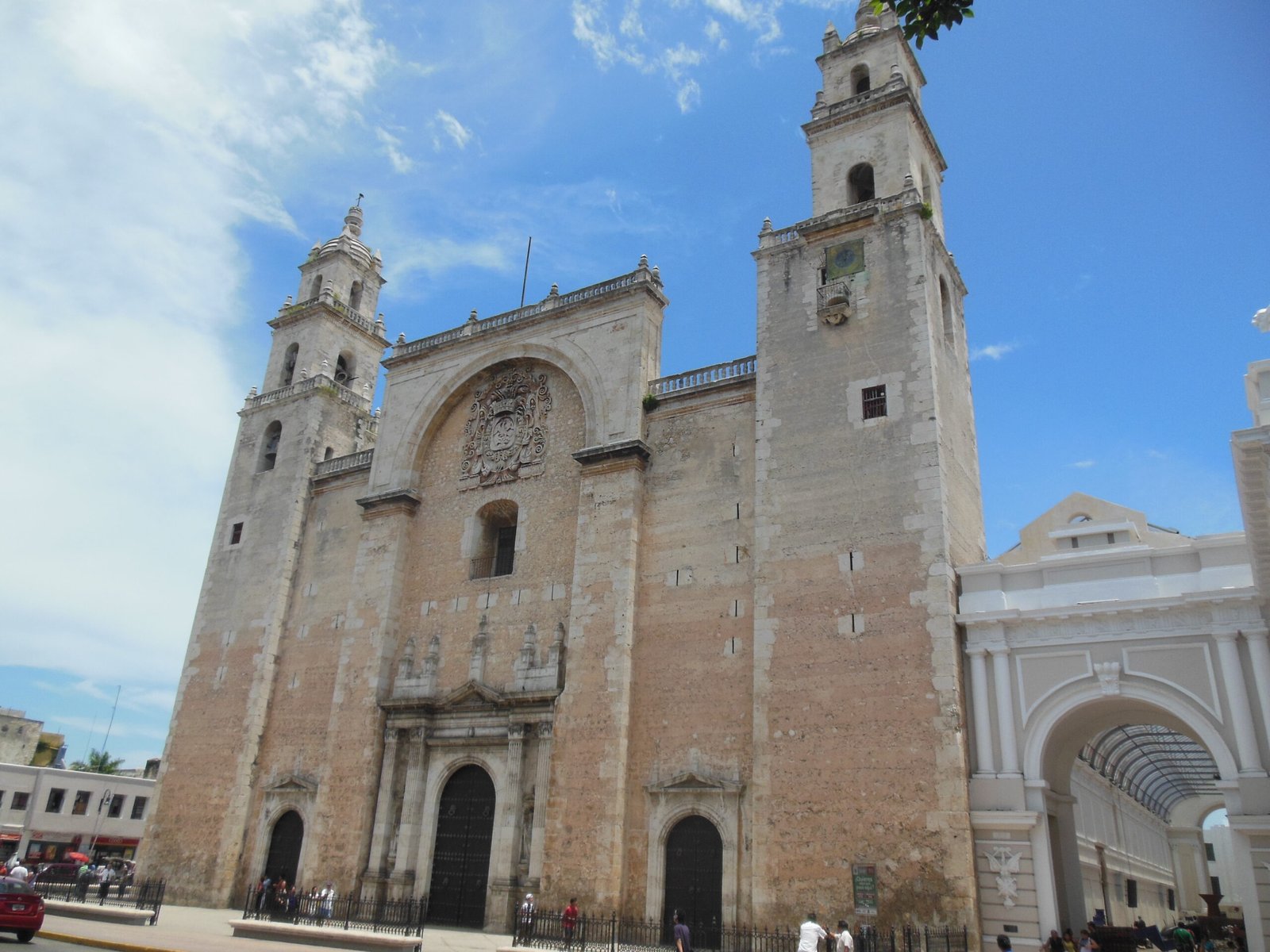
The cathedral of San Ildefonso looks onto the Plaza Grande of Mérida, the city that Francisco de Montejo «el Mozo» founded on 6 January 1542 over the Maya city of T’ho. The bull of Pius IV of 16 December 1561 raised the church to cathedral of the Yucatán, giving it Saint Ildefonso of Toledo as patron. Work began in 1562 under the first resident bishop, Francisco Toral, and for the masonry, as the INAH records, the conquerors reused stones from the pre-Hispanic buildings of the Maya city. On the completion date, institutional sources diverge: the cathedral’s official website gives 4 November 1598, the INAH 1 January 1597, the Sistema de Información Cultural record 1599 — here 1598 is used, without claiming precision to the day. The project passed through the hands of Pedro de Aulestia, Juan Miguel de Agüero and Gregorio de la Torre. Agüero «has been considered» the most influential, as the official website itself puts it, with caution, and his name remained inscribed for three centuries on the inner ring of the dome, which Manuel Toussaint read as modelled on the Roman Pantheon and which the more cautious sources call «one of the earliest in the New World». That claim to primacy has to be handled precisely: in the Americas, only the cathedral of Santo Domingo, on an island, is older. Mérida’s is, for the INAH and the SIC, the first raised on the continental mainland and the oldest in Mexico, completed when the building site of the Metropolitan Cathedral of Mexico City (1573-1813) had only just begun. The severe Renaissance-Mannerist facade plays on cubic masses and sharp zones of light and shadow between two towers 43.5 metres tall, with a great triumphal arch that the official website calls «one of the few of its kind in Novohispanic architecture». The interior is bare stone: twelve Doric columns, vaults at 22.27 metres decorated with carved coffering. In 1618 the chronicler Francisco de Cárdenas Valencia called it «the most beautiful and striking temple completed to this day in the Indies». On 24 September 1915, during the revolutionary government of Salvador Alvarado, the sacking of the cathedral destroyed Baroque and Churrigueresque retablos, the German Walcker organ of 1902, and the original Cristo de las Ampollas: the seventeenth-century image linked, according to the tradition recorded in the cathedral’s chronicle, to the miracle of Ichmul — a tree burned by flames without being consumed, then the statue that survived, covered in blisters, the fire that struck the church, dated 1634 by the chapter chronicle and 1651 by other sources. The replica carved in Querétaro was blessed on 28 February 1919 and is still venerated today. Behind the high altar has stood, since 1967, the Cristo de la Unidad by Ramón Lapayese del Río, birch on a mahogany cross, held to be the largest indoor wooden crucifix — the exact measurements differ between sources, and none is fixed here as the sole figure. The historic centre of Mérida is not inscribed on the UNESCO World Heritage List nor on the Mexican tentative list — the «Archaeological Ensemble of Mérida» on the UNESCO list is the Spanish city of the same name — but since 2019 Mérida has been a UNESCO Creative City of Gastronomy.
About the Cathedral
The Cathedral of San Ildefonso faces the Plaza Grande of Mérida, Yucatán, on the site of the Maya city of T’ho. Authorized by papal bull in 1561 and built between 1562 and 1598 — partly with stones from T’ho’s pre-Hispanic buildings, as INAH records — it is the oldest cathedral still standing on the American mainland: in all the Americas, only Santo Domingo’s island cathedral is older. Its sober Renaissance facade, twin 43.5-metre towers and bare stone interior survived the revolutionary sacking of 1915, which claimed its Baroque altarpieces and the original Cristo de las Ampollas.
Key facts
- 6 January 1542: Francisco de Montejo “el Mozo” founds Mérida on the Maya city of T’ho.
- 16 December 1561: bull of Pius IV erects the cathedral see, dedicated to San Ildefonso of Toledo.
- 1562–1598: construction, by Pedro de Aulestia, Juan Miguel de Agüero and Gregorio de la Torre; institutional sources place completion between 1597 and 1599.
- 43.5 m: height of the twin towers; the vaults rise 22.27 m on twelve Doric columns.
- 24 September 1915: revolutionary sacking under Salvador Alvarado’s government destroys the Baroque altarpieces, the 1902 Walcker organ and the original Cristo de las Ampollas.
- 28 February 1919: the Querétaro-carved replica of the Cristo de las Ampollas is blessed and enthroned.
- October 1967: Ramón Lapayese del Río’s Cristo de la Unidad installed behind the main altar.
- 2019: Mérida joins the UNESCO Creative Cities Network for gastronomy (its historic centre is not a World Heritage Site).
History
Mérida’s cathedral belongs to the first generation of the American mainland: authorized in 1561, begun in 1562 and completed in 1598, when Mexico City’s Metropolitan Cathedral was barely out of the ground. The conquerors quarried the pyramids and platforms of T’ho for its stone — a reuse INAH documents plainly — and its builders, above all Juan Miguel de Agüero, left a dome so novel that the cautious official history calls it one of the first of the New World. In 1618 the chronicler Francisco de Cárdenas Valencia judged it “the most beautiful and striking temple yet finished in the Indies”.
The 20th century was harsher than the three colonial ones. On 24 September 1915, during the revolutionary government of General Salvador Alvarado, the cathedral was sacked: three hundred years of sacred art disappeared in a day, including the Baroque and Churrigueresque altarpieces, the German Walcker organ of 1902 and the seventeenth-century Cristo de las Ampollas, the “Christ of the Blisters” tied by tradition to a tree at Ichmul that burned without being consumed. A replica carved in Querétaro was blessed in 1919 and remains the focus of Yucatecan devotion; since 1967 the bare east end has been dominated instead by the Cristo de la Unidad, Ramón Lapayese del Río’s monumental birch crucifix on a mahogany cross.
What you see
A Renaissance-Mannerist front of hard cubic masses and sharp light-and-shadow, its central portal framed by Saints Peter and Paul beneath a great triumphal arch — one of the few of its kind in New Spanish architecture, per the cathedral’s own history — between two 43.5-metre towers whose fabric still carries defensive arrowslits. Inside there is almost no colour at all: bare cut stone, twelve Doric columns, twenty shallow vaults with carved coffering, and the Pantheon-like dome. What ornament the Revolution spared is concentrated in the chapel of the Cristo de las Ampollas and in Lapayese’s vast modern crucifix behind the altar.
Practical information
- Opening hours: open daily around morning and evening mass times; check locally before visiting.
- Admission: free.
- Location: Calle 60 at Calle 61, Centro Histórico, 97000 Mérida, Yucatán, Mexico — facing the Plaza Grande.
- Status: active seat of the Archdiocese of Yucatán.
Getting there
The cathedral fronts the Plaza Grande, the exact centre of Mérida’s grid, a block from the Casa de Montejo and the Palacio de Gobierno; the city is the gateway to the Maya sites of Uxmal and Dzibilchaltún. GPS: 20.9671°N, 89.6225°W.
Nearby
- Plaza Grande and Casa de Montejo — the founder’s 1540s palace facade, directly across the square.
- Dzibilchaltún — the Maya city of the Temple of the Seven Dolls, just north of Mérida.
- Uxmal — the great Puuc-style UNESCO site, about 80 km south.
Sources
- Catedral de Mérida (Arquidiócesis de Yucatán) — official history and Cristo de las Ampollas chronicle.
- Instituto Nacional de Antropología e Historia (INAH) — Lugares INAH, Mérida cathedral record.
- Sistema de Información Cultural (SIC), Secretaría de Cultura de México — official cathedral record.
- Encyclopædia Britannica — Mérida, Mexico.
- UNESCO Creative Cities Network — Mérida (gastronomy, 2019).
- Yucatán Today and México Desconocido — practical details, cross-checked.
- Wikipedia (English and Spanish) — “Cathedral of Mérida, Yucatán”, used as a map and cross-checked.
Find it on the map
See this place and what’s around it →📷 Become a Cultural Heritage Online photographer
Share your photos of places: they stay published under your name as the author. The more they're seen, the more you get noticed — and soon a contest will reward the most appreciated photos.
Log in or sign up free to add a photo