
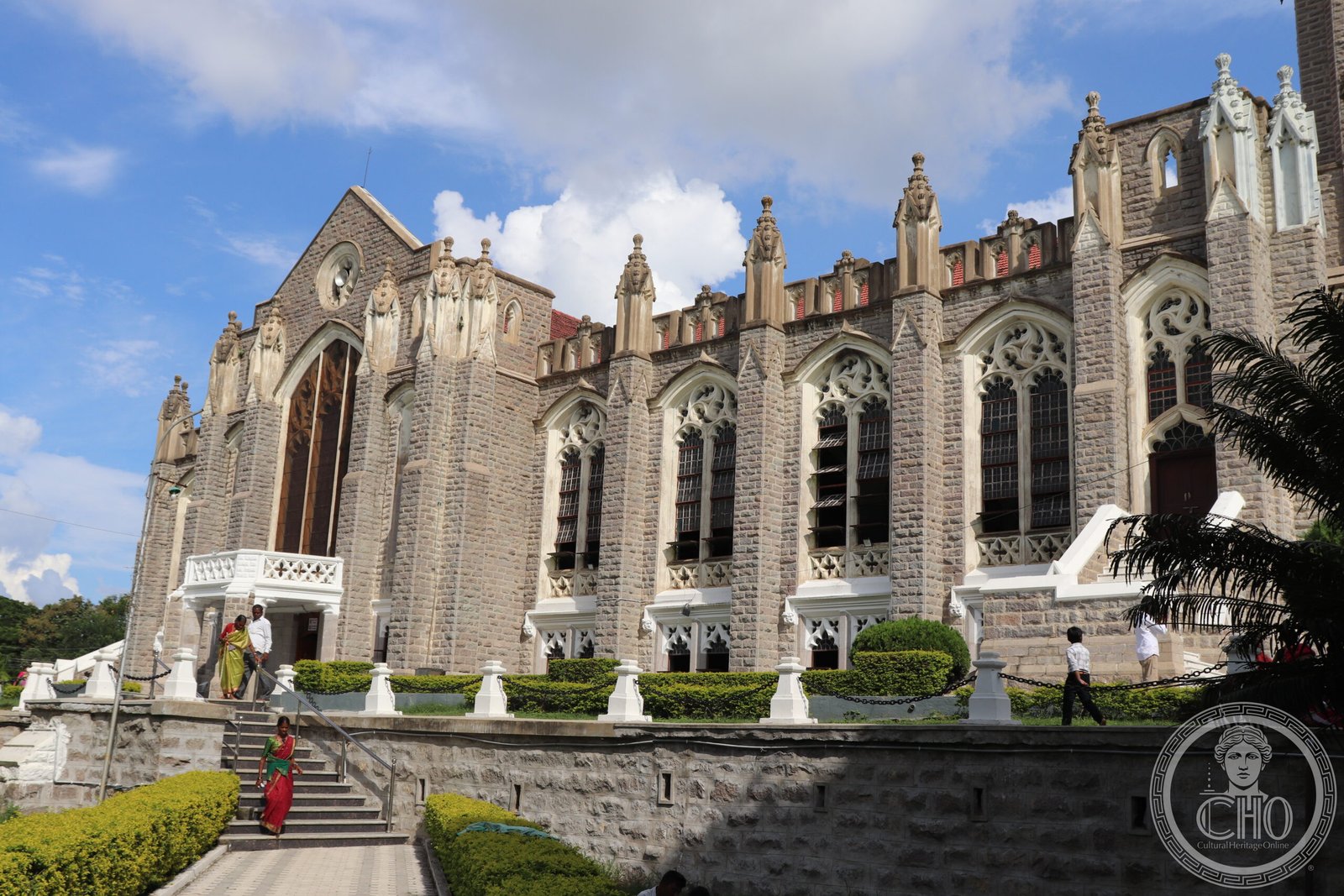
About a kilometre and a half from the centre of the small town of Medak, in Telangana, the cathedral of the Epiphany was founded by the British Wesleyan Methodist missionary Charles Walker Posnett. He had reached the region of Hyderabad in 1895 and moved to Medak around 1895-96. The foundation stone was laid at the beginning of 1914 in the Ghusnabad area. The works lasted some ten years, and Posnett conceived them also as relief employment during a severe famine that struck the district of Medak in the early twentieth century, between 1919 and 1921 according to some sources: rather than simply handing out free meals, he chose to pay the people hit by the famine to build the cathedral. The Neo-Gothic building was consecrated on 25 December 1924. The design is attributed, by a single source not found elsewhere, to the British practice Bradshaw Gass & Hope, with the architect John Bradshaw Gass. Contrary to a claim often repeated, the cathedral is not properly the largest in Asia. The firmest fact concerns not the building but the ecclesiastical district: the diocese of Medak of the Church of South India is described as the largest diocese in Asia and the second in the world after that of Rome. The building itself is called one of the largest churches in India or in Asia, measuring about thirty by sixty-one metres and seating an estimated five thousand, concrete figures more reliable than any outright superlative. Nor do authoritative sources confirm the claim, of uncertain quality, that the bell tower of fifty-three metres is the tallest in Asia. Inside are three famous stained-glass windows by the British artist Sir Frank Owen Salisbury, known as the painter laureate of England: the choir window behind the altar shows the Ascension and is dated 1927; the west transept window shows the Nativity and is from 1947; the east transept window shows the Crucifixion and is from 1958. The building also has pillars of grey granite, mosaic floors in six colours imported from Great Britain and laid by Italian craftsmen, and a vaulted roof designed for acoustic insulation. Since October 1947, when the Church of South India was formed from the union of Anglicans, Methodists and Congregationalists, the cathedral has been the seat of the diocese of Medak.
About the Cathedral
Medak Cathedral, in Telangana, India, was founded by British Methodist missionary Charles Walker Posnett and built 1914–1924, in part as a famine-relief employment scheme. Consecrated in 1924, it became the cathedral of the Church of South India’s Diocese of Medak in 1947 — a diocese described as the largest in Asia by territory.
Key facts
- Early 1914: construction begins under missionary Charles Walker Posnett.
- Construction doubled as famine-relief employment during a severe early-20th-century famine in Medak district.
- 25 December 1924: cathedral consecrated.
- Approximately 30 by 61 metres, seating an estimated 5,000 people.
- Three stained-glass windows by British artist Sir Frank Owen Salisbury: Ascension (1927), Nativity (1947), Crucifixion (1958).
- October 1947: becomes the cathedral of the Church of South India’s Diocese of Medak, described as the largest CSI diocese in Asia by territory.
History
Founded by a British Methodist missionary who deliberately used its decade-long construction as a famine-relief employment program rather than simple charity, Medak Cathedral was consecrated in 1924 and became, from 1947, the seat of one of the geographically largest dioceses of the Church of South India — a claim about ecclesiastical territory, not building size, though the cathedral itself remains one of the largest church buildings in India.
What you see
A large Gothic Revival church with grey granite pillars, a tall bell tower, and three stained-glass windows by Sir Frank Owen Salisbury depicting the Ascension, Nativity and Crucifixion, its floors laid with mosaic tiles imported from Britain in six colors.
Practical information
- Opening hours: generally open daily outside services; check current hours before visiting.
- Address: Medak, Medak district, Telangana 502110, India.
Getting there
The cathedral stands about 1.5 km from Medak town center. GPS: 18.0536°N, 78.2670°E.
Nearby
- Medak Fort — a historic fort in the same town.
Sources
- Wikipedia — “Medak Cathedral”
- CSI Diocese of Medak (official site).
- Telangana state government tourism page — Medak district.
Find it on the map
See this place and what’s around it →📷 Become a Cultural Heritage Online photographer
Share your photos of places: they stay published under your name as the author. The more they're seen, the more you get noticed — and soon a contest will reward the most appreciated photos.
Log in or sign up free to add a photo