
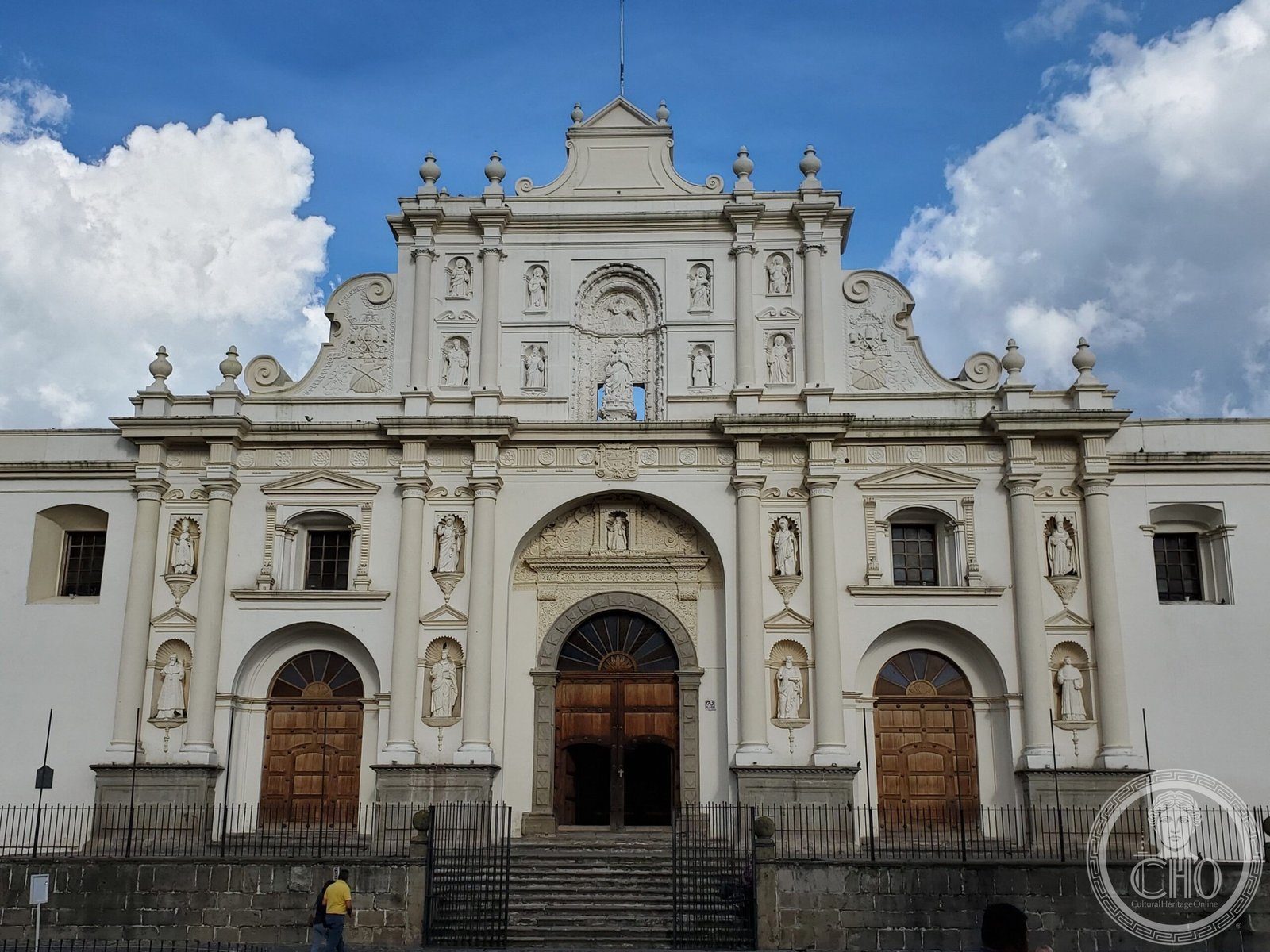
On Parque Central, in Antigua Guatemala, a colonial city on the UNESCO World Heritage list, the cathedral of Santiago is today two distinct things. One is the active parish church of San José, which occupies only the façade and the entrance of the old building. The other is the ruins of the nave and the domes behind it, open to visitors for a fee from a separate entrance on 5a Calle Oriente. The first cathedral was begun in 1545 under Bishop Francisco Marroquín, with materials recovered from the church destroyed in the landslide of 1541 in the earlier capital, and paid for in part with funds from the royal treasury and from the estate of the conquistador Pedro de Alvarado. Demolished around 1669 because it had been weakened by earlier earthquakes, it was replaced by a far larger building, opened in 1680 and attributed to the builders Juan Pascual and José de Porres, with five naves, seven entrances, seventy-eight arches, eighteen chapels and a broad dome on sixteen columns. After the earthquake of 1717 the building was repaired, according to the sources, by Diego de Porres, whose exact relationship to José de Porres is not clarified. The Santa Marta earthquakes of 29 July 1773, of an estimated magnitude of about 7.5, destroyed more than three thousand buildings in the city then called Santiago de los Caballeros, causing about five hundred to six hundred immediate deaths and at least as many in the following months from hunger and disease. The Spanish colonial authorities, who had already considered a move after the earthquake of 1717, decided this time not to rebuild the city, shifting the capital to the new Guatemala City in 1776. The cathedral was never rebuilt in full: only the entrance section was restored as a parish church, dedicated to Saint Joseph, a process the sources place roughly after 1819, on a proposal made by the priest Rafael José Luna as early as 1806. The rest of the structure remains a ruin, damaged further by the earthquakes of 1874 and 1976, and the object of conservation work by the National Council for the Protection of La Antigua Guatemala from the Eighties onwards. Under the area of the high altar there is an underground chapel known as the «Chapel of the Kings», reached by a stairway, together with a crypt and a system of galleries whose function has not been established. The remains of the conquistador Pedro de Alvarado were moved into the crypt in 1568, at the request of his daughter, taken temporarily elsewhere after the earthquake of 1976 and brought back to the cathedral in December 2007. According to several secondary sources the first bishop Francisco Marroquín and the chronicler Bernal Díaz del Castillo, who died in Antigua in January 1584, are also buried there, although these attributions have not been found in a direct primary source.
About the Cathedral
The Cathedral of Santiago, on Parque Central in Antigua Guatemala, today exists as two distinct things: the active parish church of San José, occupying the surviving entrance facade, and the ruined nave and domes behind it, open to visitors as a preserved historic ruin. The 1680 cathedral that once stood here was destroyed by the 1773 Santa Marta earthquakes, which led directly to the relocation of Guatemala’s capital.
Key facts
- 1545: first cathedral begun under Bishop Francisco Marroquín.
- 1680: a much larger cathedral inaugurated, with five naves and a dome on sixteen columns.
- 29 July 1773: the Santa Marta earthquakes destroy the cathedral and much of the city.
- 1776: Guatemala’s colonial capital relocated to what is now Guatemala City.
- Only the entrance section was later rebuilt, reconsecrated as the parish church of San José.
- Conquistador Pedro de Alvarado’s remains rest in the cathedral’s crypt, returned there in December 2007 after decades elsewhere.
History
Built and rebuilt across more than two centuries of colonial Guatemala, the cathedral reached its grandest form in 1680 before the catastrophic 1773 earthquakes destroyed it along with much of the city, prompting Spanish authorities to abandon reconstruction and move the capital entirely to a new site. Only the cathedral’s entrance was later restored as a working parish church; the rest survives as one of Antigua Guatemala’s most visited ruins, a physical reminder of the earthquake that ended the city’s two centuries as the seat of colonial power in Central America.
What you see
A cream-colored Baroque facade with three arched wooden doorways and saint statues in niches fronts Parque Central, concealing behind it the roofless nave, broken dome supports and collapsed columns of the 1680 cathedral, preserved as ruins and accessible through a separate paid entrance.
Practical information
- Opening hours: the San José parish is generally open daily outside services; the ruins section has separate paid admission hours — check current times and fees before visiting.
- Address: Parque Central (San José parish frontage on 4a Avenida Sur; ruins entrance on 5a Calle Oriente), Antigua Guatemala.
Getting there
The cathedral fronts Parque Central in the heart of Antigua Guatemala’s UNESCO-listed historic center. GPS: 14.5567°N, 90.7329°W.
Nearby
- Church of San Francisco el Grande — another earthquake-rebuilt Antigua church, holding the tomb of Central America’s first saint.
- Church of La Merced — a low, thick-walled Antigua church built specifically to withstand earthquakes.
Sources
- Wikipedia — “Antigua Guatemala Cathedral,” “1773 Guatemala earthquake”
- laantiguaguatemala.com — cathedral and San José parish history.
- Vidaantigua — “Ruinas de Catedral de Santiago”
- World Bank blog — “History, disasters and resilience: the story of Antigua Guatemala”
Find it on the map
See this place and what’s around it →📷 Become a Cultural Heritage Online photographer
Share your photos of places: they stay published under your name as the author. The more they're seen, the more you get noticed — and soon a contest will reward the most appreciated photos.
Log in or sign up free to add a photo