
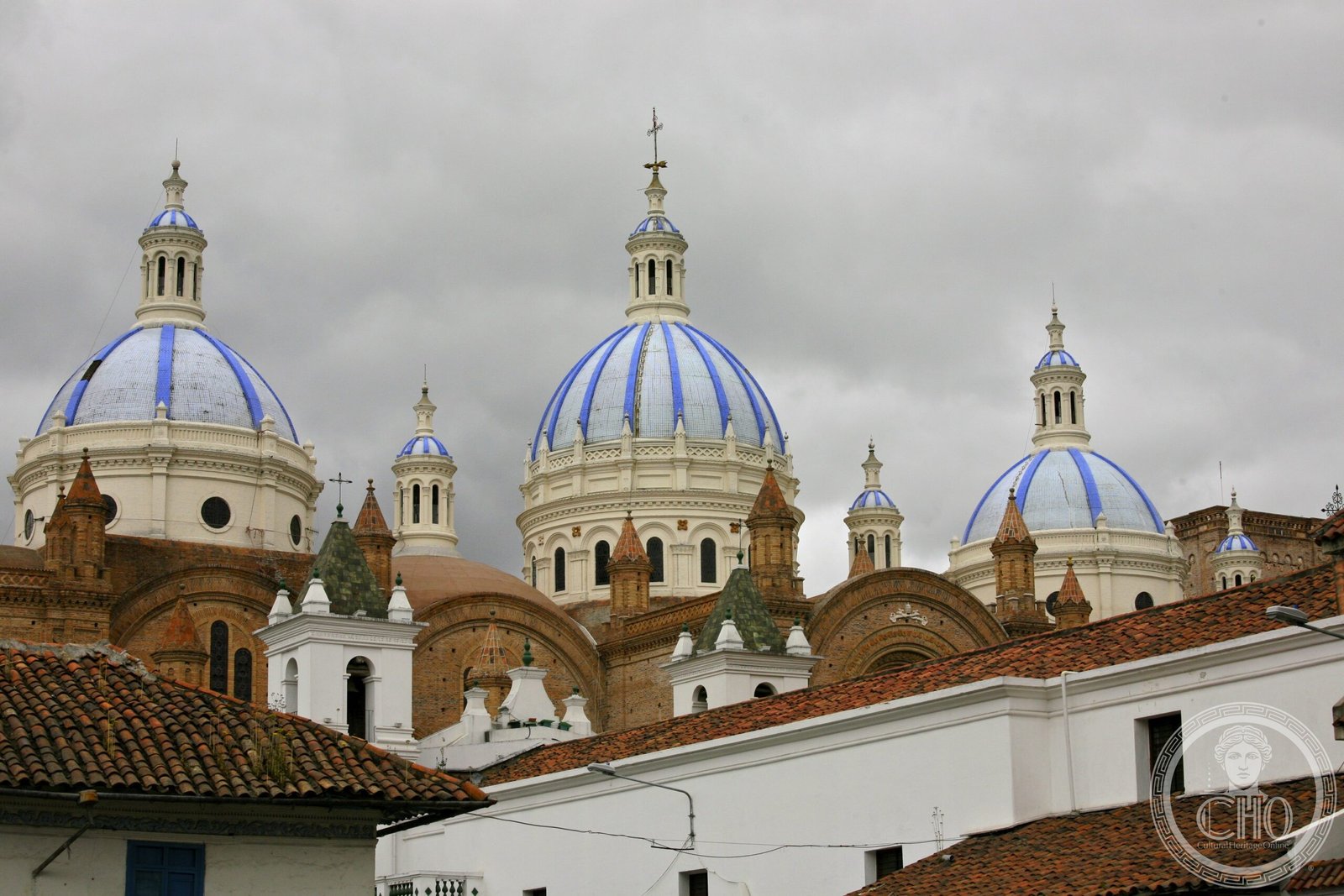
On Parque Calderón, in the historic centre of Cuenca, in Ecuador, inscribed on the UNESCO World Heritage list, the cathedral of the Immaculate Conception was designed by the German-born Redemptorist friar Juan Bautista Stiehle. He had reached Cuenca in 1873, after being expelled from Alsace-Lorraine, at the suggestion of Bishop León Garrido. Stiehle worked on the project from 1885 until his own death, in 1899, without seeing it finished. The works began on 25 October 1885, with the first stone laid on 12 December 1886. The cathedral was consecrated to the Immaculate on 28 May 1967, a few days after a bronze statue of Saint Anne, patron of the city, was placed on the front, and the works were considered complete in 1975, a building site that lasted in all some ninety years, slowed by funding difficulties and by the need to import from Europe materials and tools not available in Ecuador. The two front towers were left lower than originally planned. The version most widespread in English speaks of a miscalculation by the architect, while the Spanish-language sources offer a more technical picture, tracing the problem to a limit of the foundations confirmed only decades later, in 1972, by a geotechnical study by the engineers Marco T. Erazo V. and Edmundo Cueva C., which found foundations about four metres deep under the towers against the seven metres of the rest of the building. It should therefore be presented as a structural limit established afterwards, rather than a single spectacular design error. The famous domes clad in blue and white glazed tiles, according to Wikipedia and the sources derived from it, were imported from Czechoslovakia and installed between 1942 and 1950, although this detail is not confirmed by any independent primary source and should be taken as widely repeated but not fully verified. The new cathedral replaced the older cathedral of the city, El Sagrario, whose construction goes back to about 1567. The sources offer two explanations that are not reconciled with each other as to why a new one was needed: insufficient capacity for a growing city on the one hand, and the preference of some nineteenth-century bishops for an entirely new building, inspired by the cathedral of Málaga, on the other. Today El Sagrario, facing the new cathedral on the same square, houses the Museum of Religious Art and the celebrated historic organ of 1735, or 1739 according to the sources, an organ not to be confused with the one, not fully documented, sometimes wrongly attributed to the new cathedral. The interior of the new cathedral holds stained glass made by the Spanish artist Guillermo Larrazábal, together with other windows imported from Germany and Belgium, a sculpture of Christ by the Spanish sculptor Rafael Planas, a staircase of Carrara marble matched with local Cuenca marble, floors of Italian marble and a statue recalling the visit of Pope John Paul II in 1985.
About the Cathedral
The New Cathedral of the Immaculate Conception, on Parque Calderón in Cuenca’s UNESCO-listed historic center, was designed by German-born friar Juan Bautista Stiehle, begun in 1885 and consecrated in 1967. Its blue-and-white glazed tile domes are one of Ecuador’s most recognizable landmarks.
Key facts
- 1885: construction begins under architect Juan Bautista Stiehle, who died in 1899 without seeing it finished.
- 28 May 1967: cathedral consecrated to the Immaculate Conception.
- 1975: construction considered complete after roughly ninety years.
- Front towers left shorter than planned; a 1972 engineering study found foundations under the towers only about 4 metres deep, versus 7 metres elsewhere.
- Blue-and-white glazed tile domes reportedly imported from Czechoslovakia, installed circa 1942–1950.
- Replaced the older Cathedral of El Sagrario, across the same plaza, now a museum of religious art.
History
Designed by a German friar exiled from Alsace-Lorraine, the cathedral took roughly ninety years to build, its founder dying decades before its 1967 consecration and its distinctive front towers left permanently shorter than planned once the ground beneath them proved unable to bear the additional weight — a limitation later confirmed by formal engineering study in 1972. It replaced Cuenca’s colonial-era Old Cathedral across the same plaza, which today survives as a museum of religious art housing the city’s historic 18th-century organ.
What you see
Three large domes clad in glazed blue-and-white ceramic tile rise over Cuenca’s terracotta rooftops, fronted by twin towers deliberately left shorter than their original design, with an interior holding stained glass by Spanish artist Guillermo Larrazábal, a Christ sculpture by Rafael Planas, and marble floors and staircases combining Carrara and local Cuenca stone.
Practical information
- Opening hours: generally open daily outside services; check current hours before visiting.
- Address: Parque Calderón, historic center, Cuenca, Azuay Province, Ecuador.
Getting there
The cathedral fronts Parque Calderón in Cuenca’s UNESCO-listed historic center. GPS: 2.8975°S, 79.0050°W.
Nearby
- Old Cathedral (El Sagrario) — Cuenca’s 16th-century original cathedral, facing the New Cathedral across Parque Calderón, now a museum of religious art.
- Parque Calderón — Cuenca’s central plaza, at the heart of the UNESCO World Heritage historic center.
Sources
- Wikipedia (English and Spanish) — “New Cathedral of Cuenca,” “Old Cathedral of Cuenca”
- architecturalcuenca.com — “A Guide to Cuenca Architecture: New Cathedral”
- Arquidiócesis de Cuenca (official site).
Find it on the map
See this place and what’s around it →📷 Become a Cultural Heritage Online photographer
Share your photos of places: they stay published under your name as the author. The more they're seen, the more you get noticed — and soon a contest will reward the most appreciated photos.
Log in or sign up free to add a photo