
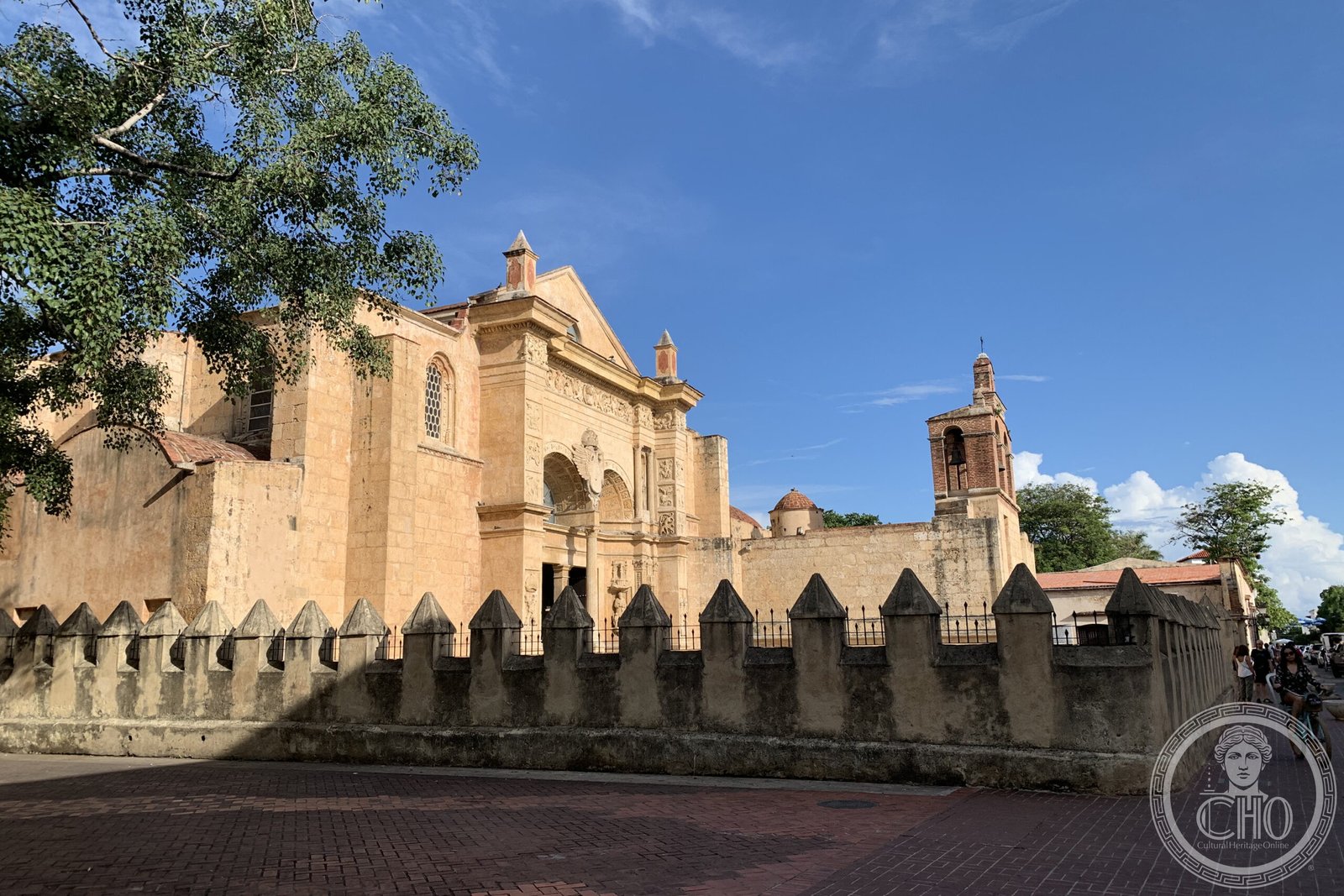
On the square of Parque Colón, between Arzobispo Merino and Isabel la Católica streets, in the Colonial Zone of Santo Domingo, the primatial cathedral of Santa María la Menor is commonly regarded as the oldest cathedral in the Americas. Work began, according to the most widespread dating, between 1512 and 1514 to a design by the Sevillian architect Alonso Rodríguez, the first bishop of Santo Domingo. A full-scale building campaign began, according to other sources, only in 1521-1522 under Bishop Alessandro Geraldini, when the project passed to Luis de Moya and Rodrigo de Liendo. The consecration took place on 31 August 1541, although the final completion, with the contribution of the architect Alonso González, is dated imprecisely by the sources between 1540 and 1550. The style is late Gothic in structure, with a Gothic-Plateresque main portal and further Renaissance Plateresque elements, such as the archbishop’s throne dated to 1540. On 12 February 1546, with the bull Super Universas, Pope Paul III raised Santo Domingo to a metropolitan archdiocese and granted it the honorary title of “Primate of the Indies”, primate of the Americas, at the request of Emperor Charles V, in recognition of the first Catholic diocese founded in the New World. In January-February 1586 the English privateer Francis Drake occupied Santo Domingo for about a month, used the cathedral as his headquarters, and his men looted altars, destroyed religious works of art and desecrated the tombs. The cathedral is also at the centre of an unresolved international dispute over the remains of Christopher Columbus. He died in Valladolid in 1506; his remains reached Santo Domingo around 1542 and stayed there for about two centuries, before being moved to Havana in 1795, when Spain ceded the eastern part of Hispaniola to France, and finally to Seville in 1898, after Spain lost Cuba. In 1877, however, workers found in the cathedral of Santo Domingo a lead box inscribed “Illustrious and distinguished man, Don Christopher Columbus”, giving rise to the Dominican thesis that in 1795 the wrong remains were moved by mistake, leaving the true relics of Columbus in Santo Domingo. The question is complicated by the fact that his son Diego Colón and his grandson Luis Colón were also buried in the same cathedral, both bearing the title “Don Colón, Admiral of the Sea”, which makes the inscription in itself inconclusive. In 1992, for the five hundredth anniversary of Columbus’s voyage, the remains claimed by the Dominican Republic were moved out of the cathedral to the purpose-built, monumental Faro a Colón, where they are displayed today: the cathedral therefore no longer holds any disputed Columbus relic. A genetic investigation led by the forensic geneticist José Antonio Lorente Acosta of the University of Granada, with results released in May 2006, compared the mitochondrial DNA of bone fragments from the Seville tomb with that of Columbus’s brother Diego, also buried in Seville, finding a match described as almost absolute. The Dominican government, however, has always refused to allow the remains kept at the Faro a Colón to be tested, so there is no direct comparison between the two sets of remains, and the dispute remains scientifically unresolved: the genetic evidence confirms the authenticity of the Seville remains, without disproving the Dominican claim, which has never been put to the test. In October 2026 the same research group announced, through a Spanish television programme, further genetic results that would cast doubt on Columbus’s Genoese origin in favour of a Spanish or Sephardic one, a preliminary announcement not yet confirmed by peer-reviewed scientific publication, and in any case separate from the question of the remains set out here.
About the Cathedral
The Cathedral Primada de América, facing Parque Colón in Santo Domingo’s Colonial Zone, is widely regarded as the oldest cathedral in the Americas, begun around 1512–1514 and consecrated on 31 August 1541. In 1546, Pope Paul III granted it the honorific title “Primate of the Americas,” recognizing it as the first Catholic diocese founded in the New World.
Key facts
- 1512–1514: construction begins under Bishop Alonso Rodríguez’s design; a major building campaign restarts 1521–1522.
- 31 August 1541: cathedral consecrated.
- 12 February 1546: Pope Paul III’s bull “Super Universas” grants the title “Primate of the Americas”
- 1586: Francis Drake occupies Santo Domingo for about a month, using the cathedral as his headquarters and looting it.
- 1877: a lead box inscribed with Columbus’s name is discovered in the cathedral, fueling the ongoing remains dispute.
- 1992: the Dominican-claimed remains are moved from the cathedral to the newly built Columbus Lighthouse mausoleum.
History
Built in the first decades of Spanish colonization and consecrated in 1541, this cathedral became the seat of the first Catholic diocese in the Americas and, from 1546, held the honorific “Primate of the Americas.” It survived Francis Drake’s 1586 occupation and looting, and for roughly two centuries held remains believed to be those of Christopher Columbus — a claim contested since 1795, when different remains were shipped to Havana and later Seville, where DNA testing in 2006 confirmed their authenticity without disproving the Dominican counter-claim, since the Santo Domingo remains, moved to the Columbus Lighthouse mausoleum in 1992, have never been tested for comparison.
What you see
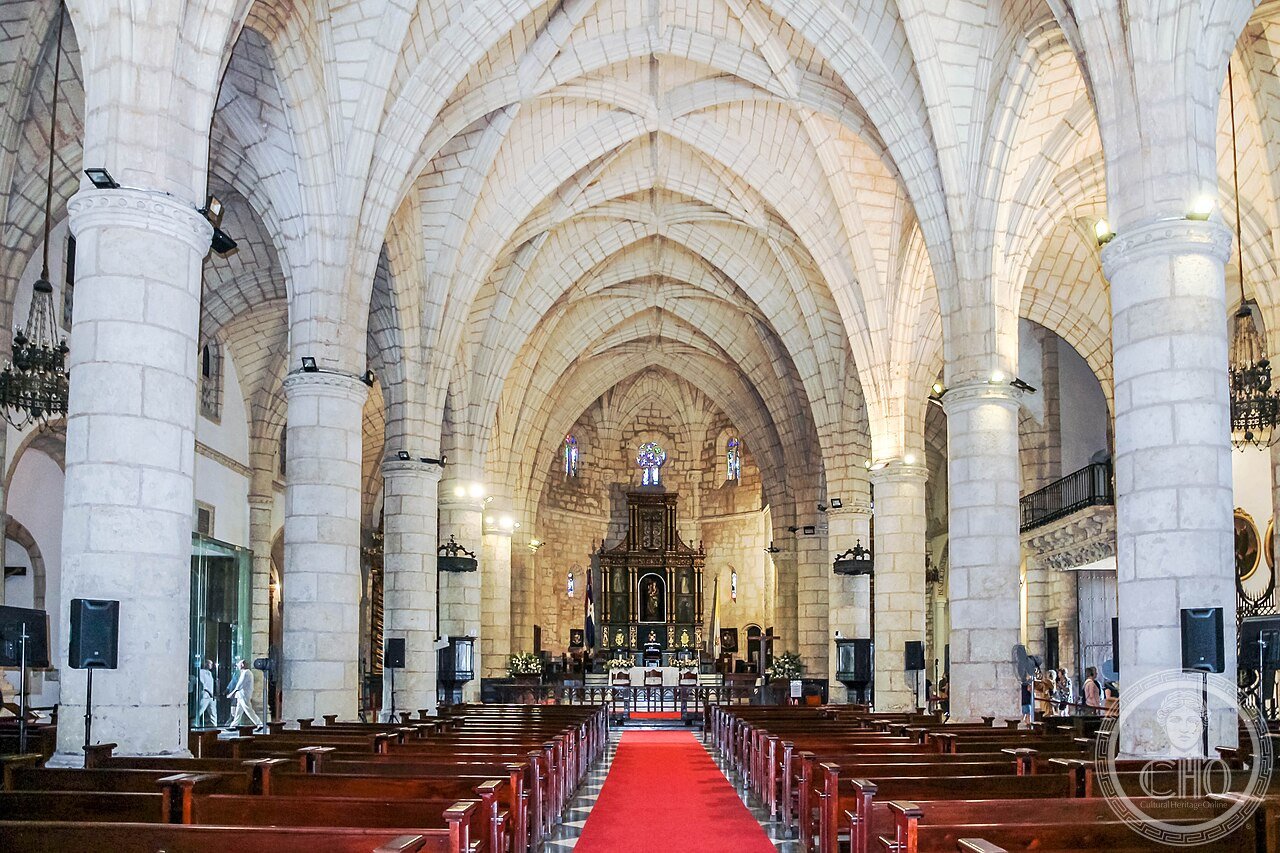
A coral-stone facade combining Late Gothic structure with a Gothic-Plateresque main portal and Renaissance decorative details, enclosed within a crenellated perimeter wall on Parque Colón, with a detached brick bell tower.
Practical information
- Opening hours: generally open daily outside services; check current hours before visiting.
- Address: Parque Colón, between Calle Arzobispo Merino and Calle Isabel la Católica, Colonial Zone, Santo Domingo, Dominican Republic.
Getting there
The cathedral fronts Parque Colón in the heart of Santo Domingo’s Colonial Zone. GPS: 18.4728°N, 69.8839°W.
Nearby
- Columbus Lighthouse (Faro a Colón) — the mausoleum built in 1992 to house the Dominican-claimed remains of Christopher Columbus, moved out of the cathedral.
- Parque Colón — the Colonial Zone’s central plaza, surrounded by 16th-century colonial buildings.
Sources
- Wikipedia — “Cathedral of Santo Domingo,” “Tomb of Christopher Columbus,” “Columbus Lighthouse,” “Battle of Santo Domingo (1586)”
- christopher-columbus.eu — DNA testing and chain-of-custody history of Columbus’s remains.
- NBC News — “DNA verifies Columbus’ remains in Spain” (2006).
- Al Jazeera — coverage of the 2024 Columbus-origin DNA announcement.
- Slate — “The tombs of Christopher Columbus in Seville and Santo Domingo”
Find it on the map
See this place and what’s around it →📷 Become a Cultural Heritage Online photographer
Share your photos of places: they stay published under your name as the author. The more they're seen, the more you get noticed — and soon a contest will reward the most appreciated photos.
Log in or sign up free to add a photo