
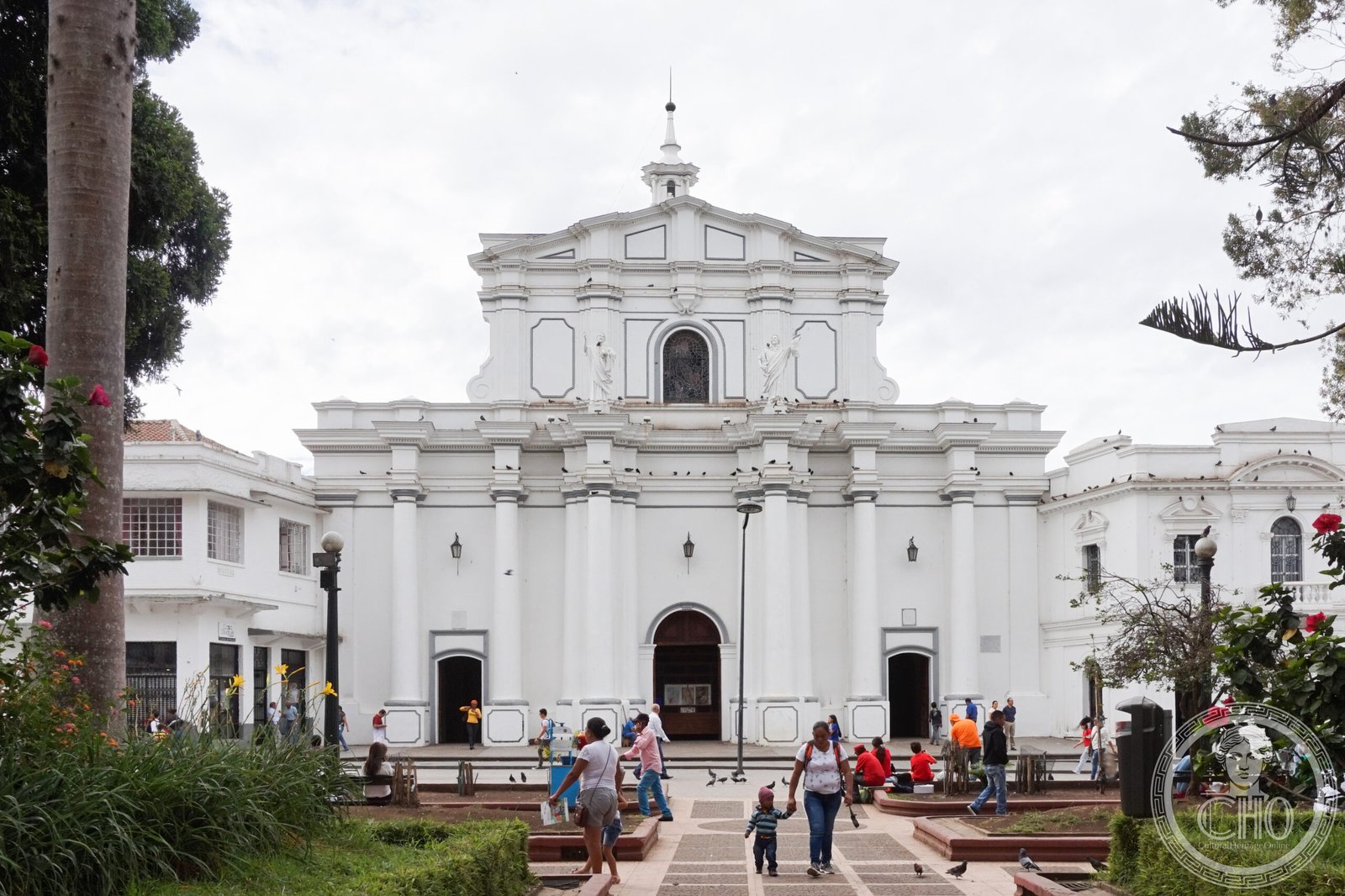
On Parque Caldas, in the heart of the “white city” of Popayán, the cathedral basilica of Our Lady of the Assumption is the third religious building to stand on this site, after earlier ones were largely destroyed by the frequent earthquakes that strike the region, including the devastating one of 2 February 1736, which brought down almost every church in the city. A second cathedral was begun on 17 December 1594, with the bell tower completed in 1682. The present building was designed starting in 1788, when Archbishop Ángel Velarde y Bustamante requested plans from the Real Academia de San Fernando in Spain, with the foundation stone laid on 30 May 1819, works resumed on 15 August 1856 under Bishop Pedro Antonio Torres, and completion on 12 June 1906 under Archbishop Manuel José Caicedo. Three architects followed one another on the project, according to a single encyclopaedic source not fully confirmed elsewhere: Marcelino Pérez de Arroyo for the original Greek-cross design, the Italian Franciscan friar Serafino Barbetti for the rebuilding phase, and the Popayán-born architect Adolfo Dueñas Lenis, who designed and completed the dome in 1906. Pope Pius XII raised the cathedral to a minor basilica on 25 April 1953; it was declared a Colombian national monument by law 163 of 30 December 1959. On Maundy Thursday, 31 March 1983, a magnitude 5.5 earthquake with its epicentre southwest of the city struck Popayán at 8:13-8:15 in the morning, with shaking that lasted about eighteen seconds and a macroseismic intensity of VIII on the Mercalli scale. Total casualties, according to different and unreconciled sources, range between 250 and 300, and the cathedral, the religious building hit hardest in the city, saw its dome and much of its roof collapse, with the death toll at the building itself reported inconsistently across sources, between a few dozen and ninety people according to the most widely repeated press accounts — a figure that should be checked against a primary official source before being treated as definitive. The church of La Milagrosa served as a temporary cathedral during a reconstruction that lasted roughly five years, also supported by international aid: according to some sources Germany funded the restoration of the church of la Ermita, and Spain that of San Francisco. The earthquake is remembered as one of the factors that pushed Colombia to adopt earthquake-resistant building codes nationally. Popayán’s Holy Week processions, which according to some sources date back to 1556, though that date is not fully confirmed, were inscribed on the UNESCO Representative List of the Intangible Cultural Heritage of Humanity on 30 September 2009. The cathedral is one of five starting points for the evening processions that, between the Tuesday and Saturday before Easter, cross about two kilometres of the city’s historic centre. Founded on 13 January 1537 by the conquistador Sebastián de Belalcázar, Popayán was a major administrative centre of the Viceroyalty of New Granada during the colonial period, and is remembered, according to sources that differ between sixteen and seventeen, as the birthplace of an exceptionally high number of Colombian presidents.
About the Cathedral
The Cathedral Basilica of Our Lady of the Assumption, on Parque Caldas in Popayán, Colombia, is the third religious building on this site, built 1819–1906 after earlier structures fell to the region’s frequent earthquakes. It remains the seat of the Archdiocese of Popayán and a starting point for the city’s UNESCO-listed Holy Week processions.
Key facts
- 2 February 1736: a major earthquake destroys nearly all of Popayán’s churches.
- 30 May 1819 – 12 June 1906: current cathedral built in stages across the 19th century.
- 25 April 1953: elevated to minor basilica by Pope Pius XII.
- 31 March 1983: a Maundy Thursday earthquake collapses the cathedral’s dome, killing an estimated 250–300 people citywide.
- 30 September 2009: Popayán’s Holy Week processions inscribed on UNESCO’s Intangible Cultural Heritage list.
- Founded 1537 by Sebastián de Belalcázar; birthplace of numerous Colombian presidents.
History
Rebuilt across the 19th century after earlier structures fell to Popayán’s recurring earthquakes, the cathedral suffered its worst blow on Maundy Thursday 1983, when its dome collapsed in a quake that struck the city mid-Holy-Week, killing hundreds across Popayán and an uncertain but substantial number inside the cathedral itself. Rebuilt over roughly five years with international assistance, it remains central to the centuries-old Holy Week processions that made this colonial “White City” one of the few places in the world with UNESCO-recognized Easter traditions.
What you see
A white neoclassical facade with a central dome and bell towers faces Parque Caldas, the design carried through several 19th-century architects to completion in 1906, its interior rebuilt following the 1983 earthquake that destroyed the original dome and pipe organ.
Practical information
- Opening hours: generally open daily outside services; check current hours before visiting.
- Address: Calle 5, facing Parque Caldas, Centro Histórico, Popayán, Cauca, Colombia.
Getting there
The cathedral fronts Parque Caldas, Popayán’s main square. GPS: approximately 2.4414°N, 76.6065°W.
Nearby
- Parque Caldas — Popayán’s central plaza, surrounded by the historic city’s colonial white-facade architecture.
- San Francisco and Santo Domingo churches — two of the other four churches from which Popayán’s UNESCO-listed Holy Week processions depart.
Sources
- Wikipedia (Spanish and English) — “Catedral de Popayán,” “Popayán,” “Terremoto de Popayán de 1983”
- UNESCO Intangible Cultural Heritage — “Procesiones de Semana Santa de Popayán” (inscribed 2009).
- GCatholic.org — Archdiocese of Popayán records.
- Servicio Geológico Colombiano — retrospective coverage of the 1983 earthquake.
Find it on the map
See this place and what’s around it →📷 Become a Cultural Heritage Online photographer
Share your photos of places: they stay published under your name as the author. The more they're seen, the more you get noticed — and soon a contest will reward the most appreciated photos.
Log in or sign up free to add a photo