
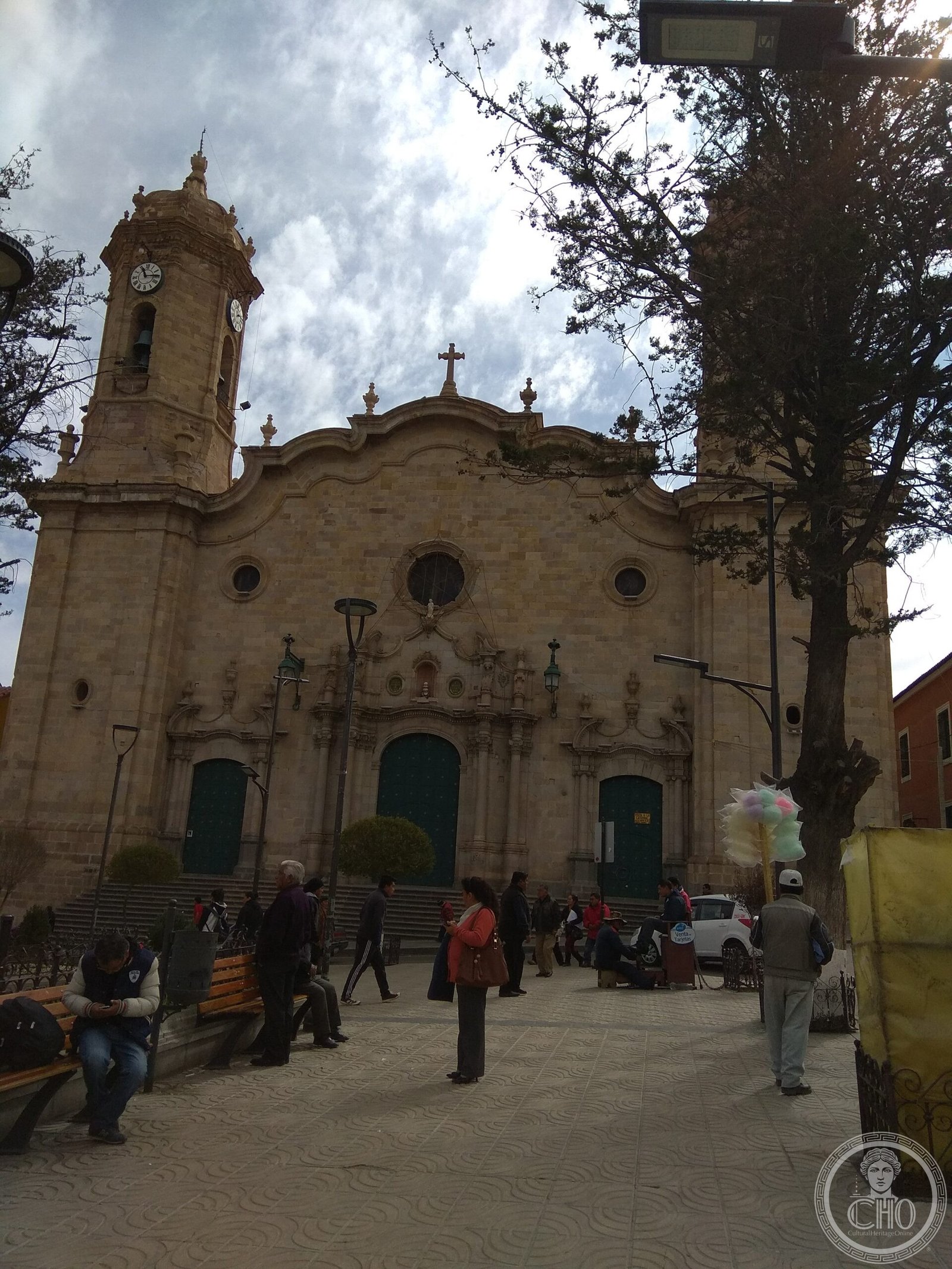
On the Plaza 10 de Noviembre, in the heart of the Bolivian city of Potosí, the metropolitan cathedral is the third religious building to stand on this site. A first church dates to 1548, rebuilt from 1564 to a design attributed, according to a single source not found elsewhere, to Juan Miguel de la Veramendi, and it collapsed in 1807 following unauthorised renovation works that had undermined its stability. The present building was begun on 6 September 1808 to a design by the Spanish Franciscan friar Manuel de Sanahuja, credited with introducing the neoclassical style to Potosí — again a claim found only in encyclopaedic sources, not in an independent architectural-historical study. It was completed in 1836 and solemnly consecrated on 4 April 1838 under the presidency of Marshal Andrés de Santa Cruz. The resulting style is a hybrid of late-colonial Baroque and neoclassical elements, rather than pure neoclassicism. Potosí owes its extraordinary history to the silver deposits of the Cerro Rico, worked from 1545, which made the city one of the chief sources of the Spanish empire’s wealth in the sixteenth and seventeenth centuries. The population grew from around fourteen thousand inhabitants in 1547 to between one hundred and fifty and one hundred and sixty thousand around 1600, making Potosí for a time the most populous city in the Americas and, according to a figure recurring in secondary sources but not confirmed in a primary demographic source, the second most populous city in the world after London. This wealth rested on the mita system, a forced-labour institution of Inca origin formalised in 1573 by Viceroy Francisco de Toledo, which compelled thousands of indigenous Andean men to work the mines and refineries in inhuman conditions, alongside enslaved African labour used chiefly in refining and minting. The overall death toll remains a matter of historiographical dispute: the figure of eight million dead is often cited in popular culture, but according to some sources derives from an estimate for the entire Viceroyalty of Peru rather than specifically for the mines of Potosí, for which other sources put the toll in the hundreds of thousands. This figure should be treated with caution, not as a definitively established one. Inside the cathedral are kept reliquaries in gold and silver and an organ donated by the mining magnate Simón I. Patiño. The celebrated colonial paintings tied to Potosí’s mining wealth, among them works by Melchor Pérez de Holguín and the iconic “Virgen del Cerro”, are found not in the cathedral but in the nearby museum of the Casa Nacional de la Moneda, the former royal mint, a separate building a short walk from the same square. The city of Potosí was inscribed on the UNESCO World Heritage List in 1987 and placed on the List of World Heritage in Danger on 17 June 2014, because of the risk of structural collapse of the Cerro Rico linked to mining activity still under way. A sinkhole that opened at the mountain’s summit in 2011 was filled with lightweight concrete, and Bolivian authorities have since filled around 95 per cent of the 132 subsidence zones identified, though the site was still listed as endangered according to the latest UNESCO Committee decision found, from 2024.
About the Cathedral
The Metropolitan Cathedral of Potosí, on Plaza 10 de Noviembre in Bolivia’s historic silver-mining city, is the third religious building on this site, built 1808–1836 and consecrated in 1838 after its predecessor collapsed in 1807. It stands at the center of a UNESCO World Heritage city whose 16th-century silver wealth came at an enormous, still-debated human cost.
Key facts
- 1548: first church built; rebuilt from 1564; collapsed in 1807 after unauthorized remodeling.
- 6 September 1808 – 1836: current cathedral built under architect Fray Manuel de Sanahuja.
- 4 April 1838: cathedral consecrated under the presidency of Marshal Andrés de Santa Cruz.
- 1545–1600s: Cerro Rico silver boom makes Potosí one of the largest, richest cities in the world.
- 1573: the mita forced-labor system formalized, conscripting indigenous workers into the mines.
- 1987 / 2014: Potosí inscribed as a UNESCO World Heritage Site, later listed as in danger due to mining-related subsidence.
History
Built in the early 19th century to replace a collapsed predecessor, the cathedral stands on the plaza of a city whose 16th- and 17th-century silver wealth from Cerro Rico briefly made it one of the largest urban centers in the world — wealth extracted through the mita forced-labor system, whose human toll historians still dispute, with popular estimates in the millions likely conflating mine-specific and viceroyalty-wide figures. Potosí’s UNESCO-listed historic center, including this cathedral, has been formally recognized as endangered since 2014 by the same mountain that built the city, now subsiding from centuries of continued mining.
What you see
A cream-colored Baroque-Neoclassical facade with twin bell towers and a central dome fronts Plaza 10 de Noviembre, its interior holding gold and silver liturgical reliquaries and an organ donated by 20th-century mining magnate Simón I. Patiño.
Practical information
- Opening hours: generally open outside services; check current hours before visiting.
- Address: Plaza 10 de Noviembre, Potosí, Bolivia.
Getting there
The cathedral fronts Plaza 10 de Noviembre, Potosí’s main square. GPS: 19.588°S, 65.753°W.
Nearby
- Casa Nacional de la Moneda — the former royal mint, now a museum housing Potosí’s most celebrated colonial paintings, a short walk from the cathedral.
- Cerro Rico — the silver mountain overlooking the city, still actively mined and the source of Potosí’s UNESCO “in danger” listing.
Sources
- Wikipedia (English and Spanish) — “Cathedral Basilica of Potosí,” “Potosí,” “Cerro Rico”
- Hispanic American Historical Review (Duke University Press) — “The Potosí Mita, 1573-1700”
- UNESCO World Heritage Centre — inscription and in-danger listing records for the City of Potosí.
Find it on the map
See this place and what’s around it →📷 Become a Cultural Heritage Online photographer
Share your photos of places: they stay published under your name as the author. The more they're seen, the more you get noticed — and soon a contest will reward the most appreciated photos.
Log in or sign up free to add a photo