
On Mitropoleos Square, in the Plaka district of Athens, the Metropolitan Cathedral of the Annunciation is the seat of the archbishop of Athens and All Greece, primate of the autocephalous Church of Greece. King Otto and Queen Amalia laid the foundation stone on Christmas Day 1842, to an initial design by the Danish architect Theophil Hansen. Work stopped between 1843 and 1846 for lack of funds. It resumed under the architect Dimitrios Zezos, who reworked the design with Greek-Byzantine elements until his death in 1857, when the building was completed under the supervision of the Frenchman François Boulanger and the Greek Panagis Kalkos. The building was dedicated to the Annunciation of the Virgin on 21 May 1862, after twenty years of work in all. According to a historiographical tradition going back to the 1940 study by the urban planner Kostas Biris on the churches of old Athens, the building materials, and the proceeds from the sale of church land, came partly from the demolition of 72 medieval churches in the city, carried out in 1843, precisely when the site was idle for lack of funds. The figure is repeated by several independent Greek outlets, but it goes back to a single primary reference source and none of them lists the 72 churches by name. It should therefore be treated as an established historiographical tradition rather than an independently verified archival fact. Beside the great cathedral, on the same square, stands the so-called Little Metropolis (Panagia Gorgoepikoos), a tiny Byzantine church of about 7.6 by 12.2 metres built entirely of spolia from various periods, some ninety reused carved reliefs. Tradition dates it to around 1200 under the metropolitan Michael Choniates, though scholarly dating proposals range between the 9th and the 13th century. Its name comes from standing within the grounds of the residence of the metropolitan of Athens, not from any rivalry with the larger cathedral. Damaged by the Athens earthquake of 7 September 1999, the cathedral was closed for restoration from 2009, with the scaffolding removed and services fully resumed only in 2016. Many weddings and funerals of the Greek royal family have been held here: that of the future King Constantine I in 1889, that of Princess Sophia to the future King Juan Carlos I of Spain in 1962, that of Constantine II himself to Princess Anne-Marie of Denmark in 1964, and more recently that of Prince Philippos to Nina Flohr in 2021. On 16 January 2023 the funeral of the former King Constantine II was also held here, a ceremony the Greek government, a republic since 1974, explicitly chose not to classify as a state funeral, causing some controversy at the time.
About the Cathedral
The Metropolitan Cathedral of Athens, on Mitropoleos Square in the Plaka district, is the seat of the Archbishop of Athens and All Greece. Built 1842–1862 through the successive work of four architects, it stands beside the much smaller, older Byzantine “Little Metropolis” church built from reused ancient and medieval spolia.
Key facts
- 25 December 1842: cornerstone laid by King Otto and Queen Amalia, initial design by Theophil Hansen.
- 1846–1857: construction resumed and reworked by architect Dimitrios Zezos after a funding gap.
- 21 May 1862: cathedral dedicated to the Annunciation, completed under François Boulanger and Panagis Kalkos.
- Tradition (per historian Kostas Biris, 1940) holds that materials came partly from 72 demolished medieval Athens churches in 1843.
- 7 September 1999: damaged in the Athens earthquake; closed for restoration 2009–2016.
- Site of numerous Greek royal weddings and funerals, most recently former King Constantine II’s funeral on 16 January 2023.
History
Built over twenty years by four successive architects and dedicated in 1862, the cathedral became the ceremonial heart of the Greek monarchy even as the country itself moved toward republicanism, hosting royal weddings and funerals from the 19th century through the 21st. Standing beside a much older, tiny Byzantine church built from centuries of reused carved stone, the cathedral itself carries an unverified but persistent tradition that its own construction drew on stone from dozens of medieval churches demolished in 1843 — a telling irony for a building meant to represent continuity with Greece’s Byzantine Christian past.
What you see
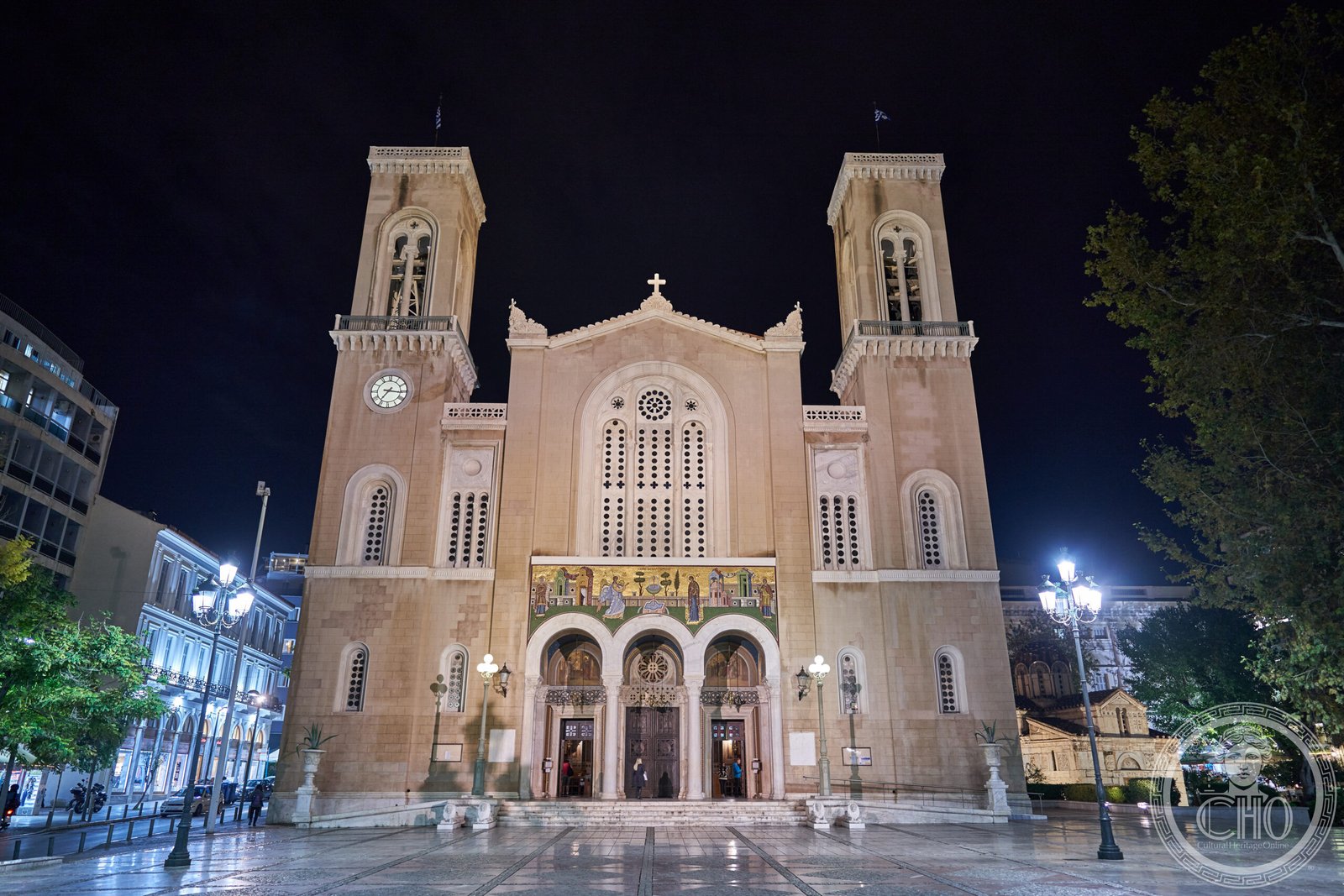
A neoclassical twin-towered facade in creamy stone, with a clock in one tower and a mosaic lunette of the Annunciation above the three arched entrance doors, facing a broad square shared with the diminutive, richly carved Little Metropolis church.
Practical information
- Opening hours: generally open daily outside services; check current hours before visiting.
- Address: Mitropoleos Square, Plaka district, Athens, Greece.
Getting there
The cathedral stands on Mitropoleos Square in the Plaka district, about 350 metres from Syntagma Square. GPS: 37.9753°N, 23.7302°E.
Nearby
- Little Metropolis (Panagia Gorgoepikoos) — a tiny, much older Byzantine church built from reused ancient and medieval carved stone, on the same square.
- Syntagma Square — Athens’s central square, a short walk away.
Sources
- Wikipedia — “Metropolitan Cathedral of Athens,” “Little Metropolis,” “Archdiocese of Athens”
- Protothema, Vima Orthodoxias, Mixanitouxronou.gr — coverage of the medieval-church-demolition tradition, citing Kostas Biris (1940).
- Unofficial Royalty — Greek royal weddings and funerals held at the cathedral.
- OrthodoxWiki — Archdiocese of Athens.
Find it on the map
See this place and what’s around it →📷 Become a Cultural Heritage Online photographer
Share your photos of places: they stay published under your name as the author. The more they're seen, the more you get noticed — and soon a contest will reward the most appreciated photos.
Log in or sign up free to add a photo