
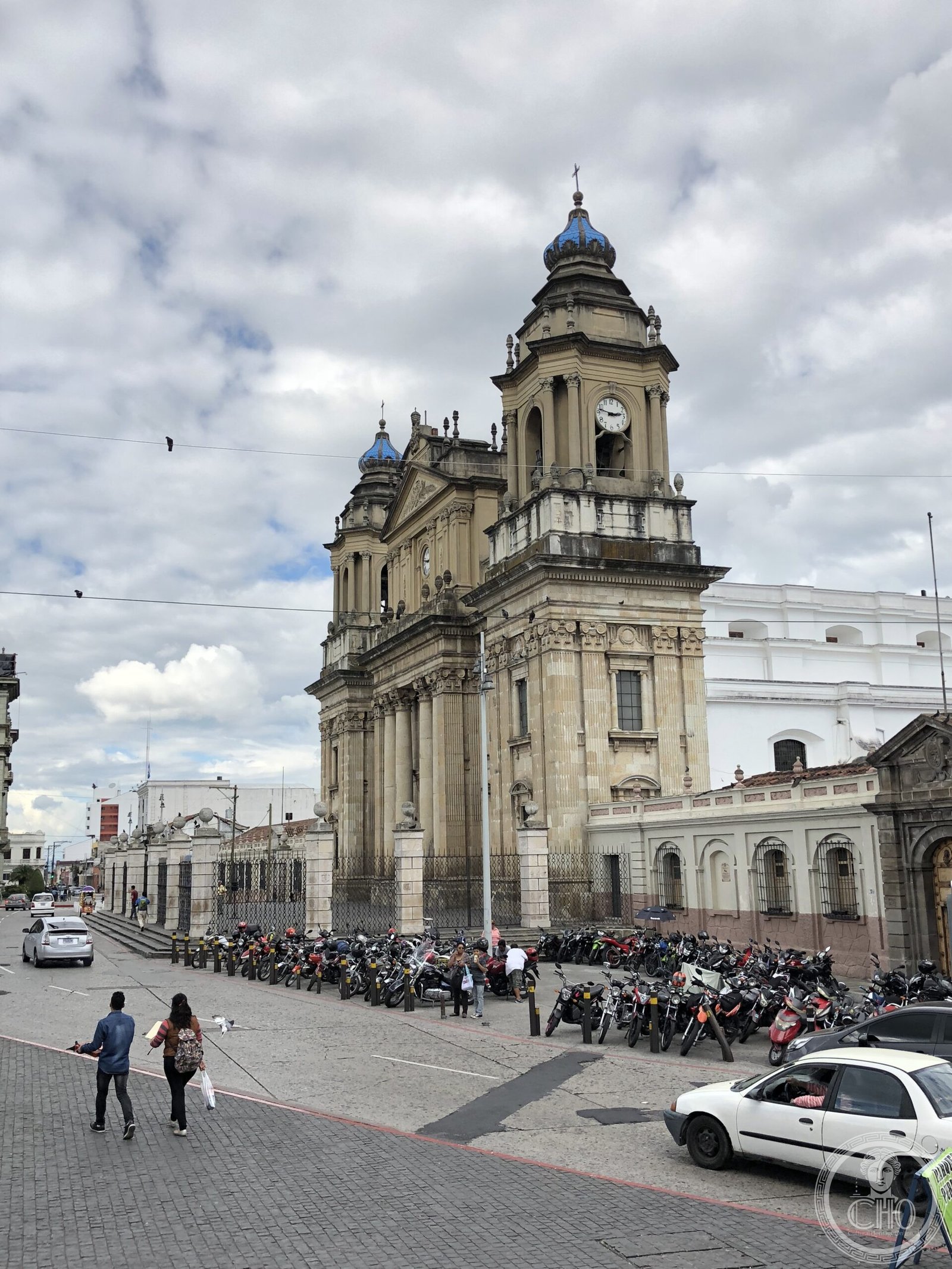
On the Plaza de la Constitución, in the historic centre of Guatemala City, the Metropolitan Cathedral was built from 1782, after the Santa Marta earthquakes of 1773 had destroyed the old cathedral of Antigua Guatemala and prompted the transfer of the capital to the Ermita valley. The neoclassical design was entrusted to the architect Marcos Ibáñez, assisted by the draughtsman Antonio Bernasconi and the engineer Joaquín de Isasi. The foundation stone was laid on 25 July 1782 by Archbishop Cayetano Francos y Monroy. The main building was blessed around 15-16 March 1815, though the towers and façade remained unfinished, completed only in 1867. The earthquakes of 1917-1918 brought down the elliptical dome, destroying the marble altar imported from Paris and the organ. The reconstruction, entrusted from 1919 to the Italian engineer Guido Albani, a specialist in reinforced concrete, ended in 1924 with a new, larger dome. Sources differ on the severity of the damage in the 1976 earthquake: some speak of towers on the verge of collapse, others of minor damage thanks precisely to the reinforced-concrete strengthening of the Twenties. The archdiocese of Guatemala, erected as a diocese on 18 December 1534 and raised to a metropolitan archdiocese on 16 December 1743, is today led by Archbishop Gonzalo de Villa y Vásquez, a Jesuit, in office since 2020. In the cathedral’s atrium, twelve stone columns, about three metres high and crowned with spheres, bear the engraved names of around thirteen thousand five hundred victims of the Guatemalan civil war (1960-1996), executed, massacred, disappeared and tortured. They were made by the archdiocese’s human rights office on the basis of the data gathered by the REMHI project. It was in this very cathedral, on 24 April 1998, that the auxiliary bishop Juan Gerardi presented the report “Guatemala: Nunca Más”, which documented the atrocities of the conflict, including the genocide against four Maya groups recognised by the United Nations Commission for Historical Clarification, concentrated between 1981 and 1983 in the so-called Ixil Triangle. Two days later, on 26 April 1998, Gerardi was beaten to death in the garage of the rectory of the parish of San Sebastián, where he lived, not in the cathedral itself. His remains were, however, moved on 26 April 2013, on the fifteenth anniversary, to a chapel dedicated to San Sebastián inside the Metropolitan Cathedral, where they rest beside those of other archbishops. Pope John Paul II visited this cathedral on 7 March 1983, during the first of his three journeys to Guatemala, addressing the faithful inside the building; in 1996 he instead greeted the crowd from the square in front, with no documented visit inside. Pope Francis has never visited Guatemala.
About the Cathedral
The Metropolitan Cathedral, on Guatemala City’s Plaza de la Constitución, seat of the Archdiocese of Guatemala, was built from 1782 after earthquakes destroyed the old capital’s cathedral in Antigua. Today its atrium holds a memorial of twelve stone pillars inscribed with roughly 13,500 names of civil war victims.
Key facts
- 25 July 1782: cornerstone laid by Archbishop Cayetano Francos y Monroy.
- 1917–1918: earthquakes collapse the dome; rebuilt in reinforced concrete by 1924.
- 24 April 1998: Bishop Juan Gerardi presents the “Guatemala: Nunca Más” civil-war report at this cathedral.
- 26 April 1998: Gerardi bludgeoned to death at the San Sebastián parish house, two days after the report’s launch.
- The cathedral atrium’s twelve pillars bear roughly 13,500 names of civil war victims.
- 26 April 2013: Gerardi’s remains transferred to a chapel inside this cathedral on the 15th anniversary of his death.
- 7 March 1983: Pope John Paul II addresses the faithful inside this cathedral, the first of his three visits to Guatemala.
History
Rebuilt in reinforced concrete after the earthquakes of 1917-18 collapsed its original dome, the cathedral became, decades later, ground zero for one of Guatemala’s most consequential and dangerous acts of truth-telling: on 24 April 1998, Bishop Juan Gerardi presented “Guatemala: Nunca Más,” the Catholic Church’s own report documenting the 36-year civil war’s atrocities, including genocide against Maya communities recognized by the UN-backed Historical Clarification Commission. He was murdered two days later. The cathedral’s atrium now carries his report’s legacy literally carved in stone — twelve pillars listing roughly 13,500 names of the war’s executed, massacred, disappeared and tortured.
What you see
A neoclassical stone facade rises between twin bell towers capped with blue-tiled onion domes, fronting the Plaza de la Constitución beside the National Palace of Culture, with a wide atrium in front lined by the twelve memorial pillars.
Practical information
- Opening hours: generally open daily outside services; check current hours before visiting.
- Address: 7a Avenida, Zone 1, Guatemala City, Guatemala.
Getting there
The cathedral stands on the east side of the Plaza de la Constitución in Guatemala City’s historic Zone 1. GPS: 14°38′30″N, 90°30′43″W.
Nearby
- National Palace of Culture — the former seat of government, on the same Plaza de la Constitución.
Sources
- Wikipedia (English and Spanish) — “Cathedral of Guatemala City,” “Archdiocese of Santiago de Guatemala,” “Juan José Gerardi Conedera,” “Guatemalan genocide,” “Historical Clarification Commission”
- Prensa Libre — construction and earthquake-restoration history of the cathedral.
- GCatholic.org — Archdiocese of Santiago de Guatemala records.
- Agencia Ocote and GHRC-USA — coverage of the cathedral’s civil-war memorial pillars and Bishop Gerardi’s assassination.
- Vatican.va — Pope John Paul II’s 7 March 1983 address at the Guatemala City cathedral.
Find it on the map
See this place and what’s around it →📷 Become a Cultural Heritage Online photographer
Share your photos of places: they stay published under your name as the author. The more they're seen, the more you get noticed — and soon a contest will reward the most appreciated photos.
Log in or sign up free to add a photo