
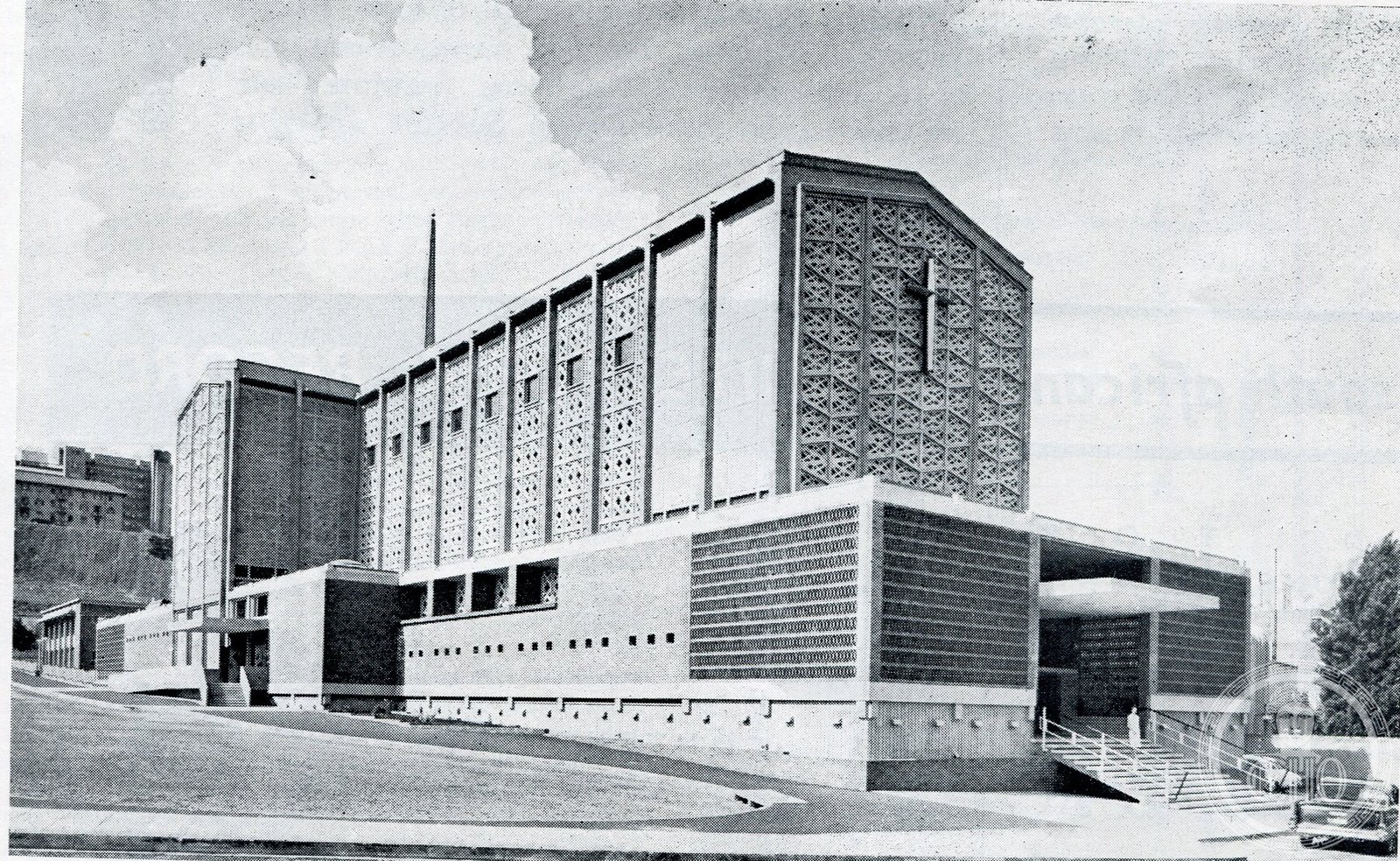
At the corner of Saratoga Avenue and End Street, in the district of Berea, the cathedral of Christ the King is the seat of the Catholic archdiocese of Johannesburg. It was built in the late Fifties to a design by the architect Brian Gregory, from Belfast, and consecrated on 29 October 1960. The building joins a reinforced concrete structure faced in exposed brick, with a rough pink-brown outer surface compared to carved rock, to a traditional Latin cross plan. The stained glass is the work of Patrick Pollen of Dublin, and the sanctuary furnishings are of Botticino marble. The roots of the parish go back to 1887, when the first Catholic mass in Johannesburg was celebrated in a reed hut on the Ferreira mining camp, before thirty-three faithful. The Catholic jurisdiction in the Transvaal was erected as an apostolic prefecture in 1886, raised to a vicariate in 1904, renamed the vicariate of Johannesburg in 1948, raised to a diocese on 11 January 1951 and finally to a metropolitan archdiocese on 5 June 2007. The present archbishop is Cardinal Stephen Brislin, installed on 28 October 2024. Unlike the archbishop of Durban, Denis Hurley, among the best known Catholic voices against apartheid, or the Anglican cathedral of St George in Cape Town, linked with Desmond Tutu, no specific episode of anti-apartheid activism is documented for this cathedral or for its archbishops of the time. On 14 September 1988 the aircraft of Pope John Paul II made an emergency landing at Johannesburg airport because of bad weather, during a journey that deliberately avoided apartheid South Africa, then left out of the official itinerary in Zimbabwe, Botswana, Lesotho, Eswatini and Mozambique. On 17 September 1995, in a South Africa by then free of apartheid, the same pope came back officially, celebrating a mass at Gosforth Park, in the Germiston area, where he presented the results of the special assembly for Africa and greeted President Nelson Mandela by name. According to sources of the archdiocese the pope also visited this cathedral on the same day, although the official Vatican transcript of the homily places the main event at Gosforth Park, and it has not been possible to confirm a separate stop at the cathedral. Catholics make up about seven per cent of the South African population.
About the Cathedral
The Cathedral of Christ the King, at the corner of Saratoga Avenue and End Street in Berea, Johannesburg, is the seat of the Archdiocese of Johannesburg. Built in the late 1950s to designs by Belfast-born architect Brian Gregory, it was consecrated on 29 October 1960.
Key facts
- 1887: Johannesburg’s first Catholic Mass celebrated in a reed hut, 33 people present.
- 11 January 1951: Diocese of Johannesburg erected.
- 29 October 1960: current cathedral consecrated.
- 14 September 1988: Pope John Paul II’s plane makes an emergency landing in Johannesburg while deliberately bypassing apartheid-era South Africa on a regional tour.
- 17 September 1995: Pope John Paul II returns to South Africa post-apartheid, celebrating Mass near Johannesburg and greeting President Nelson Mandela by name.
- 5 June 2007: elevated to the Metropolitan Archdiocese of Johannesburg.
History
Consecrated in 1960 as apartheid entrenched itself across South Africa, the cathedral’s most striking papal association came not from a visit but an avoidance: in 1988, Pope John Paul II’s plane touched down in Johannesburg only due to an emergency weather diversion, on a regional tour that had pointedly excluded apartheid South Africa from its official itinerary. He returned properly in September 1995, in a newly democratic South Africa, celebrating Mass near the city and publicly acknowledging the country’s transformation. Unlike Durban’s Archbishop Denis Hurley or Cape Town’s Anglican St George’s Cathedral, no specific anti-apartheid activism has been documented at this cathedral itself.
What you see
A rough, rose-brown concrete and face-brick exterior compared to hewn rock rises on a traditional Latin-cross plan, with an octagonal chancel volume behind a pierced-concrete screen wall, a rooftop cross, and stained glass by Dublin artist Patrick Pollen inside.
Practical information
- Opening hours: generally open daily outside services; check current hours before visiting.
- Address: corner of Saratoga Avenue and End Street, Berea, Johannesburg, South Africa.
Getting there
The cathedral stands in the Berea district of Johannesburg. GPS: 26°11′36″S, 28°03′07″E.
Nearby
- Berea district — a historic inner-city Johannesburg neighborhood surrounding the cathedral.
Sources
- Wikipedia — “Cathedral of Christ The King, Johannesburg,” “Archdiocese of Johannesburg,” “Denis Hurley”
- GCatholic.org and Catholic-Hierarchy.org — Archdiocese of Johannesburg records.
- Archdiocese of Johannesburg (catholicjhb.org.za) — cathedral history.
- The Heritage Portal — “A Great City Deserves Great Cathedrals”
- Vatican.va — homily transcript, Gosforth Park, 17 September 1995.
- Southern African Catholic Bishops’ Conference — cathedral’s 65th anniversary coverage.
Find it on the map
See this place and what’s around it →📷 Become a Cultural Heritage Online photographer
Share your photos of places: they stay published under your name as the author. The more they're seen, the more you get noticed — and soon a contest will reward the most appreciated photos.
Log in or sign up free to add a photo