
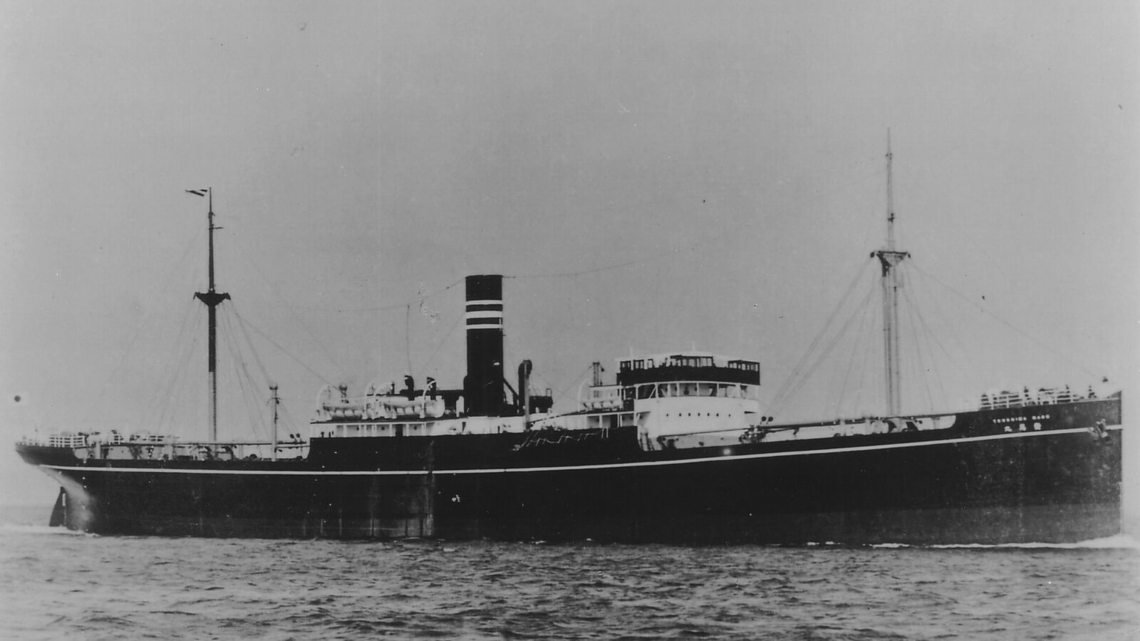
A 1915-built passenger and cargo ship, torpedoed off Akusekijima in August 1944 while carrying evacuee schoolchildren from Okinawa toward Nagasaki.
At a glance
Tsushima Maru entered service in 1915 as a merchant vessel. Decades later, in the final year of the Pacific War, it was requisitioned to move Okinawan civilians away from an expected American invasion. On the night of 22 August 1944 the submarine USS Bowfin sank it near Akusekijima. Of roughly 1,788 people aboard, only 254 survived.
History
By mid-1944 Japan’s government ordered mass evacuation from the Ryukyu Islands. Tsushima Maru sailed from Okinawa toward Kagoshima carrying civilians, most of them schoolchildren, along with some parents and teachers. It moved as part of Convoy Namo 103, alongside two other merchant ships and naval escorts. Bowfin struck at night. The ship went down quickly. Survey data compiled by the Tsushima Maru Commemoration Association recorded 1,661 civilian evacuees, including 834 schoolchildren, of whom roughly 775 died. Wider tallies put total deaths at 1,534, with 780 of the child victims later identified by name through reports from bereaved families. Afterward, Japanese authorities imposed a gag order. Survivors and families rarely discussed the sinking for years, and public memory of the disaster only slowly took shape.
What you see
There is no building to walk through. What remains is a wreck site and a scattering of memorials. The hull was located and identified underwater in December 1997, off Akusekijima. On land, monuments stand in Naha City on Okinawa, on Akuseki Island itself, and at Funakoshi beach on Amami Island. Each marks a point in the geography of loss, from embarkation to the place the ship went down. Memorial ceremonies are still held at sea near the approximate sinking location.
Cultural significance
Tsushima Maru has become one of the defining civilian tragedies of Okinawa’s wartime experience. Its story has been retold across Japanese books, articles, and documentaries. The postwar silence enforced by the gag order makes the later documentation effort, matching names to victims, feel especially deliberate. As of January 2026, Japanese authorities were reportedly considering retrieving artifacts from the wreck, a step that would add physical evidence to a history long carried mainly through testimony and memorial sites.
Key facts
- Built: 1915
- Sunk: 22 August 1944, by USS Bowfin
- Location: near Akusekijima, Ryukyu Islands, Japan
- Passengers aboard: approximately 1,788, mostly schoolchildren
- Survivors: 254, including about 59 children
- Wreck located and identified: December 1997
Practical information & getting there
You cannot visit the wreck itself without a specialist expedition. Instead, the Tsushima Maru Memorial Museum in Naha, Okinawa, holds photographs of identified students and forms the main point of public engagement with the story. Memorial monuments on Okinawa, Akuseki Island, and Amami Island’s Funakoshi beach are accessible to travelers moving through the Ryukyu chain, though each sits in a different, sometimes remote, location. Ferry and inter-island transport link these islands, so plan crossings in advance.
Sources & resources
Find it on the map
See this place and what’s around it →📷 Become a Cultural Heritage Online photographer
Share your photos of places: they stay published under your name as the author. The more they're seen, the more you get noticed — and soon a contest will reward the most appreciated photos.
Log in or sign up free to add a photoDo you manage this place?
This page is read by travellers and heritage enthusiasts who find it on Google. Keep it accurate — and make it work for you. Free for non-profit heritage institutions.