
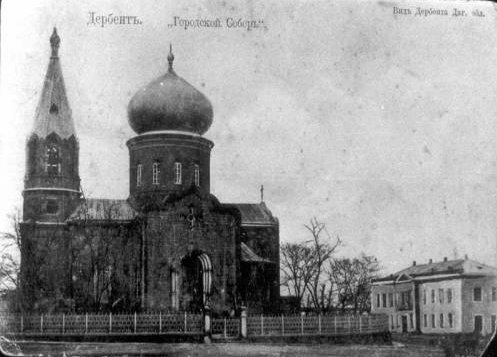
A Russian-Byzantine cathedral raised by imperial subscription and demolished under Soviet atheism, it survives only in fragments and old inscriptions.
At a glance
Consecrated in 1853, the cathedral stood on what is now Freedom Square in Derbent, on the site later occupied by a monument to Vladimir Lenin. Designed by Prince Grigory Gagarin, it replaced a cramped garrison church housed in a converted 11th-century mosque. It was destroyed in 1938.
History
Before its construction, Derbent’s Orthodox population worshipped in a converted mosque, pressed into service in 1823 on the order of General Aleksey Yermolov. That building, later known as the Kilis Mosque, served the garrison alone. As Derbent’s civilian Orthodox community grew, and the city became capital of the Derbent Governorate in 1846, calls for a proper cathedral intensified. Governor Prince Alexander Gagarin led the fundraising. Subscriptions came from across the empire. Soldiers gave 3,000 roubles. Muslim residents contributed alongside merchants, a Kuban landowner and even a Moscow trader who sent chandeliers. Costs still outran donations, forcing officials to borrow city funds and draw on customs revenue. Total expenditure reached 44,507 roubles and 84 kopecks. The foundation was laid on 8 May 1849 before Prince Mikhail Vorontsov himself. Workers uncovered older ruins beneath the site, possibly a 4th-century Albanian church, complete with clay pipes and brick vaults. The cathedral opened for worship in December 1853 and gained cathedral status in 1902. It was demolished in 1938 as part of the state’s anti-religious campaign.
What you see
Gagarin designed the church in the Russian-Byzantine style, drawing on Byzantine massing filtered through 19th-century imperial taste. Local hewn stone formed the walls; it held 500 worshippers. A cast-iron floor was planned, then swapped for walnut parquet. Furnishings arrived from across Russia: crosses and candlesticks from Moscow, bells from Astrakhan, an iconostasis from Tbilisi. A bell-tower clock, made in Odessa, marked the hours. Gagarin himself painted several icons, including the Last Supper and images of St. George and St. Alexander Nevsky. A fence and square were added in 1875, framing the building within the city’s civic core.
Cultural significance
The cathedral marked Derbent’s transformation into an administrative and religious center under Russian imperial rule. Its funding drive, drawing Orthodox and Muslim donors alike, reflected the layered communities of the Caucasus frontier. A 2020 discovery in Derbent’s carpet museum — a wooden icon-case fragment bearing a commemorative inscription — offered rare physical testimony to the lost building, echoing a passage recorded decades earlier in Evgeny Kozubsky’s 1906 history of the city.
Key facts
- Consecrated: 26 November 1853; services began 15 December 1853
- Architect: Prince Grigory Gagarin, Russian-Byzantine style
- Construction supervisor: field engineer captain V. I. Gerschelman
- Capacity: approximately 500 worshippers
- Given cathedral status: 1902
- Demolished: 1938, under the Soviet Gosateizm campaign
- Site today: monument to Vladimir Lenin, Freedom Square, Derbent
Practical information & getting there
Nothing of the cathedral remains standing. You can visit Freedom Square in central Derbent, where the Lenin monument now occupies the former site. The location sits within walking distance of Derbent’s old town and its Naryn-Kala fortress, both easily reached on foot from the city center.
Sources & resources
Find it on the map
See this place and what’s around it →📷 Diventa un fotografo di Cultural Heritage Online
Condividi le tue foto dei luoghi: restano pubblicate con la tua firma come autore. Più vengono viste, più ti fai conoscere — e presto un concorso premierà le foto più apprezzate.
Accedi o registrati gratis per aggiungere una fotoDo you manage this place?
This page is read by travellers and heritage enthusiasts who find it on Google. Keep it accurate — and make it work for you. Free for non-profit heritage institutions.