
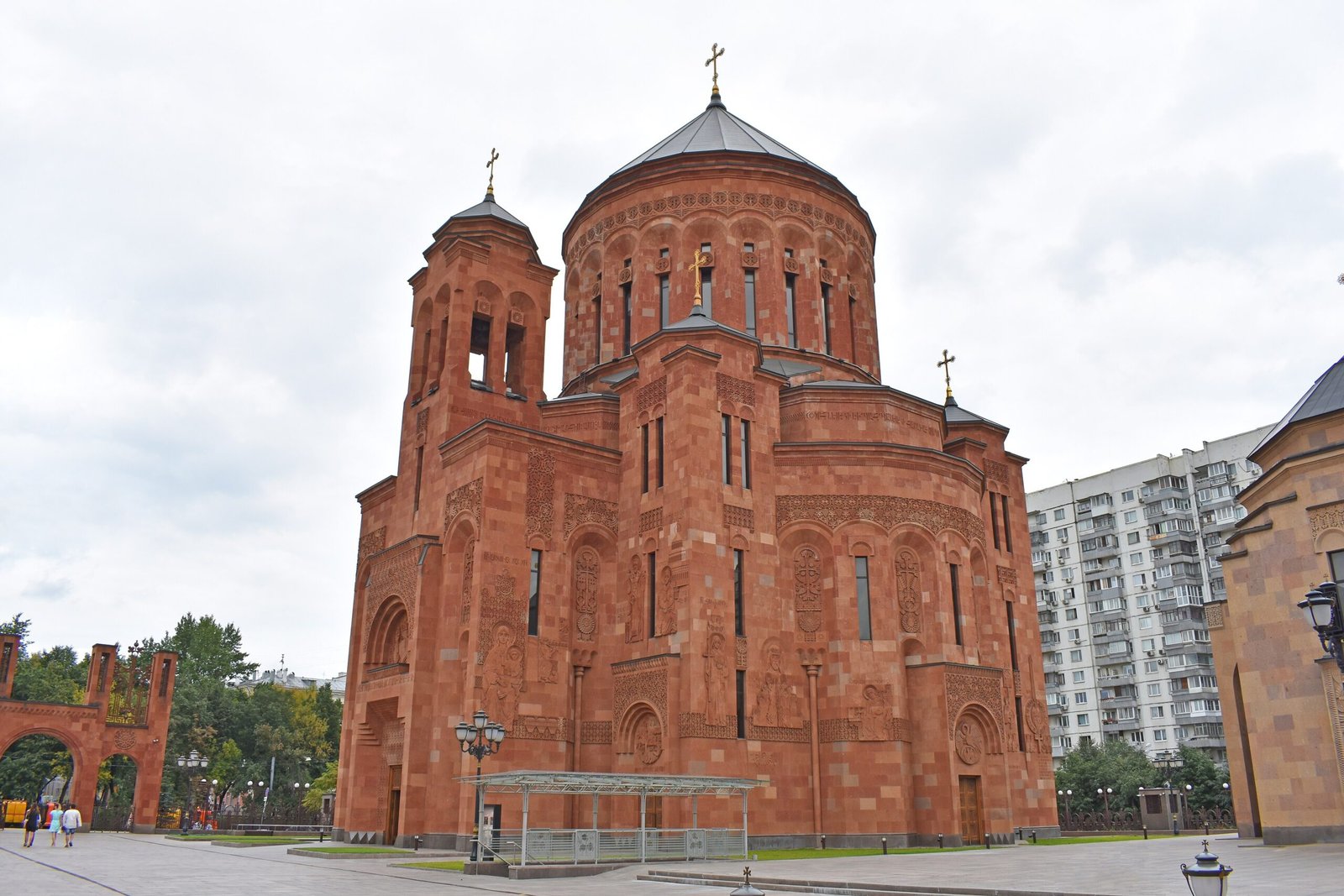
Faced in tuff stone carried from Armenia by rail, the Holy Transfiguration Cathedral rises above southeastern Moscow as the largest Armenian church built outside the Armenian homeland.
At a glance
Officially the Cathedral of the Transfiguration, this is the seat of the Diocese of Russia of the Armenian Apostolic Church. Designed by architect Artak Ghulyan and consecrated in September 2013, it anchors a 2.5-hectare complex of school, museum, chapel and diocesan offices. It stands as the tallest Armenian church anywhere outside Armenia itself.
History
Before the Soviet era Moscow had three Armenian churches. Two, dating to the 18th century, were demolished by Soviet authorities by the 1930s. Only the small 19th-century Holy Resurrection Church at the Armenian Cemetery survived, returned to the church in 1956 and serving as the city’s sole Armenian place of worship for decades. As Moscow’s Armenian population grew after the Soviet collapse, plans for a new cathedral took shape in 1996, when city authorities allotted land. Progress stalled. A 2001 embezzlement scandal forced out Archbishop Tigran Kyureghian, replaced by Yezras Nersisian, brother of Catholicos Garegin II, who began fresh fundraising. Garegin II and Patriarch Alexy II laid the cornerstone in October 2004. Construction proper began in 2006 and ran seven years, funded partly by businessmen Samvel Karapetyan and Ruben Vardanyan and by donated materials whose total value remains uncertain, though estimates for the whole complex reach $30–35 million. Garegin II presided over the consecration on September 17, 2013, attended by Patriarch Kirill, Armenia’s president and diplomatic guests from Russia’s Muslim, Buddhist and Jewish communities. The first Divine Liturgy followed on September 22. In 2017 relics of Gregory the Illuminator, Armenia’s patron saint, were presented to the cathedral.
What you see
Ghulyan’s design follows traditional Armenian church form, its walls faced with tuff stone quarried at Anipemza, near the medieval capital of Ani, and shipped in over one hundred railroad cars. The cathedral reaches 58 metres including its 7-metre cross, just short of Yerevan’s St. Gregory the Illuminator Cathedral. The dome spans 21 metres across. Inside, space holds up to 1,200 worshippers; the wider complex accommodates around 2,400. Bas-reliefs cover the exterior in dense detail, depicting Mesrop Mashtots, Gregory of Narek, Saint Sarkis and Gregory the Illuminator alongside non-Armenian figures such as Saint George.
Cultural significance
For Moscow’s Armenian community, estimated at up to 500,000 though official census figures are lower, the cathedral answered decades of absence following the Soviet-era destruction of earlier churches. Its scale and the diplomatic presence at its consecration signaled the Armenian Church’s institutional standing in Russia. The 2017 gift of Gregory the Illuminator’s relics reinforced the site’s status as a spiritual center for the diaspora, not merely a parish church.
Key facts
- Architect: Artak Ghulyan (took over design in 2004)
- Consecrated: September 17, 2013, by Catholicos Garegin II
- Height: 58 metres including a 7-metre cross
- Dome diameter: 21 metres
- Capacity: 1,000–1,200 in the cathedral; up to 2,400 across the complex
- Facing stone: tuff from Anipemza, Armenia
- Complex area: 2.5 hectares, including a school, chapel and museum
Practical information & getting there
The cathedral sits in Moscow at coordinates near 55.788°N, 37.621°E. You can reach the complex via the city’s metro network; parking for 200 to 300 cars is available on site for those arriving by car. The complex includes an underground museum and exhibition hall worth allowing extra time for.
Sources & resources
Find it on the map
See this place and what’s around it →📷 Become a Cultural Heritage Online photographer
Share your photos of places: they stay published under your name as the author. The more they're seen, the more you get noticed — and soon a contest will reward the most appreciated photos.
Log in or sign up free to add a photoIs this page about you?
This page is read by travellers and heritage enthusiasts who find it on Google. Tell us how you are connected to this place and we will take it from there.