
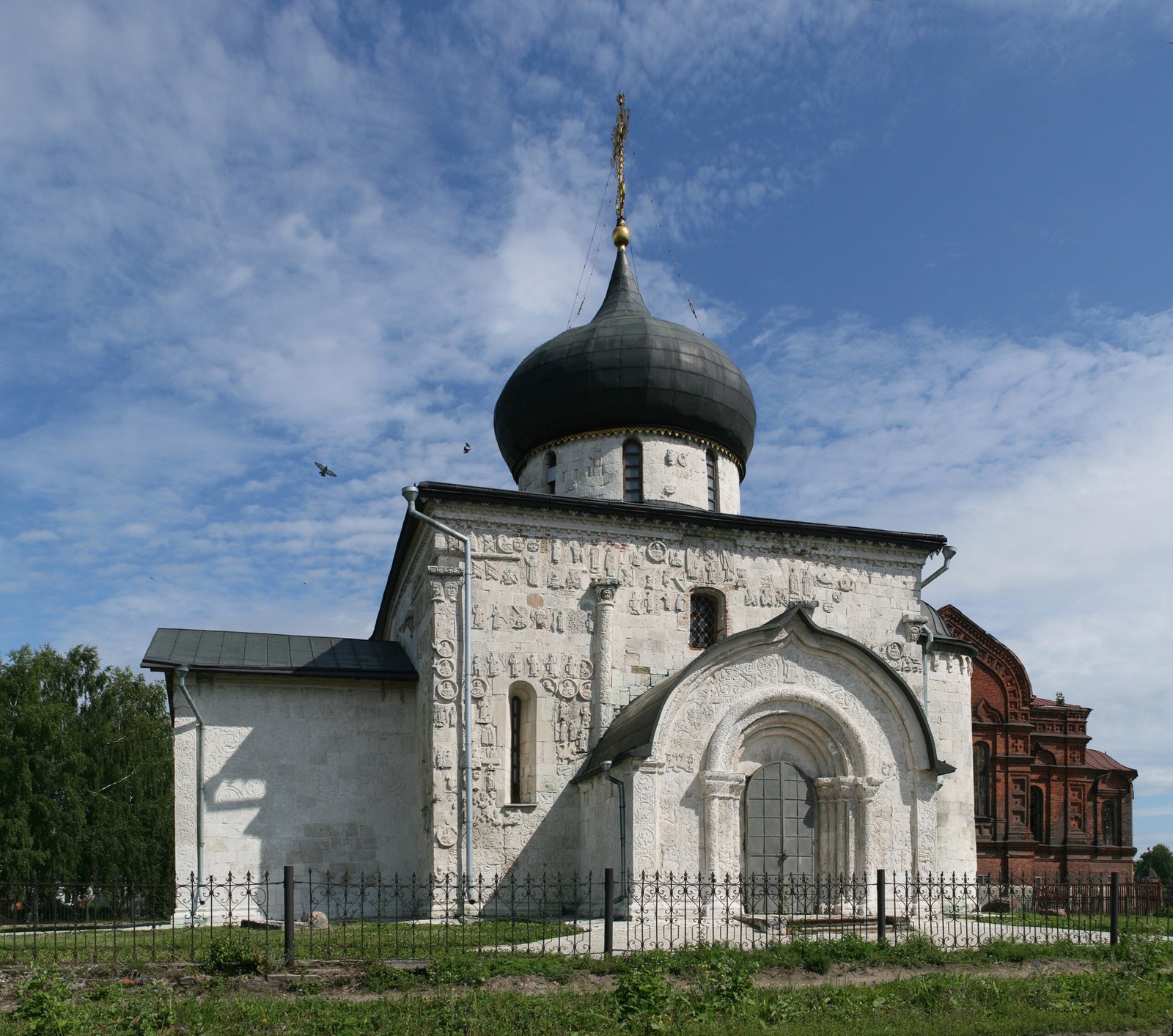
Built between 1230 and 1234, this white-stone cathedral was the last of the great pre-Mongol churches of Vladimir-Suzdal, its walls once covered edge to edge in carved reliefs whose original arrangement no one has fully recovered.
At a glance
Saint George Cathedral stands alone in a meadow at the center of Yuryev-Polsky, a small town founded by Yuri Dolgorukiy in 1152. It replaced an earlier cathedral on the same site and was raised under Prince Sviatoslav, who oversaw its construction personally. Completed only three years before the Mongol invasion of Rus, it is prized less for its architecture than for the extraordinary stone carving that once wrapped its exterior.
History
Yury Dolgorukiy first built a cathedral here, dedicated to his patron saint George. By 1230 that building was judged beyond repair. Sviatoslav, ruler of a newly independent Yuryev-Polsky principality after 1212, supervised a replacement finished in just four years. The new cathedral was admired widely enough to serve as a model for the Assumption Cathedral in Moscow a century later. Sviatoslav himself was buried inside in 1252.
Disaster struck in the 1460s, when the building collapsed. Vasili Yermolin was sent to rebuild it and claimed to restore the original form. He did not fully succeed. Many carved stones were shattered, others reused blindly in the walls, and some scattered onto neighboring farms, later recovered by Pyotr Baranovsky during Soviet-era work. A 17th-century bell-tower and 19th-century additions were removed in the 20th century, leaving the cathedral isolated as it appears today. It later served as a Soviet museum.
What you see
The cathedral is asymmetrical, a trait built into it from the start rather than a result of later repair. Four square-sectioned columns support a compact central volume, with an apse on the eastern side. The northern wall preserves the most original masonry; the southern wall suffered worst in the collapse and shows the clearest signs of Yermolin’s improvised reassembly.
What remains of the carving mixes human and animal figures with floral ornament, cut in fine relief across the stone surface. Scholars believe two teams worked the facade: a dozen sculptors on the figural reliefs, and eighteen to twenty-four more on the floral bands. Much of the original sequence survives only in paper reconstructions.
Cultural significance
Saint George Cathedral belongs to a small group of white-stone churches, barely a dozen, that survived from the Vladimir-Suzdal principality before the Mongols arrived. Its carving is unusual for Rus sculpture of any period, combining figural and floral motifs otherwise known mainly from frescoes. Unlike several sister churches in the region, it was never inscribed as a UNESCO World Heritage site, though Russia lists it as a federally protected architectural monument.
Key facts
- Location: Yuryev-Polsky, Vladimir Oblast, Russia
- Built: 1230–1234, replacing an earlier 12th-century cathedral
- Patron: Prince Sviatoslav, buried inside in 1252
- 17th-century restoration after collapse: Vasili Yermolin
- Heritage status: Russian federal architectural monument (#3310181000)
Practical information & getting there
Yuryev-Polsky lies within the Golden Ring region northeast of Moscow, reachable by road or rail via Vladimir. The cathedral stands in open ground with unobstructed views from every side, its later additions long since demolished. Check current opening arrangements locally, as it functions today as a museum site rather than an active parish church.
Sources & resources
Find it on the map
See this place and what’s around it →📷 Become a Cultural Heritage Online photographer
Share your photos of places: they stay published under your name as the author. The more they're seen, the more you get noticed — and soon a contest will reward the most appreciated photos.
Log in or sign up free to add a photoIs this page about you?
This page is read by travellers and heritage enthusiasts who find it on Google. Tell us how you are connected to this place and we will take it from there.