
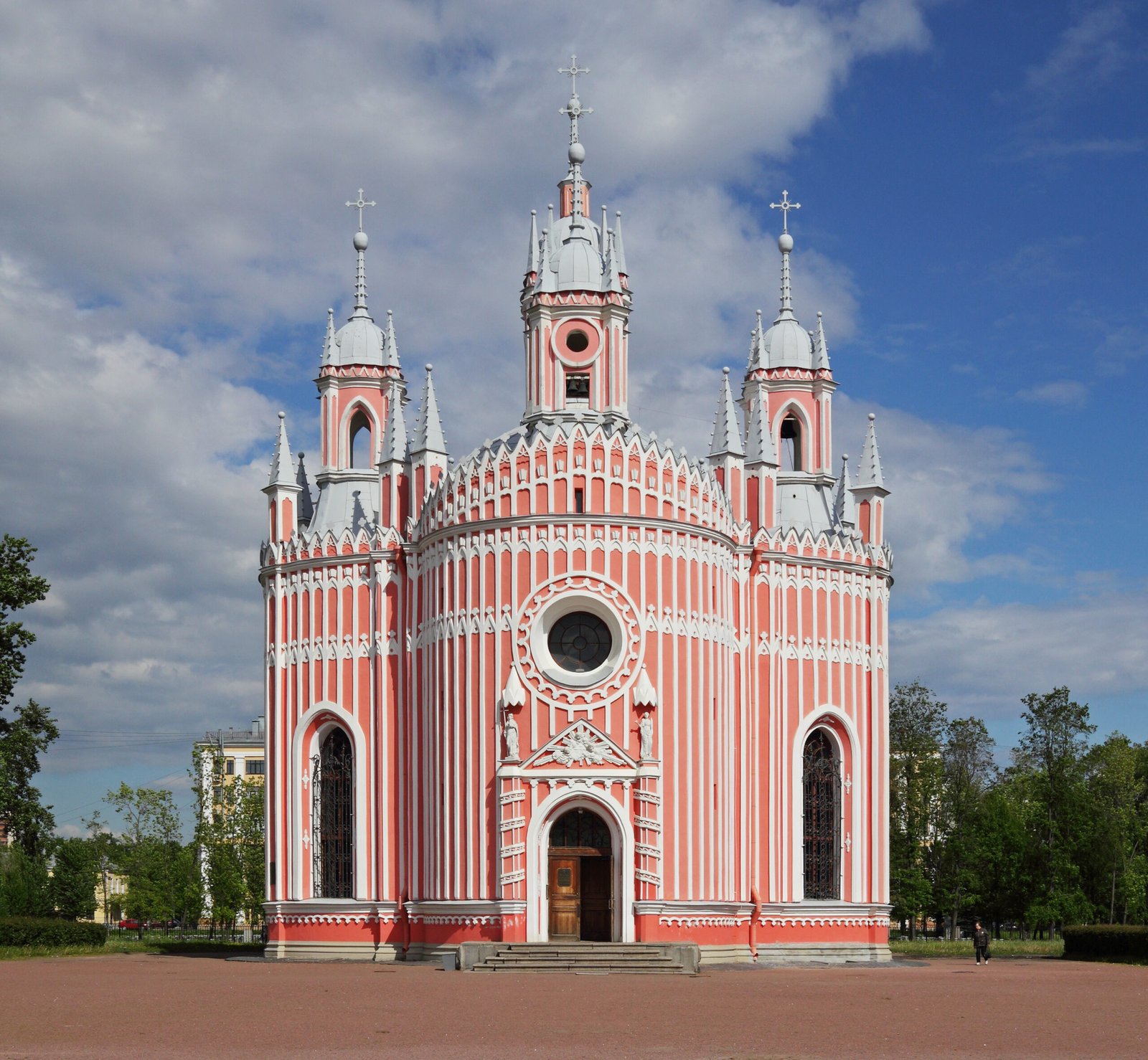
A striped pink-and-white confection rising from a former frog swamp, this memorial church remains one of Russia’s earliest and strangest experiments in Gothic Revival.
At a glance
Built between 1777 and 1780 by court architect Yury Felten for Catherine the Great, the Chesme Church commemorates Russia’s 1770 naval victory over Ottoman forces at Chesme Bay. It stands beside the similarly Neo-Gothic Chesme Palace on what is now Lensoveta Street, roughly midway between central Saint Petersburg and Tsarskoye Selo.
History
Catherine II chose the site herself. She had received news of the Chesme victory here. Gustav III of Sweden attended the laying of the foundation stone in 1777, and Joseph II of Holy Roman Empire fame was present at the consecration three years later. The church later passed briefly to the Knights of the Order of St. George, earning a third nickname. Soviet rule brought harder times: closed in 1923, it served as a storehouse, then a wartime facility for the Institute of Aviation Technology. War damage followed during the siege years. Restoration under architects M.I. Tolstov and A.P. Kulikov ran from 1970 to 1975, after which the building briefly became a museum of the Battle of Chesme, stocked with objects from the Central Naval Museum. Religious use resumed in 1991.
What you see
Painted in bands of pink and white, the church has been likened to a candy cone shooting upward from the ground. Felten built it in brick and white stone on a quatrefoil plan, four semi-cylindrical arms covered by barrel vaults, a layout rooted in Moscow baroque estate churches of the late 1600s. Onto this he grafted Gothic ornament: lancet windows, finials, spires, a rose window over the entrance, and small domes replacing the expected onion shapes. Angels flank the portal. Crenellated parapets crown the walls, and one tower holds a 100-kilogram bell. The choice of style nodded to Turkish exoticism and to the Anglomania then shaping Catherine’s palace gardens. Nothing of the original interior survives; a 1930 fire destroyed the Italian icons, and later decades saw the space repainted, then filled with naval battle scenes, then restored again for worship. A painting of Christ’s arrival in Nazareth now hangs inside.
Cultural significance
Historians count the Chesme Church among the very first Neo-Gothic buildings in the Saint Petersburg region, a rare instance of Gothic Revival reaching Russian church architecture so early. Some regard it as the city’s single most striking church. Its grounds, the Chesmenskoe War Veterans’ Cemetery, hold unnamed graves from 1812 to 1944. Grigori Rasputin’s coffin rested here in 1916, before burial at Tsarskoye Selo, adding a darker footnote to its long institutional life.
Key facts
- Architect: Yury Felten, court architect to Catherine the Great
- Built: 1777–1780
- Style: Gothic Revival / Russian pseudo-gothic
- Commemorates: the 1770 Battle of Chesme
- Restored: 1946 (palace) and 1970–1975 (church)
- Heritage status: officially protected
Practical information & getting there
The church sits near the Moskovskaya metro station, along Moskovsky Prospekt between Park Pobedy and the city center. You can walk from the metro in a few minutes. Regular Orthodox services have run here since 1991, so check the parish’s own schedule before visiting. The adjoining cemetery is open for quiet walking.
Sources & resources
Find it on the map
See this place and what’s around it →📷 Become a Cultural Heritage Online photographer
Share your photos of places: they stay published under your name as the author. The more they're seen, the more you get noticed — and soon a contest will reward the most appreciated photos.
Log in or sign up free to add a photoIs this page about you?
This page is read by travellers and heritage enthusiasts who find it on Google. Tell us how you are connected to this place and we will take it from there.