
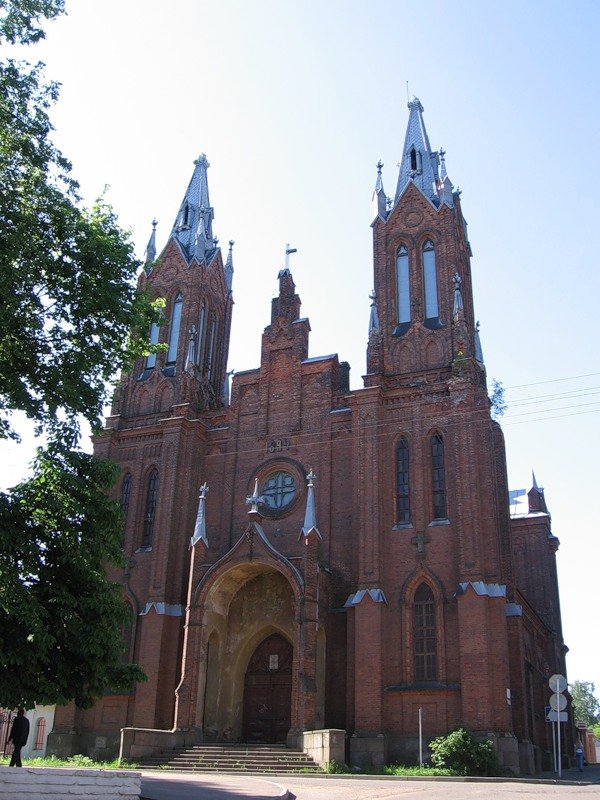
A neo-Gothic Catholic church raised over twelve years in provincial Smolensk, closed under Soviet rule and used as an archive for decades, its stained glass and painted vaults still awaiting full restoration.
At a glance
Built between 1884 and 1896, the Immaculate Conception Church is a large-bodied Gothic Revival building in the heart of Smolensk. It served the Archdiocese of Mohilev before decades of Soviet requisition, and today functions partly as a place of worship and partly as a heritage site under repair. Its parish now numbers around 9,000 people.
History
Work began in 1884 under a construction committee that included the abbot Stefan Denisevich, governoral architect Mikhail F. Meisher, and engineer Leon Dubeykovsky. Attribution of the finished design also involves the governoral architect Yevgeny Ferdinandovich Lyshinsky, brought in later, and Wikidata credits Liavon Vitan-Dubiejkawski among the architects associated with the building. The church was first consecrated on October 23, 1896, then reconsecrated on June 29, 1897, after Warsaw craftsmen finished painting its walls, vaults, and biblical canvases and installing the stained glass between 1897 and 1899.
The parish’s own records were seized during the 1918 revolution. Its curate and a group of parishioners were executed in the Great Terror of 1937, and the congregation was disbanded. In 1940 the building became a repository, just ahead of the German occupation in 1941. From the 1950s it held the civil archive of the Smolensk region. By the mid-1980s the structure was declared an emergency, and in 1995 it gained status as a regional cultural monument.
What you see
The church presents a substantial neo-Gothic mass, its scale unusual for the region’s Catholic architecture of the period. Tall windows carry stained glass made by Warsaw workshops in the late 1890s, among the building’s most striking surviving features. Painted vaults and wall canvases with biblical scenes once covered much of the interior, though decades as an archive have left the fabric strained. The former rectory, restored since the 2000s, now serves the community as a chapel while the main church awaits repair.
Cultural significance
The building traces the arc of Catholic life under the Russian Empire, Soviet suppression, and post-Soviet revival in one structure. Its closure in 1940 and reuse by the NKVD, then by civil archives, mirrors the fate of many religious buildings repurposed for state administration. Plans announced in 2010 by Governor Sergei Antoufiev, involving Polish funding, marked an attempt to return the church to its congregation. By early 2015 the building stood empty, officially classed as a specialized structure awaiting its next chapter.
Key facts
- Location: Smolensk, Russia
- Constructed: 1884–1896
- Style: Gothic Revival
- Heritage status: Regional cultural monument (since 1995)
- Parish size: approximately 9,000
Practical information & getting there
The church stands within Smolensk, reachable by local transport from the city centre. Services are currently partial, held in part in the restored former rectory chapel while the main building undergoes assessment. Check the official site before visiting, since restoration work may affect access.
Sources & resources
Find it on the map
See this place and what’s around it →📷 Become a Cultural Heritage Online photographer
Share your photos of places: they stay published under your name as the author. The more they're seen, the more you get noticed — and soon a contest will reward the most appreciated photos.
Log in or sign up free to add a photoIs this page about you?
This page is read by travellers and heritage enthusiasts who find it on Google. Tell us how you are connected to this place and we will take it from there.