
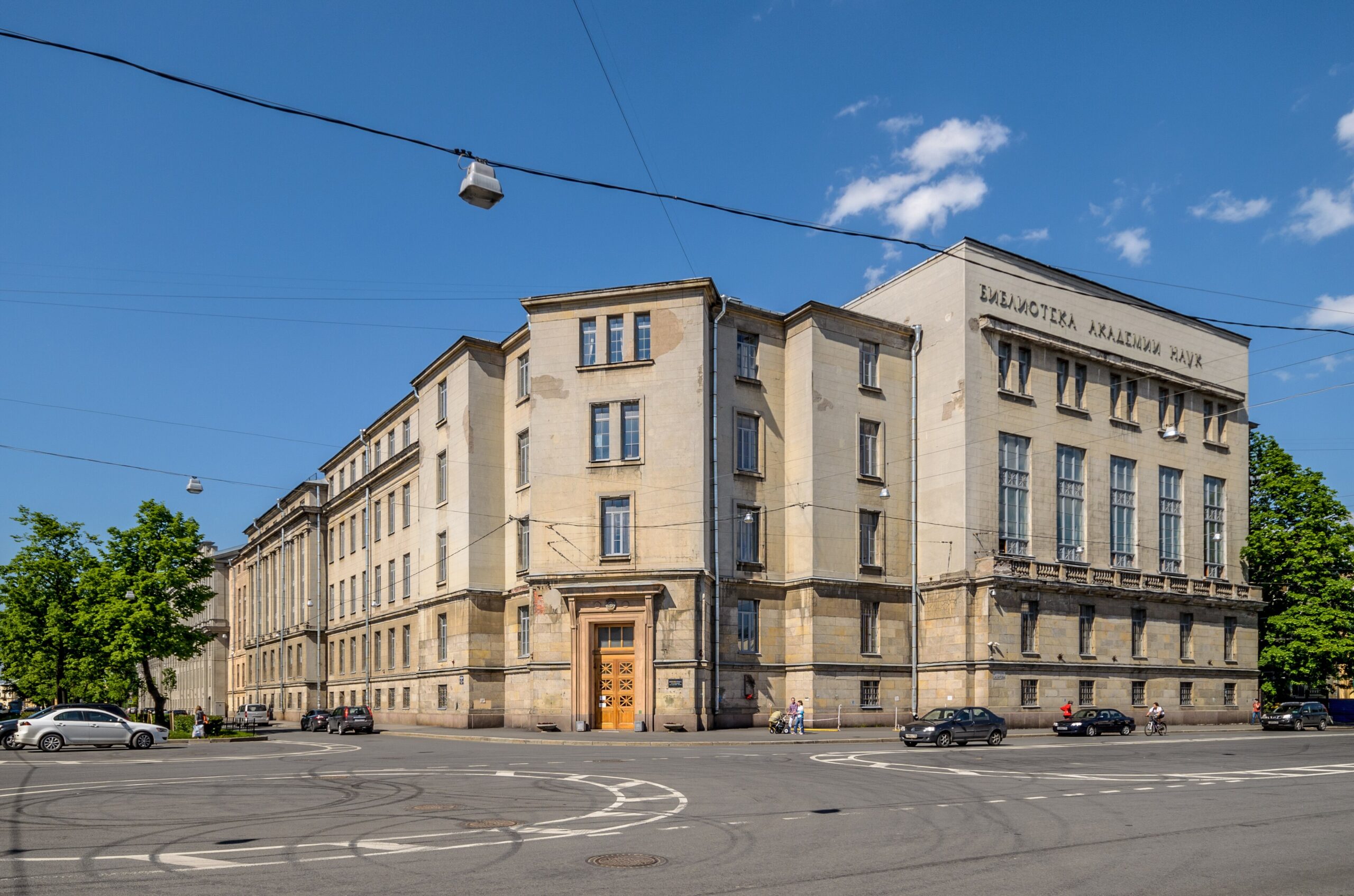
Founded by decree of Peter the Great, this Vasilievsky Island institution has survived fire, siege and flood to remain one of Russia’s great repositories of scholarship.
At a glance
The Library of the Russian Academy of Sciences, known by its Russian acronym BAN, is a state-owned research library serving academy staff and scholars with higher education. Its central collection sits alongside library holdings maintained by academic institutions across Saint Petersburg and beyond. It has been legally entitled to a free copy of Russian academic publications since 1747, and of all Russian publications since 1783.
History
Peter I ordered the library’s founding in 1714. Three early collections formed its core: books from the Moscow Pharmaceutical Order, the Gottorp library, and the library of the Dukes of Courland. By 1728 it opened to the public on Vasilievsky Island, in a building it shared with the Academy of Sciences and the Kunstkamera. A first fire, caused by faulty chimneys, struck in December 1747, destroying dozens of titles and the famed Gottorp Globe. The collection grew steadily through the 18th and 19th centuries, split in 1818 into Russian and Foreign departments under reformers including naturalist Karl Baer. In 1924-25 the holdings finally moved into a purpose-built structure erected in 1914, a building that had spent the First World War serving as a military hospital. The library stayed open through the siege of Leningrad, 1941 to 1944. Then, on 15 February 1988, catastrophic fire struck again. It destroyed 298,000 books outright and damaged two to three million more with heat and smoke; over 734,000 volumes were soaked by firefighting foam. Citizens across the city took damp books home to dry them, a radio-organised rescue that saved 93 percent of the wetted volumes by late March. Roughly 10,000 books were lost to mold regardless. Losses fell hardest on the Baer collection of pre-1930 foreign scientific works and on early Russian medical and scientific texts from the 17th to 19th centuries.
What you see
The library occupies its 1914 building on Vasilievsky Island, purpose-built for its collections before war intervened. Reading rooms and stack floors hold millions of volumes across two historic departments, Russian and Foreign, a division dating to 1818. Older material sits alongside catalogs built up by generations of academician-librarians. Scars from 1988 remain part of its living history, not merely its records.
Cultural significance
Few institutions trace their founding directly to Peter the Great. Denis Diderot praised the library’s early ambitions in his Encyclopédie of 1751, noting how thoroughly Peter had stocked it “in all fields of science.” The obligatory deposit laws of 1747 and 1783 make it a foundational archive of Russian print culture. Its 1988 fire remains one of the worst library disasters of the 20th century, and the citizen-led drying effort afterward is remembered as an extraordinary act of civic preservation.
Key facts
- Founded: 1714, by decree of Peter I
- Location: Vasilievsky Island, Saint Petersburg
- Current building occupied: 1924-1925 (constructed 1914)
- 1988 fire losses: 298,000 books destroyed; 2-3 million damaged
- Heritage status: listed
Practical information & getting there
The library stands on Vasilievsky Island, an easy walk from the historic university and academy buildings clustered near the Neva embankment. Access is restricted to employees of Russian Academy of Sciences institutions and scholars holding higher education credentials; casual visitors should not expect general reading-room access. Check the official website before planning a visit, as admission and hours are subject to institutional rules rather than tourist schedules.
Sources & resources
Find it on the map
See this place and what’s around it →📷 Become a Cultural Heritage Online photographer
Share your photos of places: they stay published under your name as the author. The more they're seen, the more you get noticed — and soon a contest will reward the most appreciated photos.
Log in or sign up free to add a photoIs this page about you?
This page is read by travellers and heritage enthusiasts who find it on Google. Tell us how you are connected to this place and we will take it from there.