
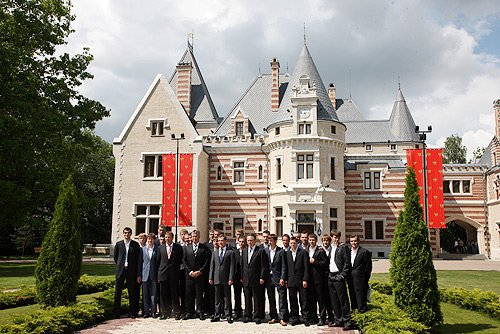
A Gothic Revival fantasy built for a Baltic German baronial family, later requisitioned by revolutionaries, turned into a sanatorium for Soviet celebrities, and finally rebuilt as a presidential residence west of Moscow.
At a glance
Meyendorff Castle, also known as Meindorf Castle or Barvikha, stands between Barvikha and Odintsovo along the Podushkinskoye Highway. Pyotr Boytsov designed it in a Châteauesque, Gothic Revival idiom for the Meyendorf family, a cadet branch of the House of Uexküll. Construction ran from 1874 to 1885, decades before the family formally established the estate in 1904. Today it functions as State Residence Barvikha, a country retreat of the Russian presidency, though the older name persists in common use.
History
The Meyendorfs settled the estate just before the upheavals of the 20th century. Baron F. M. Meyendorf served as first secretary of the Russian diplomatic mission to Denmark from 1908, a posting freighted with meaning given the Tsarina’s Danish birth. War changed everything. The family left Russia after 1914, and following the October Revolution Bolshevik leaders, including Lenin, occupied the castle. By 1935 the grounds had become an exclusive sanatorium. Mikhail Bulgakov, Sergey Korolyov and Yuri Gagarin all rested here. A wartime cemetery on site carries a miniature version of Yevgeny Vuchetich’s Mamayev Monument. The estate’s modern chapter began in 2002, after Jacques Chirac needled Vladimir Putin about Russia lacking anything like the Loire châteaux. Putin’s staff found Barvikha, transferred it to the presidential office, and rebuilt the 1,300-square-metre manor. It reopened in November 2008 as the grandest state residence in the country.
What you see
Boytsov’s design borrows freely from French château models, stacking turrets, steep rooflines and asymmetrical massing into a silhouette unusual for the Moscow region. The scale is compact by castle standards, roughly 1,300 square metres, but the vertical emphasis and decorative stonework give it theatrical presence among the birch woods. The nearby cemetery offers a quieter counterpoint. Vuchetich’s small-scale Mamayev figure sits among the war graves, a modest echo of his colossal Volgograd monument.
Cultural significance
Few Russian estates carry such a layered political record. A diplomat’s private house became a Bolshevik headquarters, then a sanatorium threading together writers, rocket engineers and cosmonauts, then a head-of-state residence. It was here that the Meyendorff Declaration of 2008 was signed by Armenia and Azerbaijan, an attempt to defuse the Nagorno-Karabakh conflict. Dmitry Medvedev used Barvikha as his primary residence while Gorky-9 was under renovation. The castle’s renaming and rebuilding under Putin also reflects a deliberate act of prestige-building, a Russian answer to French royal architecture.
Key facts
- Architect: Pyotr Boytsov
- Built: 1874–1885
- Style: Gothic Revival / Châteauesque
- Original owners: the Meyendorf family (House of Uexküll)
- Current use: State Residence Barvikha, presidential residence
- Heritage-listed site
Practical information & getting there
The castle lies along the A106, Podushkinskoye Highway, between Barvikha and Odintsovo, roughly 20 minutes from central Moscow by car. As an active state residence, access is restricted and there is no general public visiting program. Views from the surrounding roads and woodland give a sense of the silhouette, but expect controlled security around the perimeter.
Sources & resources
Find it on the map
See this place and what’s around it →📷 Become a Cultural Heritage Online photographer
Share your photos of places: they stay published under your name as the author. The more they're seen, the more you get noticed — and soon a contest will reward the most appreciated photos.
Log in or sign up free to add a photoIs this page about you?
This page is read by travellers and heritage enthusiasts who find it on Google. Tell us how you are connected to this place and we will take it from there.