
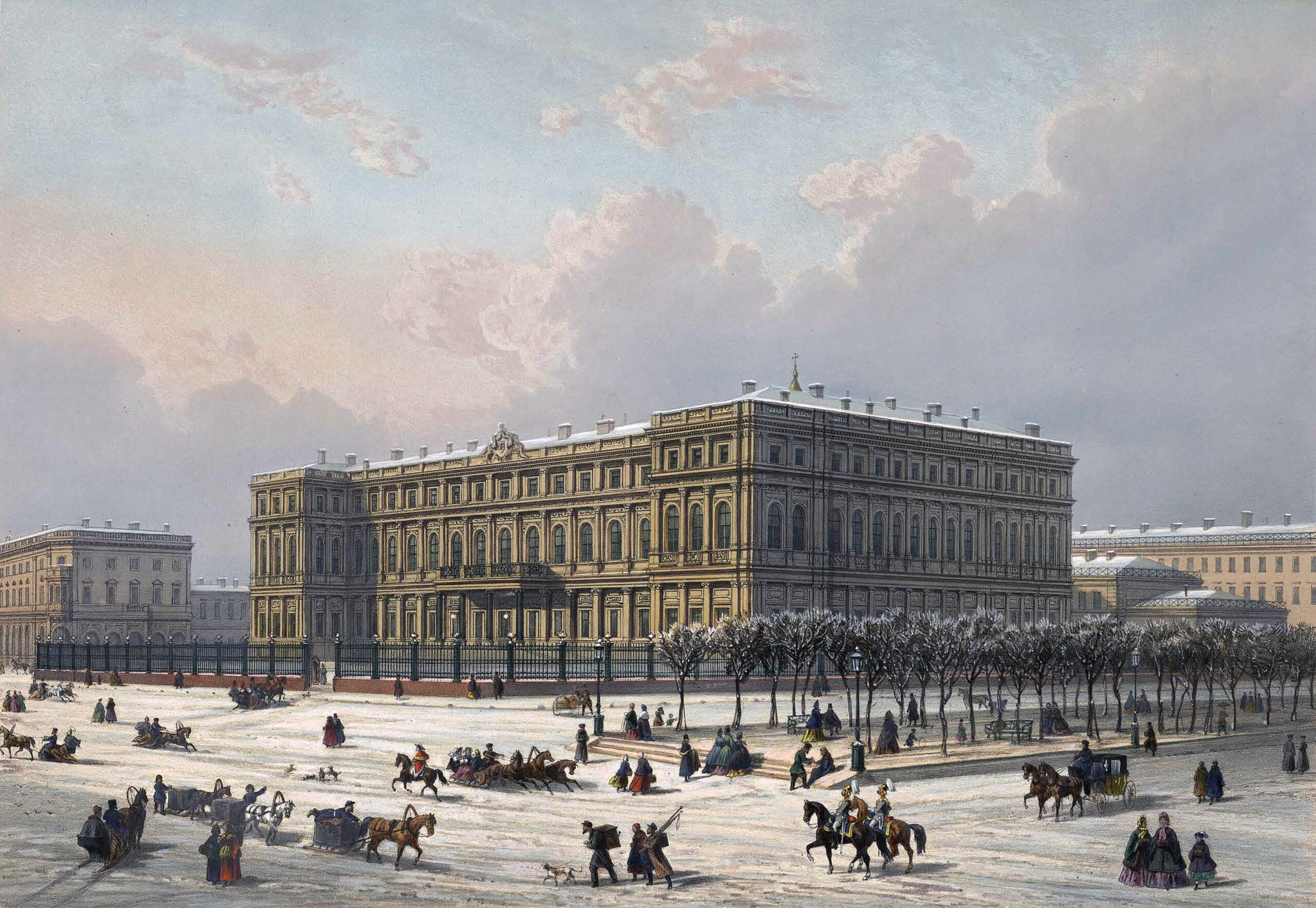
Built for a son of Nicholas I, this Italian Renaissance-styled palace later schooled noble daughters and then housed Soviet trade unions, its marble staircase surviving three very different regimes.
At a glance
Nicholas Palace stands on what is now Labour Square, once Blagoveshchenskaya Square. Andreas Stackensneider designed it for Grand Duke Nikolai Nikolaievich, one of several Petersburg residences he built for the children of Nicholas I. A cast-iron fence still separates the complex from the square. Beyond the main house, a palatial church, a manege, and outbuildings complete the ensemble.
History
Stackensneider worked across mid-nineteenth-century Saint Petersburg, and this commission fit a pattern of grand ducal residences he raised for the tsar’s family. The palace passed back to the crown in 1894. It reopened as the Kseniinsky Institute for Noble Young Ladies, a school whose corridors the memoirist E. M. Almedingen recalled decades later. She remembered frescoed dormitories and a porter in scarlet and gold guarding doors of carved wood and cut glass. After the revolution the Bolsheviks renamed the building the Palace of Labour and gave it to the trade unions. They stripped away parts of the eclectic interior to fit their own offices. By 2004 much of the space was sublet to commercial tenants, a use that has continued since.
What you see
Stackensneider gave the façade an Italian Renaissance treatment, making the palace the dominant landmark on its square. The house church sits in the eastern wing, facing the garden. Leftover brick and stone from St. Isaac’s Cathedral were reused to finish the vestibule. Seventeen paintings by Nikolai Tikhobrazov line the staircase. On the first floor an enfilade opens with the White Drawing Room, its moulded overdoors and painted panels leading through a Small Dining Room to the Chinese Drawing Room. The Rose Drawing Room anchors the west façade, its ceiling painted with “The Judgement of Paris.” Upstairs, the Ballroom and a Banqueting Room rise seventeen metres, the Dancing Hall carrying sculptural work by Iensen. Andrei Tour supplied furniture for the state rooms.
Cultural significance
Few Petersburg interiors carry so vivid a first-person account of daily life within them. Almedingen’s memoir turns the White Hall and its Corinthian pillars into something closer to lived memory than architectural description. The building’s successive identities as ducal residence, girls’ institute, and trade-union headquarters trace the shifting priorities of Russian institutions across a single structure. That layering, rather than any one moment, is the palace’s real inheritance.
Key facts
- Architect: Andreas (Andrei) Stackensneider, 1802–65
- Original occupant: Grand Duke Nikolai Nikolaievich of Russia
- Later use: Kseniinsky Institute for Noble Young Ladies, from 1894
- Soviet-era name: Palace of Labour (Dvorets truda)
- Location: Labour Square, Saint Petersburg
- Heritage-listed structure
Practical information & getting there
The palace sits on Labour Square in central Saint Petersburg, easily reached on foot from the Admiralty and St. Isaac’s Cathedral. Much of the interior now serves commercial tenants rather than the public, so access to the historic rooms is limited. Check current signage and any posted visiting arrangements before planning a stop, since the building’s function continues to shift.
Sources & resources
Find it on the map
See this place and what’s around it →📷 Become a Cultural Heritage Online photographer
Share your photos of places: they stay published under your name as the author. The more they're seen, the more you get noticed — and soon a contest will reward the most appreciated photos.
Log in or sign up free to add a photoIs this page about you?
This page is read by travellers and heritage enthusiasts who find it on Google. Tell us how you are connected to this place and we will take it from there.