
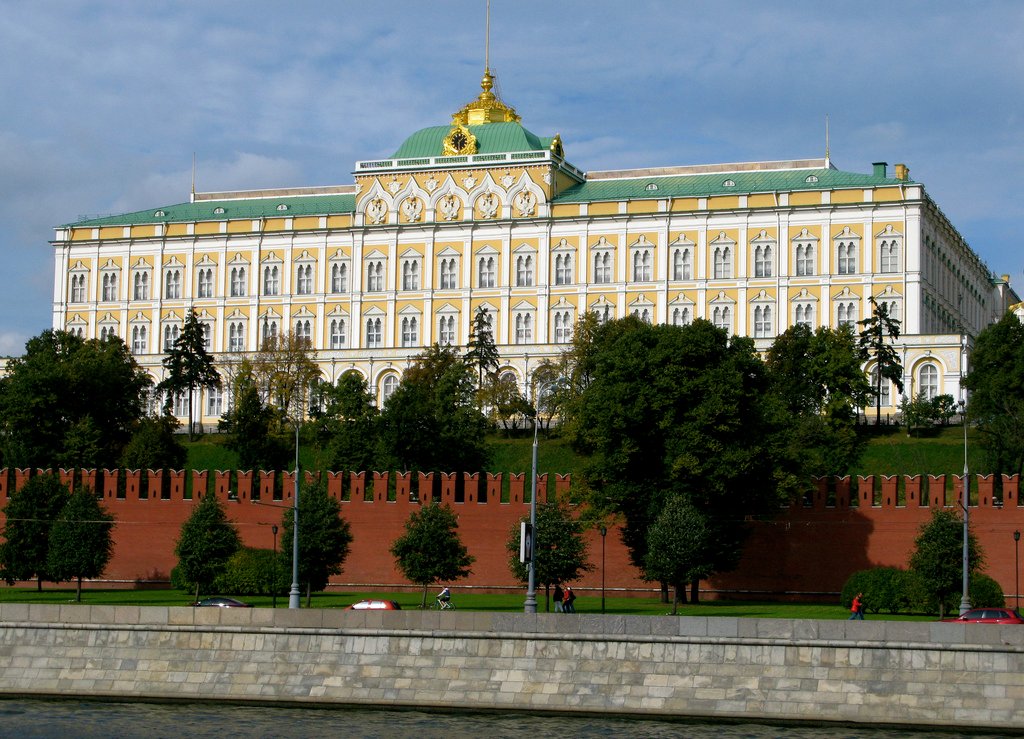
Built to proclaim the might of Russian autocracy, this sprawling Kremlin residence still functions as the working seat of Russia’s presidency, its gilded halls opening only rarely to visitors.
At a glance
Raised on Borovitsky Hill between 1837 and 1849, the Grand Kremlin Palace replaced an earlier Baroque residence attributed to Rastrelli. Konstantin Thon, the architect behind the Kremlin Armoury and the Cathedral of Christ the Saviour, led its design in a Russian-Byzantine idiom. The building runs 124 metres long and rises 47 metres, folding more than 700 rooms into roughly 25,000 square metres.
History
The site carried centuries of Muscovite history before Thon’s crews arrived. Demolition cleared not only the old tsarist palace but also the 16th-century Church of St. John the Baptist, itself built where Moscow’s very first church had stood. The new palace absorbed rather than erased the past: it incorporates the earlier Terem Palace and nine churches spanning the 14th to 17th centuries. In the 1930s the small Church of the Saviour on Bor, once standing in the inner courtyard, was torn down. Soviet authorities later merged two ceremonial halls for use by the Supreme Soviet, only for lavish 1990s restorations to return them to Thon’s original scheme.
What you see
Behind a deceptively three-storey façade lie just two floors, the upper one tall enough for double tiers of windows. Thon enlarged the window framing of the older Terem Palace into arched openings with narrow piers, lending the ground floor the rhythm of an enclosed gallery. Above, pilasters and carved white-stone platbands echo 17th-century Russian ornament. A grand staircase of 66 steps, cut from Revel stone and flanked by artificial-marble walls and Serdobol marble columns, forced the main entrance off-centre into the eastern range. Five state halls — Georgievsky, Vladimirsky, Aleksandrovsky, Andreyevsky and Ekaterininsky — take their names from imperial orders, each dressed in its own iconography of stars, ribbons and monograms.
Cultural significance
The palace was conceived as architecture-as-statement, a physical assertion of tsarist power. Its symbolism proved durable. Bas-reliefs of the double-headed eagle and the arms of Moscow, St Petersburg, Kazan, Astrakhan, Poland and Tavrida were stripped after 1917 and replaced with Soviet insignia. Georgievsky Hall hosted a reception for servicemen after the 1945 Victory Parade. Today the Hall of the Order of St. Andrew stages presidential inaugurations, and the Vladimirsky Hall remains a venue for signing international treaties, binding the building’s ceremonial past to Russia’s present statecraft.
Key facts
- Location: Moscow Kremlin, Russia
- Built: 1837–1849 (inception 1838)
- Architect: Konstantin Thon
- Style: Byzantine Revival and Russian Revival architecture
- Dimensions: 124 m long, 47 m high, c. 25,000 m² total area
- Rooms: over 700, including five named order halls and nine historic churches
- Heritage status: listed
- Current use: official working residence of the President of Russia and a museum
Practical information & getting there
The palace sits inside the Moscow Kremlin, reachable on foot from Sobornaya Square via the Annunciation Entrance. Because it remains an active presidential residence, you cannot simply walk in. Tours run only during gaps in official events, arranged in advance through the Head of the Commandant’s Office of the Moscow Kremlin. Visitors on approved tours may see the Faceted Chamber, the Terem Palace rooms, the Private Half of the Imperial Family and most ceremonial order halls, though Catherine Palace, the Emperor’s study and the Golden Chamber of Tsaritsyno stay off the itinerary. Check the official Kremlin website before planning a visit.
Sources & resources
Find it on the map
See this place and what’s around it →📷 Become a Cultural Heritage Online photographer
Share your photos of places: they stay published under your name as the author. The more they're seen, the more you get noticed — and soon a contest will reward the most appreciated photos.
Log in or sign up free to add a photoIs this page about you?
This page is read by travellers and heritage enthusiasts who find it on Google. Tell us how you are connected to this place and we will take it from there.