
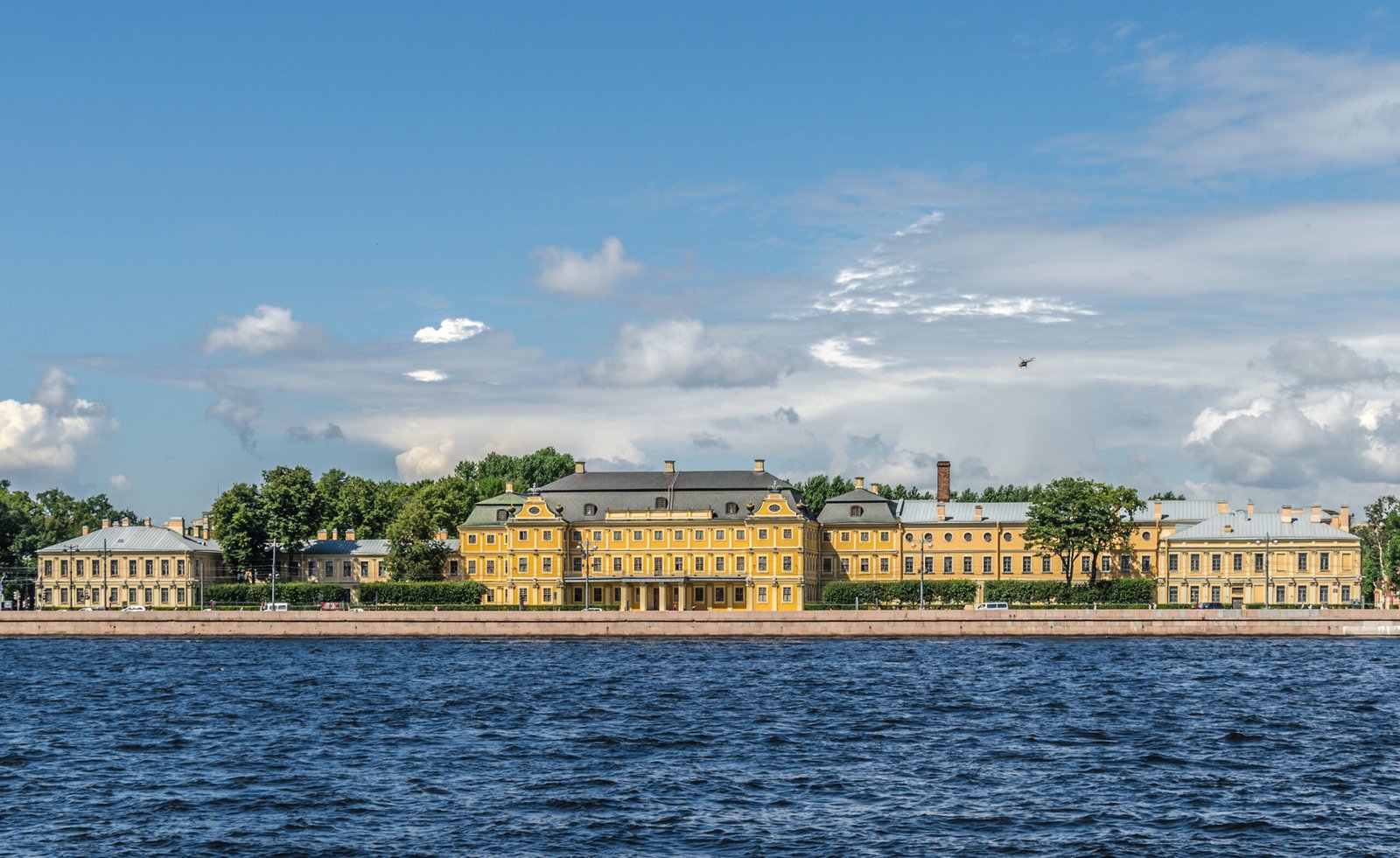
On Vasilyevsky Island’s granite embankment stands the first grand stone house of Peter the Great’s Saint Petersburg, built for his most powerful courtier and now a quiet outpost of the Hermitage.
At a glance
The Menshikov Palace is a Petrine Baroque residence on Universitetskaya Embankment, facing the Bolshaya Neva. Founded in 1710, it belonged to Alexander Menshikov, governor general of the young capital and closest confidant of Peter I. Since 1981 it has operated as a branch of the State Hermitage Museum, displaying Russian decorative art of the late 17th and early 18th centuries.
History
Work began in 1710, barely seven years after the city itself was founded. Italian architect Giovanni Maria Fontana raised the first structure, opened for use as early as 1711. Construction dragged on for another sixteen years. German architect Gottfried Johann Schädel later took charge of the project, with Domenico Trezzini, Bartolomeo Rastrelli, Georg Johann Mattarnovy and Jean-Baptiste Le Blond all lending a hand at various points. Then, in 1727, everything changed. Menshikov fell from favour, his property was confiscated, and he was exiled to Siberia with his family. The palace passed to the state. From 1731 it housed the First Cadet Corps, a military school, and by the late 19th century it had been restored to serve as that institution’s own museum. History returned dramatically in the summer of 1917, when the First All-Russian Congress of Soviets of Workers’ and Soldiers’ Deputies met within its walls. The building’s collections were transferred to the Hermitage and other museums in 1924. A long restoration between 1956 and 1981 finally prepared the palace for its present role as a public museum.
What you see
The palace exemplifies Petrine Baroque, the restrained early style favoured by Peter I as a deliberate break from old Muscovite forms. Its facade along the embankment is disciplined and symmetrical, closer to the Dutch and North German houses Peter admired than to later Rastrelli extravagance. Inside, the state rooms retain period decoration reconstructed through decades of careful restoration. Walnut panelling and Delft tile stoves recall the taste of a Russian elite newly oriented toward Western Europe. Corridors feel narrow by later imperial standards. That scale is itself a historical document, a reminder that this was still a young capital finding its architectural voice.
Cultural significance
Few surviving buildings capture the ambitions and dangers of Petrine Russia so directly. Menshikov’s palace was, for a time, the grandest private residence in the new capital, a display of the wealth and influence one man could accumulate at Peter’s side. Its confiscation is a lesson in the risks of that same proximity to power. The 1917 Congress of Soviets adds another layer, briefly making this Baroque interior a stage for revolutionary politics. As a Hermitage branch, the palace now anchors Vasilyevsky Island’s museum quarter and preserves decorative arts that might otherwise have been scattered.
Key facts
- Location: Universitetskaya Embankment, Vasilyevsky Island, Saint Petersburg
- Founded: 1710; construction continued until 1727
- Architects: Giovanni Maria Fontana, later Gottfried Schädel, with contributions from Trezzini, Rastrelli, Mattarnovy and Le Blond
- Style: Petrine Baroque
- Later use: First Cadet Corps (from 1731); site of the 1917 Congress of Soviets
- Museum status: Branch of the State Hermitage Museum since 1981
- Heritage protection: Listed heritage site
Practical information & getting there
You will find the palace on Vasilyevsky Island, close to other Hermitage buildings and the Kunstkamera. It sits within easy walking distance of Vasileostrovskaya metro station. As a Hermitage branch, entry follows the main museum’s ticketing and seasonal hours, so check the official listing before visiting. The embankment setting rewards a slow approach on foot, with views across the Neva toward the historic centre.
Sources & resources
Find it on the map
See this place and what’s around it →📷 Become a Cultural Heritage Online photographer
Share your photos of places: they stay published under your name as the author. The more they're seen, the more you get noticed — and soon a contest will reward the most appreciated photos.
Log in or sign up free to add a photoIs this page about you?
This page is read by travellers and heritage enthusiasts who find it on Google. Tell us how you are connected to this place and we will take it from there.