
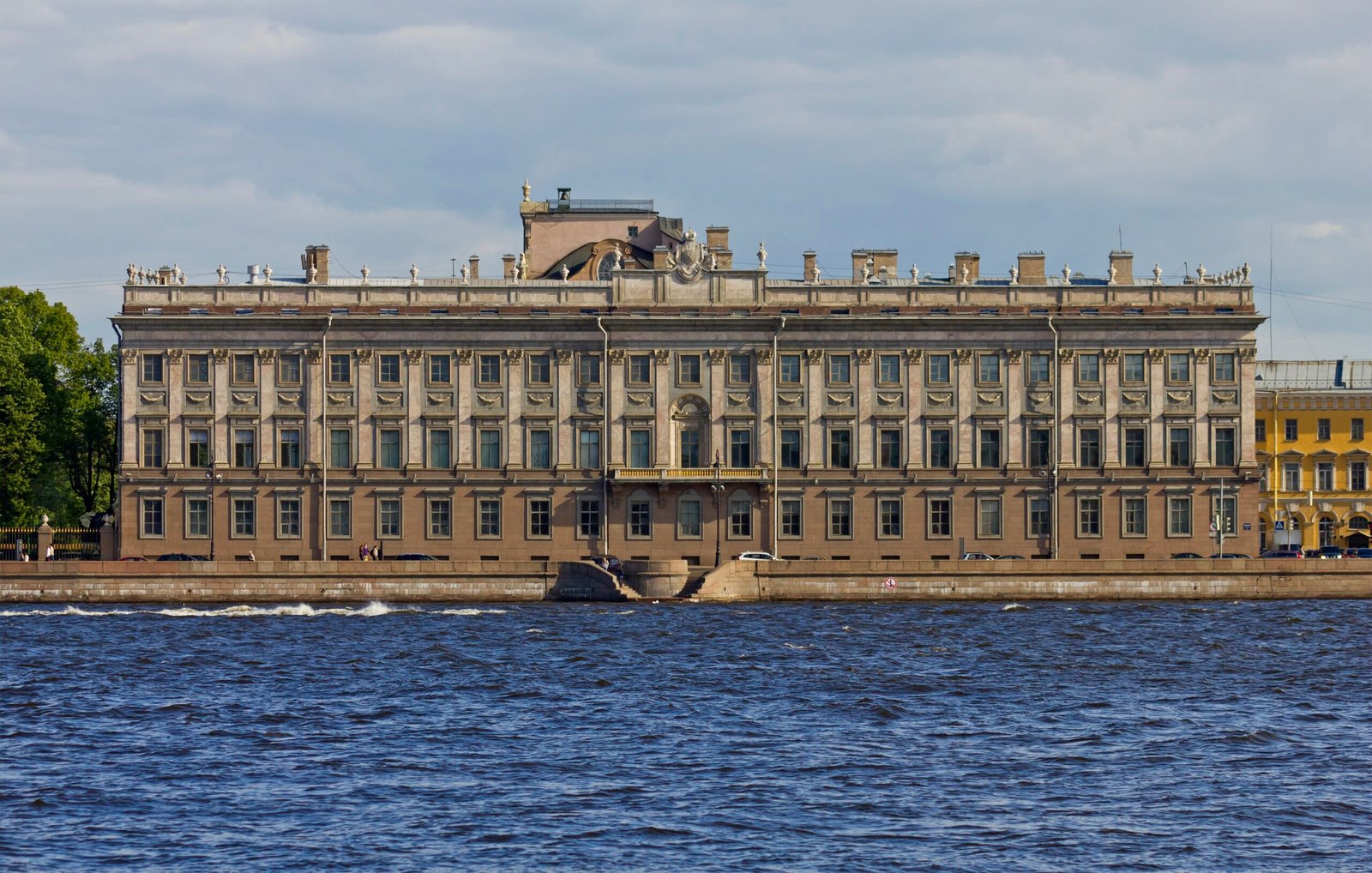
A gift of empire and affection, this palace between the Field of Mars and the Neva embankment was among the first Neoclassical buildings in Saint Petersburg.
At a glance
Catherine the Great commissioned the palace for her favourite, Count Grigory Orlov. Antonio Rinaldi, fresh from work on the royal palace at Caserta, designed it. Construction ran from 1768 for seventeen years. It now serves as a branch of the Russian State Museum.
History
Orlov never lived to see the finished building; the palace passed through a succession of Romanov hands after his death. Stanisław II Augustus, the last king of Poland, leased it briefly in 1797–1798. It later belonged to Grand Duke Constantine Pavlovich and his descendants. In 1843 Grand Duke Constantine Nikolayevich had it substantially reworked by architect Alexander Brullov, sparing only the main staircase and the Marble Hall. After the revolution the building cycled through Soviet institutions: the Ministry of Labour, the Academy of Material Culture, and, from 1937 to 1991, the main Leningrad branch of the Lenin Museum. For decades an armoured car once used by Lenin stood on display in its courtyard.
What you see
The name comes from its decoration. Thirty-two shades of marble cover the exterior and interior surfaces. Rough Finnish granite anchors the ground floor. Above it, polished pink Karelian marble pilasters rise beside white Urals-marble capitals and festoons. Bluish-grey veined marble panels mark the divisions between floors, and dolomite from Tallinn was carved into ornamental urns. The plan is trapezoidal, and each of the four facades carries a distinct design despite strict internal symmetry. Sculptors and painters including Fedot Shubin, Mikhail Kozlovsky and Stefano Torelli worked on the interior decoration. The recessed courtyard now holds an equestrian statue of Alexander III by Paolo Troubetzkoy, moved here from its original site before the Moscow Railway Station.
Cultural significance
Few buildings trace Russia’s political turns so plainly in one shell. Imperial gift, aristocratic residence, exiled king’s lodging, revolutionary shrine, museum. The palace absorbed each role without losing its marble skin. It stands as one of the earliest and most complete expressions of Neoclassicism in the city Peter the Great built.
Key facts
- Architect: Antonio Rinaldi
- Construction began: 1768; work lasted 17 years
- Style: Neoclassical, Classicism
- Commissioned by: Catherine the Great, for Count Grigory Orlov
- 1843 renovation: Alexander Brullov, for Grand Duke Constantine Nikolayevich
- Current use: branch of the Russian State Museum
- Heritage status: officially protected
Practical information & getting there
The palace stands between the Field of Mars and Palace Quay, just east of the New Michael Palace, in central Saint Petersburg. It is walkable from the Hermitage and Palace Square. You can visit the permanent exhibitions inside as part of the Russian Museum network; check current opening times before travelling.
Sources & resources
Find it on the map
See this place and what’s around it →📷 Become a Cultural Heritage Online photographer
Share your photos of places: they stay published under your name as the author. The more they're seen, the more you get noticed — and soon a contest will reward the most appreciated photos.
Log in or sign up free to add a photoIs this page about you?
This page is read by travellers and heritage enthusiasts who find it on Google. Tell us how you are connected to this place and we will take it from there.