
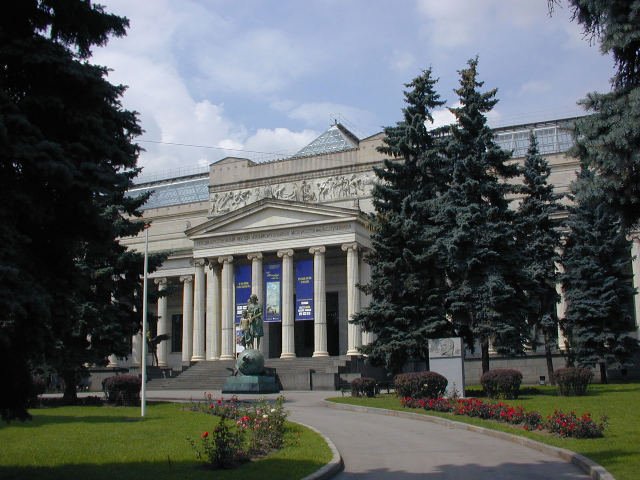
Facing the Cathedral of Christ the Saviour on Volkhonka street, this columned palace of plaster casts and old masters grew from one professor’s obsession with antiquity into Russia’s largest collection of European art.
At a glance
Opened in 1912 as the Alexander III Museum, it was designed by architect Roman Klein with engineering input from Vladimir Shukhov and Ivan Rerberg. Renamed for Alexander Pushkin in 1937, on the centenary of his death, it now holds roughly 700,000 objects spanning Byzantine icons to modern sculpture.
History
Ivan Tsvetaev, director of the Rumyantsev Museum and father of poet Marina Tsvetaeva, spent years persuading philanthropist Yuriy Nechaev-Maltsov to fund a fine arts museum for Moscow. Construction ran from 1898 to early 1912. The Bolshevik Revolution scattered its holdings; French Impressionist works were seized and stored away for decades before some returned in 2019. In 2016 researchers found 59 Italian Renaissance sculptures inside the collection, missing from Berlin since the Second World War. In March 2022 several deputy directors resigned over Russia’s invasion of Ukraine.
What you see
Klein’s building presents a classical Ionic portico, built to house Tsvetaev’s teaching collection of plaster casts alongside genuine antiquities. Inside, the hall of early Italian art opened in 1924. A vast expansion, first entrusted to Norman Foster and later redesigned by Yuri Grigoryan’s studio Project Meganom, aims to knit together a Museum Quarter of surrounding buildings. Heritage campaigners fought to keep a 1930s petrol station on site; it survives, enclosed in glass.
Cultural significance
The museum anchors Moscow’s cultural calendar. Since 1981 it has hosted pianist Sviatoslav Richter’s December Nights festival. Its cast collection, unusual for its completeness, still lets visitors trace European sculpture from antiquity to Rodin. Long-serving director Irina Antonova, in the post from 1961 to 2013, shaped its identity for half a century.
Key facts
- Location: Volkhonka street, Moscow, Russia
- Architect: Roman Klein, with Vladimir Shukhov and Ivan Rerberg
- Founded/opened: 1912 (as the Alexander III Museum)
- Renamed for Pushkin: 1937
- Collection size: around 700,000 objects
- Heritage status: officially protected
Practical information & getting there
The museum sits opposite the Cathedral of Christ the Saviour, an easy walk from central Moscow metro stations. Ongoing reconstruction of the Main Building and surrounding Museum Quarter, planned through the early 2020s, may affect access to some galleries. Check the official website before visiting to confirm which halls and the December Nights festival dates are open.
Sources & resources
Find it on the map
See this place and what’s around it →📷 Become a Cultural Heritage Online photographer
Share your photos of places: they stay published under your name as the author. The more they're seen, the more you get noticed — and soon a contest will reward the most appreciated photos.
Log in or sign up free to add a photoIs this page about you?
This page is read by travellers and heritage enthusiasts who find it on Google. Tell us how you are connected to this place and we will take it from there.