
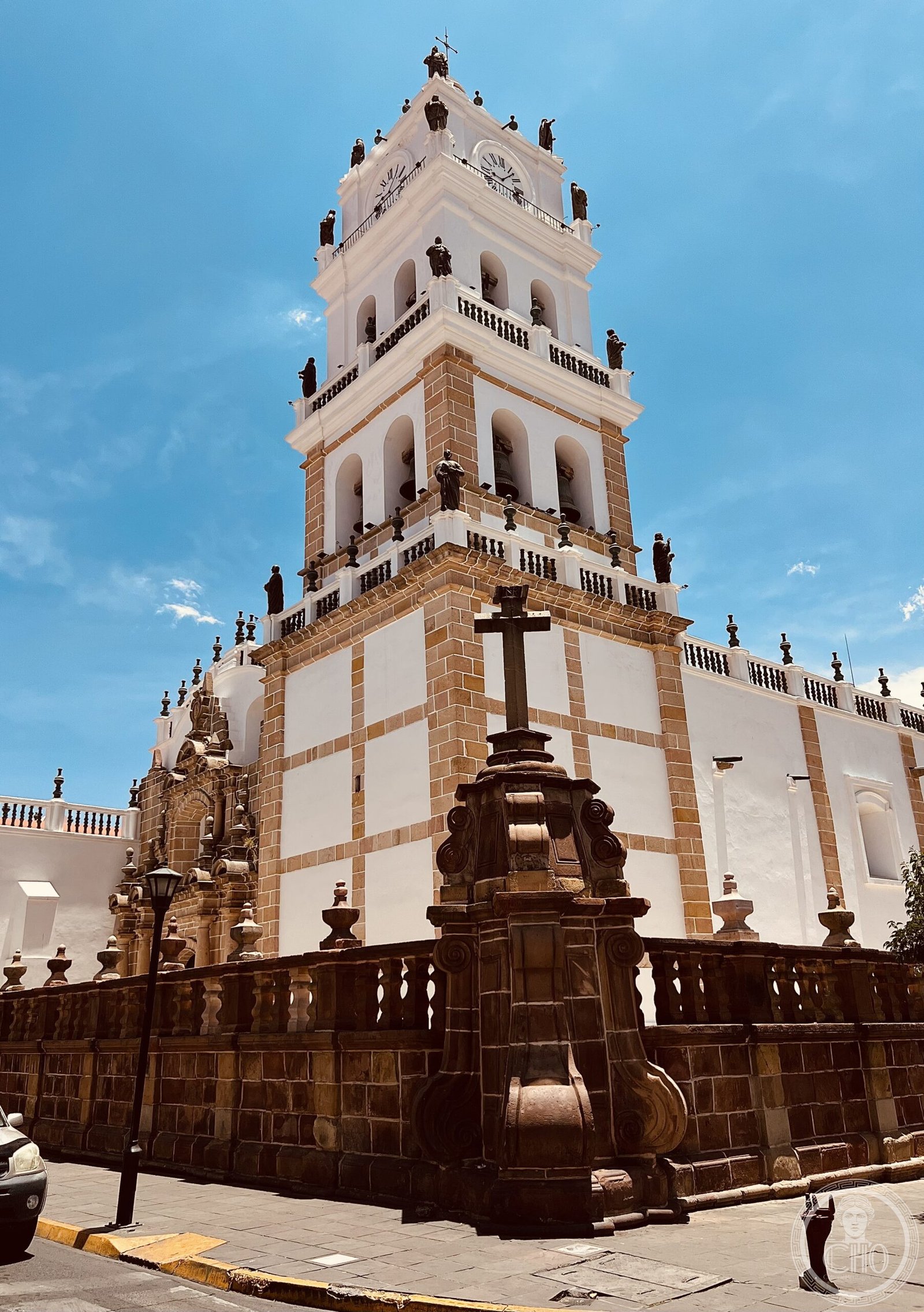
In Sucre, Bolivia, work on the present metropolitan cathedral began in the middle of the sixteenth century, the sources differing between 1551 and 1559 as the starting year, and went on in phases into the 18th century. The nave facing the square, the last section to be completed, carries more Baroque ornament than the older parts. The result is a building that joins styles gathered over time: Renaissance origins, Baroque and Andean «mestizo Baroque» development, with Neoclassical and late Gothic elements in the more recent interior finishes. The bell tower, decorated with terracotta images of the twelve apostles and the four evangelists, holds an English clock ordered in London in 1765 for 568 pounds, installed in 1772 and set going in 1786. Local tradition holds that this clock struck the hour of the rising of 1809. Inside there are a wooden choir carved by Cristobal de Hidalgo and six paintings on the martyrdom of the apostles attributed to a painter the sources call «Montufar», which needs further checking. In the adjoining chapel, built in 1617, the cathedral keeps the venerated image of the Virgin of Guadalupe of Sucre, painted in 1601 by the Hieronymite friar Diego de Ocana on a canvas 1.26 metres by 80 centimetres. In 1784, as the original canvas was tearing under the weight of the jewels given by the faithful over the centuries, it was reinforced with a sheet of gilded silver, leaving visible of the original painting only the faces and hands of the Virgin and the Child. The rest is today metal covered with donated pearls, diamonds, rubies, sapphires, emeralds, topazes and garnets. An inventory of 1784, quoted by press sources and not independently confirmed by a primary academic source, speaks of 10,565 pieces of jewellery, and the Catholic press in Spanish calls it «the richest image in America», a claim to be given with its attribution and not as established fact. There is no documented separate monstrance of that name: the gem-covered object is the painted image itself, not a distinct liturgical vessel. The diocese of La Plata, or Charcas, was erected on 27 June 1552 by Pope Julius III as a suffragan of Lima, and on 20 July 1609 Pope Paul V raised it to a metropolitan archdiocese, making it one of the oldest and most important archiepiscopal seats of colonial South America. It was renamed archdiocese of Sucre on 11 November 1924, after the city changed its name from La Plata, or Chuquisaca, to Sucre, in honour of the independence hero Antonio Jose de Sucre. In 2022 Pope Francis granted the cathedral the title of «Primate» of Bolivia, making it the highest-ranking ecclesiastical seat in the country. The present archbishop is Monsignor Ricardo Ernesto Centellas Guzman, in office since 2020. A recurring confusion in tourist sources should be corrected: the declaration of independence of Bolivia, on 6 August 1825, was signed not in the cathedral but in the Casa de la Libertad next door, on the same Plaza 25 de Mayo. The genuine historical link of the cathedral is with the earlier revolution of Chuquisaca of 25-26 May 1809, often called in regional historiography the «first cry of freedom in America», which gave its name to the square in front. Sucre, nicknamed the «White City» for the whitewashed façades of its historic centre, remains the constitutional capital of Bolivia and the seat of the judiciary, while La Paz houses the government. The historic centre of Sucre was inscribed on the UNESCO World Heritage List in 1991, taking in the whole of the colonial religious and civil architecture of the city, of which the cathedral, on the Plaza 25 de Mayo, is part, although it has not been possible to verify whether it is named individually in the official text of the nomination.
About the Metropolitan Cathedral
In Sucre, Bolivia, construction of the current Metropolitan Cathedral began in the mid-16th century — sources vary between 1551 and 1559 as the start year — and continued in phases into the 18th century, with the nave facing the plaza, the last section completed, showing the most Baroque ornamentation relative to the older parts of the building. The result blends styles accumulated over time: Renaissance origins, Baroque and Andean “mestizo Baroque” development, with Neoclassical and later Gothic elements in more recent interior finishes.
Key facts
- 1551/1559-18th century: the cathedral built in phases over roughly two centuries.
- 1601: Fray Diego de Ocaña paints the Virgin of Guadalupe of Sucre, later encrusted with thousands of donated jewels.
- 20 July 1609: elevated to a metropolitan archdiocese, among South America’s earliest.
- 25-26 May 1809: the Chuquisaca Revolution, “Spanish America’s first cry for independence,” breaks out on the adjoining plaza.
- 1991: Sucre’s historic center, including this cathedral, inscribed as a UNESCO World Heritage Site.
- 2022: Pope Francis grants the cathedral the title “Primada,” Bolivia’s senior ecclesiastical seat.
History
Built in phases across two centuries of colonial rule, the cathedral became one of South America’s earliest metropolitan archdioceses in 1609, and stands on the plaza where the 1809 Chuquisaca Revolution — not Bolivia’s 1825 independence declaration, signed next door at the Casa de la Libertad — first rang out against Spanish rule. Its true treasure, though, is inside: a 1601 painted image of the Virgin of Guadalupe of Sucre, its canvas so thickly overlaid with donated jewels over the centuries that it had to be reinforced with gilded silver in 1784, leaving only the Madonna’s painted face and hands visible amid the gems.
What you see
A bell tower decorated with terracotta apostles and evangelists houses an English clock installed in 1786, while inside, a carved wooden choir and paintings of the apostles’ martyrdoms surround the jewel-covered Virgin of Guadalupe in her 1617 chapel. The plaza-facing nave, the last part built, carries the richest Baroque ornamentation of the whole complex.
Practical information
- Opening hours: generally open daily outside services; check current hours before visiting.
- Address: Plaza 25 de Mayo, corner of Calle Nicolás Ortiz, Sucre, Chuquisaca, Bolivia.
Getting there
The cathedral stands on Plaza 25 de Mayo, the heart of Sucre’s historic center, next to the Casa de la Libertad. GPS: 19°02′55″S, 65°15′37″W.
Nearby
- Casa de la Libertad — the adjoining building where Bolivia’s independence was actually declared in 1825.
Sources
- Wikipedia (English and Spanish) — “Metropolitan Cathedral of Sucre” and “Roman Catholic Archdiocese of Sucre”
- Correo del Sur — “Catedral Primada de Sucre,” 24 July 2022 (correodelsur.com).
- Aleteia (Spanish edition) — “Virgen de Guadalupe de Sucre: por qué es la imagen más rica de América”
- UNESCO World Heritage Centre — “Historic City of Sucre,” inscribed 1991.
Find it on the map
See this place and what’s around it →📷 Become a Cultural Heritage Online photographer
Share your photos of places: they stay published under your name as the author. The more they're seen, the more you get noticed — and soon a contest will reward the most appreciated photos.
Log in or sign up free to add a photo