
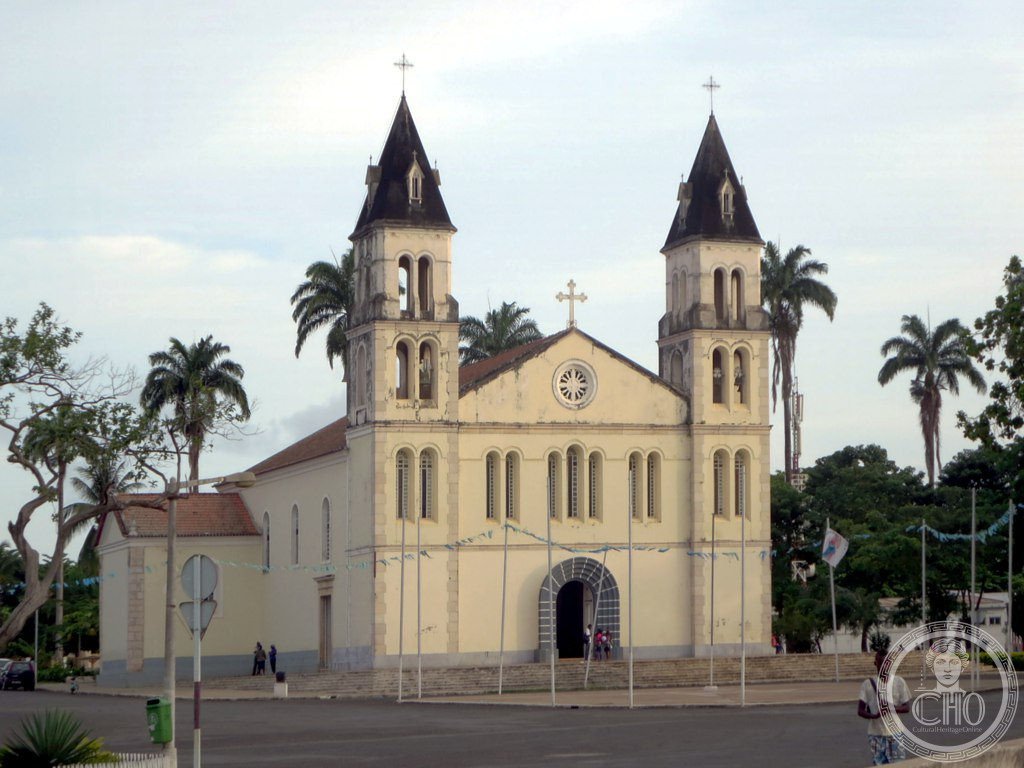
In the city of São Tomé, capital of São Tomé and Príncipe, a first church dedicated to Nossa Senhora da Graça was built in the late 15th century, near the defensive tower raised by Captain Álvaro de Caminha in 1492-93. A single source gives 1504 as the year of foundation by Augustinian missionaries, but that is not confirmed elsewhere. On 3 November 1534 Pope Paul III, with the bull «Aequum reputamus», established the diocese of São Tomé, then one of the largest sees ever created, reaching from Cape Palmas, in present-day Liberia, to the Cape of Good Hope, and raised the parish church to a cathedral. That date, often quoted as the «foundation» of the building, in fact refers to the establishment of the diocese and not to the construction of the church. The cathedral was rebuilt between 1576 and 1578 under King Sebastian of Portugal, with the works carried on under Philip II but abandoned in 1585, leaving only a temporary wooden façade. Further rebuildings followed in 1784, when the building was found in a precarious state with its façade in ruins, in 1814, rebuilt on the initiative of the inhabitants themselves, and finally in 1956, with a major restoration that gave it the present eclectic Romanesque Revival façade. The interior is known for its decoration in azulejos, the characteristic Portuguese blue tiles. No source explicitly documents a fire at the cathedral, but in 1599 a Dutch attack sacked the city and burned several churches, and the Dutch occupied the island between 1641 and 1648, circumstances compatible, though not directly documented, with the repeated rebuildings of the church. São Tomé was the site of the first large-scale tropical plantation economy based on sugar monoculture and on the labour of enslaved people, a model later exported to Brazil and to the Americas. By the Thirties of the sixteenth century the island was the largest producer of sugar for the European market, ahead of Madeira, before a decline that began in the Eighties of that same century with the growth of the Brazilian plantations. It became an important hub for the transshipment of enslaved people, with period estimates of some 10,000-12,000 people imported in 1510 and 4,072 received in 1516 for re-export. No source documents a direct link between the cathedral building and the slave trade beyond the general colonial context. The most explicit connection comes from the visit of Pope John Paul II, on 6-7 June 1992, who in the course of his apostolic journey called the institution of slavery a cruel offence against the dignity of the African people. The territory of the diocese was progressively reduced between 1596 and 1842 with the creation of neighbouring dioceses. It was renamed diocese of São Tomé in 1924 and finally diocese of São Tomé and Príncipe in 1957. The present bishop is Monsignor João de Ceita Nazaré, in office since 9 January 2024. According to figures for 2015, about 112,000 people, 57.4 per cent of the population, were Catholic. The cathedral appears in the Portuguese catalogues of architectural heritage, SIPA and HPIP, although no protected status in the national register of São Tomé and Príncipe is confirmed.
About Sé Cathedral
In São Tomé city, capital of São Tomé and Príncipe, a first church dedicated to Nossa Senhora da Graça was built in the late 15th century, near the defensive tower erected by Captain Álvaro de Caminha in 1492-93; a single source dates the church’s founding to 1504 under Augustinian missionaries, though this is unconfirmed elsewhere. On 3 November 1534, Pope Paul III established the Diocese of São Tomé with the bull “Aequum reputamus” — then one of the largest sees ever created, stretching from Cape Palmas in modern Liberia to the Cape of Good Hope — elevating the parish church to cathedral status; this date, often cited as the building’s “founding,” actually refers to the diocese’s establishment, not the church’s construction.
Key facts
- Late 15th century: a first church built near a fort erected in 1492-93.
- 3 November 1534: São Tomé made a bishopric, the church elevated to cathedral.
- 1576-1578: rebuilt under King Sebastian of Portugal, left with only a wooden façade after 1585.
- 1784, 1814, 1956: further reconstructions, the last giving the current Neo-Romanesque façade.
- 6-7 June 1992: visited by Pope John Paul II, who condemned the slave trade’s legacy on the island.
- 1957: the see renamed the Diocese of São Tomé and Príncipe.
History
Rebuilt roughly every century since 1576 — after abandonment, decay, and possibly the fallout of Dutch attacks that burned churches across the town in 1599 — Sé Cathedral’s own unstable construction history mirrors the turbulence of the island it stands on, once the site of the first large-scale tropical sugar-plantation economy and a major hub for the transatlantic slave trade. Pope John Paul II’s 1992 visit, in which he explicitly condemned that history, remains the clearest documented moment linking the cathedral itself to the island’s darkest chapter.
What you see
The cathedral’s current Neo-Romanesque, eclectic-revival façade dates only to a 1956 remodeling, the latest layer on a building rebuilt repeatedly since 1576. Inside, blue Portuguese azulejo tilework decorates the interior, a recurring feature of colonial-era Portuguese ecclesiastical architecture across the former empire.
Practical information
- Opening hours: generally open daily outside services; check current hours before visiting.
- Address: Praça do Povo, São Tomé city, São Tomé and Príncipe.
Getting there
The cathedral stands on the central square of São Tomé city, near the Presidential Palace, easily reached on foot from the town center. GPS: 0°20′18″N, 6°43′58″E.
Nearby
- Praça do Povo — the central square of São Tomé city, adjacent to the cathedral.
Sources
- Wikipedia — “Our Lady of Grace Cathedral, São Tomé” and “Diocese of São Tomé and Príncipe” (en.wikipedia.org).
- Portuguese Wikipedia — “Sé Catedral de Nossa Senhora da Graça de São Tomé”
- Vatican.va — Apostolic Journey to Angola and São Tomé and Príncipe, June 1992.
- World History Encyclopedia — “The Portuguese Colonization of São Tomé and Principe”
Find it on the map
See this place and what’s around it →📷 Become a Cultural Heritage Online photographer
Share your photos of places: they stay published under your name as the author. The more they're seen, the more you get noticed — and soon a contest will reward the most appreciated photos.
Log in or sign up free to add a photo