
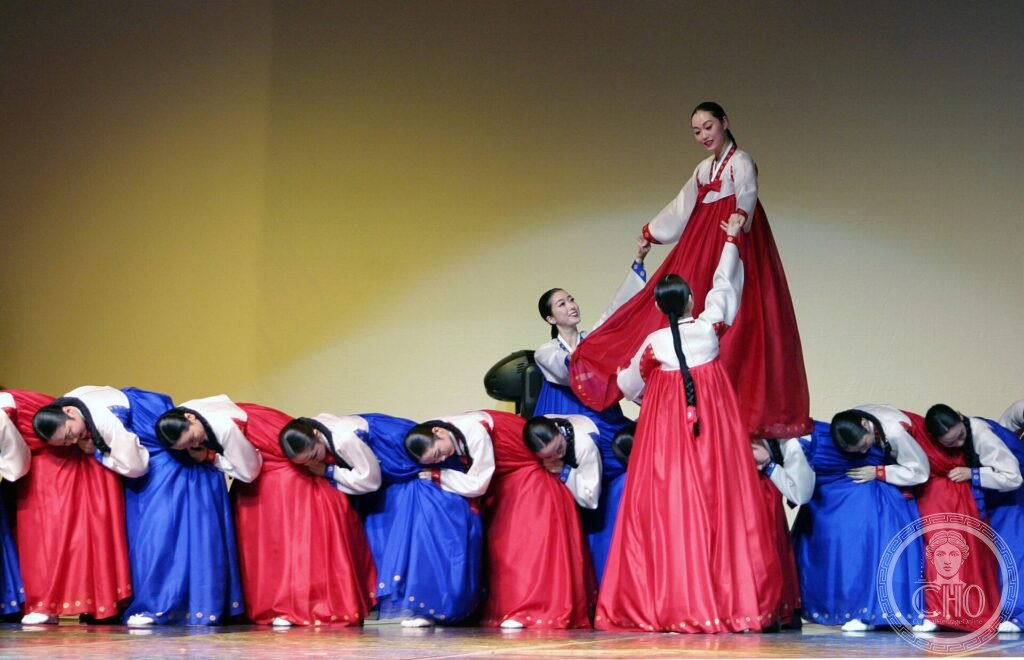
An ancient Korean circle dance performed exclusively by women, combining song, movement, and folk games under the full moon to celebrate harvest and seasonal turning points.
At a glance
Ganggangsullae is a women-only dance tradition rooted in agrarian ritual. Performed in circles that can continue through the night, it weaves together sung melodies, rhythmic footwork, and traditional games into a single flowing celebration. The practice remains strongest in the southwestern coastal province of South Jeolla, particularly in the Jindo and Haenam regions, where regional variations preserve distinct musical and movement vocabularies.
Origins & history
The dance originated as a ritual to bring about bountiful harvests, though the precise age of the practice is not specified in available sources. Over centuries it evolved beyond its agricultural function to become a symbol of Korean cultural identity and women’s community. Ganggangsullae has maintained continuity through oral transmission and seasonal performance, particularly during moments of collective celebration.
The practice
Women gather in circles, often outdoors under moonlight, and begin with a slow, stately form called “Late Ganggangsullae.” The tempo and character shift into “Jajeun-Ganggangsullae,” celebrated for its delicate and feminine expression. In Haenam and Jindo, a third form, “Jung-Ganggangsullae,” adds local complexity. Throughout the night, dancers move in synchronized patterns while singing, and break into folk games that punctuate the continuous circle. The performance is entirely vocal and body-based; no instruments are used.
Cultural significance
Ganggangsullae embodies collective joy and women’s solidarity in Korean culture. Its association with Chuseok (autumn harvest festival) and Daeboreum (first full moon of the lunar year) marks it as a practice tied to seasonal renewal and gratitude. The dance preserves feminine aesthetic values and demonstrates how women’s expressive traditions sustained community bonds across generations.
Key facts
- Performed exclusively by women in circle formations
- Primary region: South Jeolla Province, especially Jindo and Haenam
- Associated festivals: Chuseok and Daeboreum (full moon celebrations)
- UNESCO Intangible Cultural Heritage inscription: 2009 (reference 00188)
- Coordinates of anchor community (Jindo): 34.48593, 126.26111
- No instrumental accompaniment; performed by voice and movement alone
Where to experience it
Jindo and the surrounding region of South Jeolla Province remain the heartland of Ganggangsullae practice. The dance is most commonly performed during Chuseok and Daeboreum celebrations, when communities gather to mark the agricultural and lunar calendar. Specific venues and current performance schedules are best confirmed through local cultural offices or festival programs.
Sources & resources
Find it on the map
See this place and what’s around it →📷 Become a Cultural Heritage Online photographer
Share your photos of places: they stay published under your name as the author. The more they're seen, the more you get noticed — and soon a contest will reward the most appreciated photos.
Log in or sign up free to add a photo