
In March 1000 the emperor Otto III went on pilgrimage to Gniezno to pray at the tomb of Saint Adalbert of Prague, martyred three years earlier. His meeting with Prince Bolesław I the Brave, known to history as the Congress of Gniezno, led to the founding of the archdiocese of Gniezno, the first autonomous ecclesiastical structure in Poland — a recognition that would open the way, just twenty-five years later, to the first coronation of a Polish king in this very cathedral.
About Gniezno Cathedral
Gniezno Cathedral traces its origins to a temple built on a cruciform plan by Mieszko I, Poland’s first historically documented ruler, before 977 — the year his wife, Duchess Dąbrówka, was buried there; this structure itself replaced an earlier 9th-century oratory. The cathedral’s status was transformed by the martyrdom of Saint Adalbert of Prague in 997: his funeral took place at Gniezno in 999, followed swiftly by his canonisation under Pope Sylvester II. In March 1000, Holy Roman Emperor Otto III travelled to Gniezno specifically to pray at Adalbert’s tomb, an occasion that became the Congress of Gniezno — a diplomatic summit with Prince Bolesław I the Brave at which, according to tradition, wide-ranging plans for a renewed order across Germany, France, Rome, England, and the Slavic lands were discussed. Concretely, Otto’s visit led to the establishment of the Archdiocese of Gniezno as Poland’s own primary ecclesiastical authority under direct papal oversight, freeing the young Polish church from dependence on neighbouring German dioceses. This new ecclesiastical independence paved the way for Bolesław I the Brave’s coronation as Poland’s first king at Gniezno on 18 April 1025; three further coronations followed there — Bolesław II in 1076, Przemysł II in 1295, and finally Wenceslaus II in August 1300, the last royal coronation held at Gniezno before Kraków’s Wawel Cathedral took over that role. Among the cathedral’s greatest treasures are the Gniezno Doors, a pair of bronze doors cast around 1175 and comprising 18 panels depicting scenes from the life and martyrdom of Saint Adalbert — widely regarded as among the finest surviving examples of Romanesque metalwork anywhere in Europe. Adalbert’s remains rest today in a silver sarcophagus within the cathedral’s nave. Following fire damage caused by Soviet artillery shelling in 1945, the cathedral was reconstructed during the 1950s and 1960s, with later Baroque additions deliberately removed to restore the building’s medieval Gothic character from its coronation-era heyday.
Key facts
- Before 977: cruciform temple built by Mieszko I; his wife Dąbrówka buried there in 977
- 997/999: Saint Adalbert of Prague martyred; his funeral held at Gniezno in 999
- March 1000: Emperor Otto III’s pilgrimage and the Congress of Gniezno; Archdiocese of Gniezno established
- 18 April 1025: Bolesław I the Brave crowned Poland’s first king at Gniezno
- 1076/1295/1300: further royal coronations of Bolesław II, Przemysł II, and Wenceslaus II
- c. 1175: the bronze Gniezno Doors cast, 18 panels depicting Saint Adalbert’s life
- 1945: cathedral damaged by fire from Soviet artillery shelling
- 1950s-1960s: reconstruction restores the building’s medieval Gothic character
History
Emperor Otto III’s March 1000 pilgrimage to Adalbert’s tomb, and the diplomatic Congress of Gniezno that accompanied it, represents one of the earliest and most consequential moments of formal international recognition for the emerging Polish state — the resulting establishment of an independent Archdiocese of Gniezno freed the Polish church from subordination to German ecclesiastical authority, a prerequisite that helped make Bolesław I the Brave’s own coronation as king, just twenty-five years later in 1025, politically and religiously possible. The cathedral’s role hosting four royal coronations across nearly three centuries, from 1025 to 1300, situates Gniezno as Poland’s original coronation church, a role it held before Kraków’s Wawel Cathedral assumed that function for the kingdom’s later medieval and early modern monarchs.
The 1945 wartime damage and subsequent mid-20th-century restoration, which deliberately stripped away later Baroque additions to recover the cathedral’s medieval Gothic appearance, reflects a broader Polish post-war approach to restoring historically significant national monuments to the specific architectural state associated with their most symbolically important period — in Gniezno’s case, the coronation-era Gothic form the building held during Poland’s own medieval royal history.
What you see
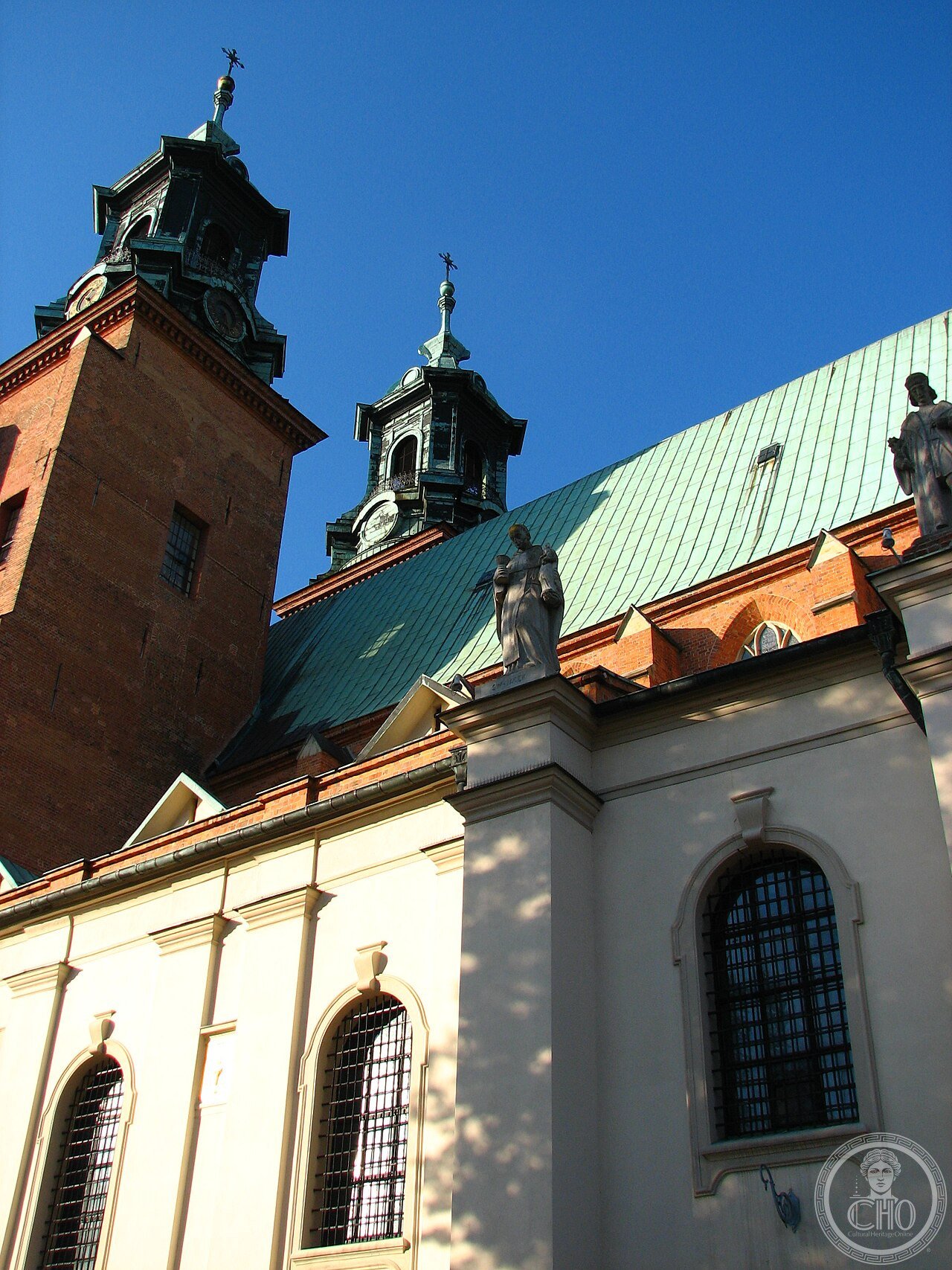
The Gniezno Doors, cast in bronze around 1175 and comprising 18 panels depicting the life and martyrdom of Saint Adalbert, remain one of the finest surviving examples of Romanesque metalwork in Europe. Adalbert’s relics rest in a silver sarcophagus within the cathedral’s nave. The cathedral’s Gothic architecture, restored during the 1950s-1960s reconstruction to remove later Baroque additions, reflects the building’s medieval coronation-era appearance, its prominent towers visible across the historic Wzgórze Lecha (Lech’s Hill) on which it stands.
Practical information
- Opening hours: generally open daily with seasonal variation; check current hours before visiting; free admission
- Address: Wzgórze Lecha, 62-200 Gniezno, Poland
Getting there
Gniezno Cathedral is reachable by car or train from Poznań (approximately 45 minutes) in Greater Poland Voivodeship. GPS: 52.5370° N, 17.5918° E.
Nearby
- Gniezno Archdiocesan Museum — a museum of church treasures, near the cathedral
- Poznań — approximately 45 minutes away; the regional capital
- Lake Jelonek — a lake in central Gniezno, near the historic hill
Sources
- Wikipedia — “Gniezno Cathedral” (en.wikipedia.org)
- Zabytek.pl — “Gniezno – Cathedral of the Assumption of the Blessed Virgin Mary and St Adalbert” (zabytek.pl)
- Wielkopolska.travel — “Cathedral in Gniezno” (wielkopolska.travel)
Find it on the map
See this place and what’s around it →📷 Become a Cultural Heritage Online photographer
Share your photos of places: they stay published under your name as the author. The more they're seen, the more you get noticed — and soon a contest will reward the most appreciated photos.
Log in or sign up free to add a photo