

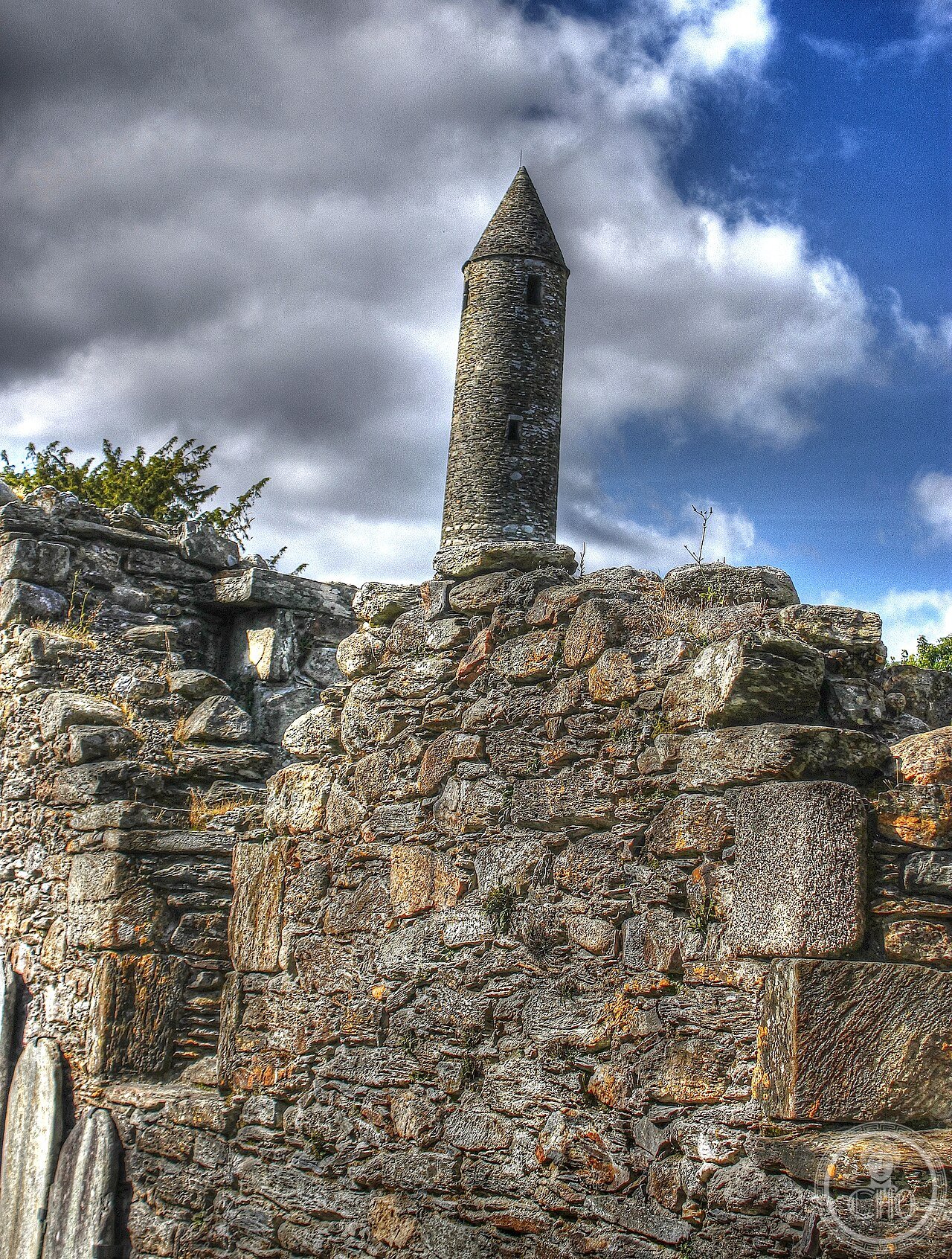
Saint Kevin chose to live as a hermit in a reused Bronze Age tomb, suspended nine metres above the waters of the upper lake of Glendalough. Around his hermitage grew one of the great monastic centres of Ireland: around 1042, oak felled in its woods was used to build what archaeologists identify as the second longest Viking ship ever documented, some thirty metres of hull.
About Glendalough
Glendalough — from the Irish Gleann Dá Loch, “Valley of the Two Lakes” — was founded in the 6th century by Saint Kevin (Cóemhghein), a descendant of one of Leinster’s ruling families who studied as a boy under three holy men, Eoghan, Lochan, and Eanna, before seeking retreat from the world. Kevin settled by the shore of the upper lake, taking as his hermitage an artificial cave about nine metres above the water that had originally served as a Bronze Age tomb; his own writings describe his struggles there in terms of fighting “knights,” which scholars interpret as an account of spiritual self-examination and temptation. He died around 618, traditionally on 3 June. Followers drawn to his holiness gradually built a community around his hermitage, which grew over the following centuries into one of the most celebrated monastic centres and pilgrimage destinations in early medieval Europe, its abbots and scholars recorded at length in the Irish annals. Around 1042, oak timber cut from Glendalough’s own woodland was used to build a Viking longship recognised by archaeologists as the second-longest ever recorded, at approximately 30 metres in length — striking evidence of the site’s integration into the wider Norse-Irish world beyond its own monastic seclusion. The Annals of Tigernach record Glendalough being “plundered by the foreigners” in 1176. From 1214, when the dioceses of Glendalough and Dublin were united, the site’s ecclesiastical and cultural standing steadily diminished, and English forces destroyed the settlement in 1398, though it continued afterward as a local parish church and place of pilgrimage.
Key facts
- Foundation: late 6th/early 7th century, by Saint Kevin, who died c. 618
- Kevin’s hermitage: a repurposed Bronze Age tomb cave, 9 metres above the upper lake
- Round tower: approximately 30 metres tall, built 10th-11th century as bell tower, lookout, and refuge from Viking raids
- c. 1042: Glendalough oak used to build the second-longest recorded Viking longship (c. 30 metres)
- 1176: recorded as “plundered by the foreigners” in the Annals of Tigernach
- 1214: diocese united with Dublin, beginning centuries of decline
- 1398: settlement destroyed by English forces; continued after as a local pilgrimage church
History
The detail of Glendalough’s own oak timber being used around 1042 to build one of the largest Viking ships ever archaeologically documented complicates any simple narrative of early Irish monasteries as passive victims of Norse raiding: it suggests instead a site whose natural resources were directly drawn upon within the broader Viking Age maritime economy of the Irish Sea, whether through trade, tribute, or seizure. Saint Kevin’s own choice of an adapted Bronze Age tomb as his hermitage cave situates his foundation within a broader early Irish Christian pattern of consciously repurposing older, pre-Christian sacred or ceremonial sites for new ascetic and monastic purposes.
The 1214 union of the Glendalough and Dublin dioceses, followed by the site’s steady decline and its final destruction by English forces in 1398, traces a trajectory shared by many major early Irish monastic foundations as ecclesiastical authority in Ireland became increasingly centralised under Anglo-Norman and later English control — yet Glendalough’s continued function as a site of local pilgrimage even after its formal destruction reflects the durability of Saint Kevin’s cult among the surrounding population long after the monastery’s institutional importance had faded.
What you see
The round tower, standing roughly 30 metres tall with an entrance 3.5 metres above the ground and originally six internal timber floors connected by ladders, remains the site’s most recognisable structure; its conical roof was rebuilt in 1876. St Peter and St Paul’s Cathedral, the largest building on the site, shows construction phases from its early nave through modifications in the late 12th and early 13th centuries. St Kevin’s Church, popularly known as “St Kevin’s Kitchen,” is notable for its miniature round-tower-style belfry rising from the west end of its stone roof, with a conical cap and four small windows. The wider monastic city also includes a graveyard with numerous carved crosses and cross-slabs, set within the wooded valley between Glendalough’s two lakes.
Practical information
- Opening hours: the monastic site is open daily; visitor centre with seasonal hours; admission fee applies to the visitor centre
- Address: Glendalough, R757, County Wicklow, Ireland
Getting there
Glendalough is reachable by car from Dublin (approximately 1 hour) in County Wicklow, within the Wicklow Mountains National Park. GPS: 53.0109° N, -6.3277° E.
Nearby
- Wicklow Mountains National Park — surrounding the monastic site, with extensive walking trails
- Upper and Lower Lough — the two lakes giving Glendalough its name
- Powerscourt Estate — a historic estate and gardens, within reach in County Wicklow
Sources
- Wikipedia — “Glendalough” (en.wikipedia.org)
- Heritage Ireland — “Glendalough Monastic Site and Visitor Centre” (heritageireland.ie)
- Monastic Ireland — “Glendalough” (monastic.ie)
Find it on the map
See this place and what’s around it →📷 Become a Cultural Heritage Online photographer
Share your photos of places: they stay published under your name as the author. The more they're seen, the more you get noticed — and soon a contest will reward the most appreciated photos.
Log in or sign up free to add a photo