

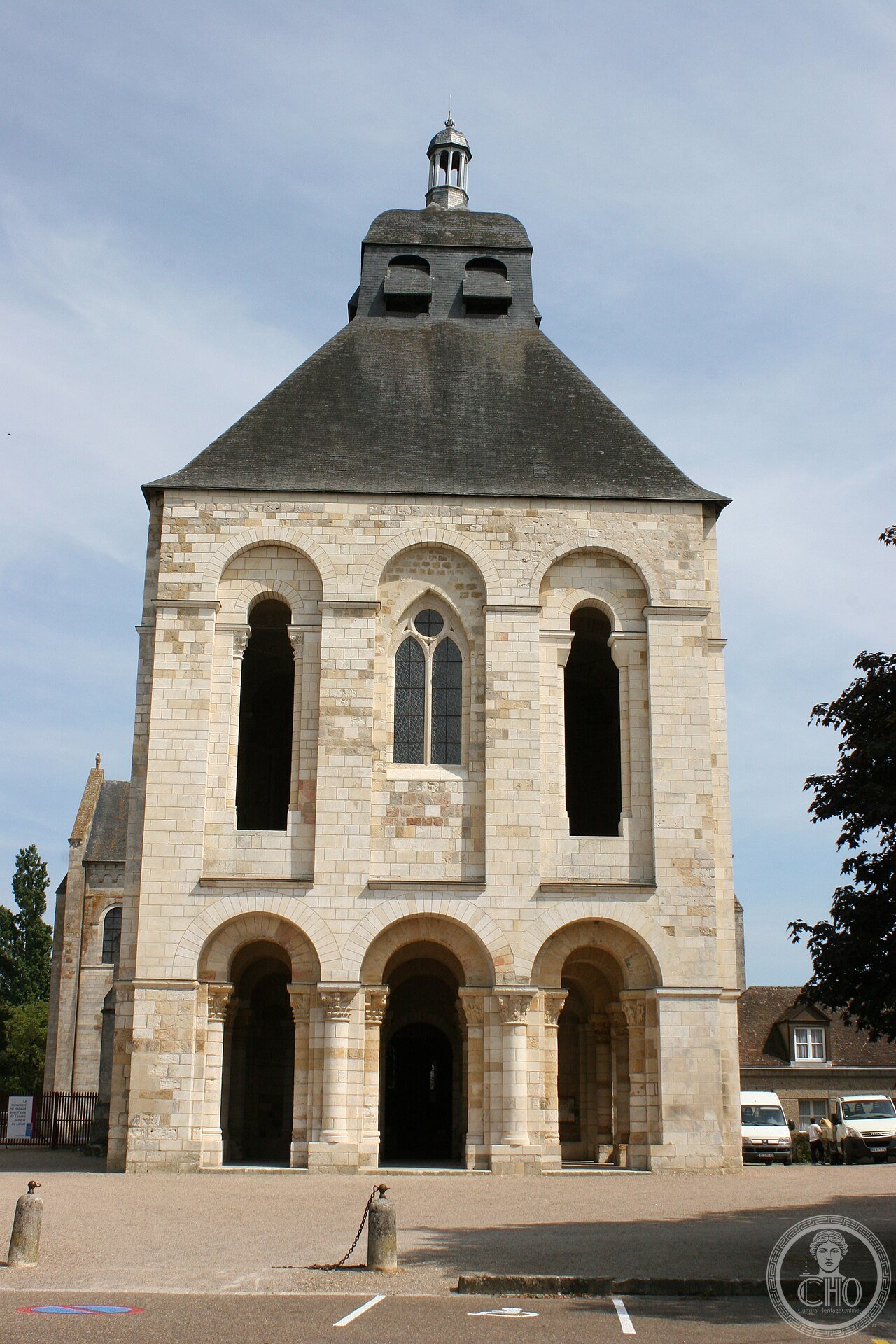
Around 672, by tradition, the second abbot of Fleury, Mummolus, brought the relics of Saint Benedict here from Montecassino, then in ruins after the Lombard devastations of the sixth century. The monks of the Italian abbey, however, have never accepted that version: they hold that the relics of the founder of Western monasticism never left Montecassino. A dispute that has lasted, literally, thirteen centuries.
About Fleury Abbey
Fleury Abbey (Floriacum), in Saint-Benoît-sur-Loire in the Loiret department of France, was founded around 640 and ranks among the most celebrated Benedictine monasteries of Western Europe, renowned above all for its claimed possession of the relics of Saint Benedict of Nursia, founder of Western monasticism. According to tradition, Mommolus, the abbey’s second abbot, effected the relics’ transfer from the Abbey of Monte Cassino in Italy around 672, after that founding Benedictine house had fallen into ruin following the Lombard devastations of the 6th century. The claim has never gone uncontested: monks of the Italian monastery at Monte Cassino — itself founded personally by Benedict — dispute the story entirely, maintaining that their founder’s relics never left Monte Cassino at all, a disagreement that has persisted for well over a millennium. Whatever the truth of the relics’ actual location, their claimed presence at Fleury brought the abbey immense medieval prestige and pilgrim traffic. The abbey stands today as a masterpiece of Romanesque architecture, its monks having played a central role in the religious life of the surrounding community for centuries. At the north door, a tympanum from the end of the 12th century depicts Christ’s teaching to the evangelists and apostles, with a lintel below portraying the transfer of Saint Benedict’s relics from Monte Cassino to the abbey — an iconographic representation considered exceptional within the Centre-Val de Loire region and a major work of Romanesque sculpture in its own right.
Key facts
- Foundation: c. 640
- Relic transfer claim: c. 672, by second abbot Mommolus, from a ruined Monte Cassino
- Disputed status: Monte Cassino’s own monks maintain the relics never left Italy — an unresolved dispute lasting over 1,300 years
- Architectural style: a masterpiece of Romanesque architecture
- North door tympanum: late 12th century, depicting Christ teaching the apostles, with a lintel showing the relics’ transfer from Monte Cassino
- Regional significance: an exceptional iconographic work within Centre-Val de Loire
History
The Fleury-Monte Cassino relic dispute represents one of medieval Christendom’s longest-running and most historically significant disagreements over a major saint’s actual physical remains, its origins tracing directly to the genuine chaos and destruction the original Monte Cassino community suffered following 6th-century Lombard raids — a period of real institutional crisis at Benedict’s own founding monastery that made claims of relic relocation to safer French territory at least superficially plausible, even if Monte Cassino’s own monks have never accepted the account. Unlike Conques’s well-documented, deliberately clandestine theft of Sainte Foy’s relics from Agen, Fleury’s claim rests on a rescue narrative framed as pious preservation during a period of genuine monastic crisis rather than covert theft from a functioning rival institution — a distinction that shaped how each community’s claim was subsequently received and contested.
The north portal’s late-12th-century tympanum, explicitly depicting the relics’ transfer in its lintel imagery, demonstrates how thoroughly Fleury’s own community had institutionally committed to and publicly proclaimed its version of events by the high medieval period, using major architectural sculpture to visually reinforce a historical claim that remained genuinely contested by the rival Italian community. This centuries-long, unresolved dispute over Saint Benedict’s actual remains — a question modern scholarship has still not definitively settled — makes Fleury one of the more genuinely open historical mysteries connected to any major medieval relic cult in Western Christendom.
What you see
The north door’s late-12th-century tympanum and lintel, depicting Christ’s teaching and the disputed relic transfer, is the abbey’s essential single destination for its exceptional Romanesque sculptural quality. The Romanesque architecture more broadly, spanning the abbey’s long medieval building history, gives visitors a comprehensive sense of the community’s sustained architectural ambition. Saint Benedict’s shrine itself, whatever the truth of its contents, remains an active site of pilgrimage and veneration.
Practical information
- Opening hours: generally open daily, check current hours before visiting; free admission
- Address: Place de l’Abbaye, 45730 Saint-Benoît-sur-Loire, France
Getting there
Saint-Benoît-sur-Loire is reachable by car from Orléans (approximately 30 minutes) in the Loiret department, Centre-Val de Loire, along the Loire river. GPS: 47.8098° N, 2.3051° E.
Nearby
- Orléans — approximately 30 minutes away; a major historic city on the Loire, associated with Joan of Arc
- Loire river — the abbey stands directly on its banks, within the Loire Valley UNESCO World Heritage landscape
- Germigny-des-Prés — a nearby Carolingian oratory, one of the oldest surviving churches in France
Sources
- Wikipedia — “Fleury Abbey” (en.wikipedia.org)
- Catholic Encyclopedia — “Abbey of Fleury” (newadvent.org)
- Val de Sully Tourisme — “Fleury Abbey” (tourisme-valdesully.fr)
Find it on the map
See this place and what’s around it →📷 Become a Cultural Heritage Online photographer
Share your photos of places: they stay published under your name as the author. The more they're seen, the more you get noticed — and soon a contest will reward the most appreciated photos.
Log in or sign up free to add a photo