

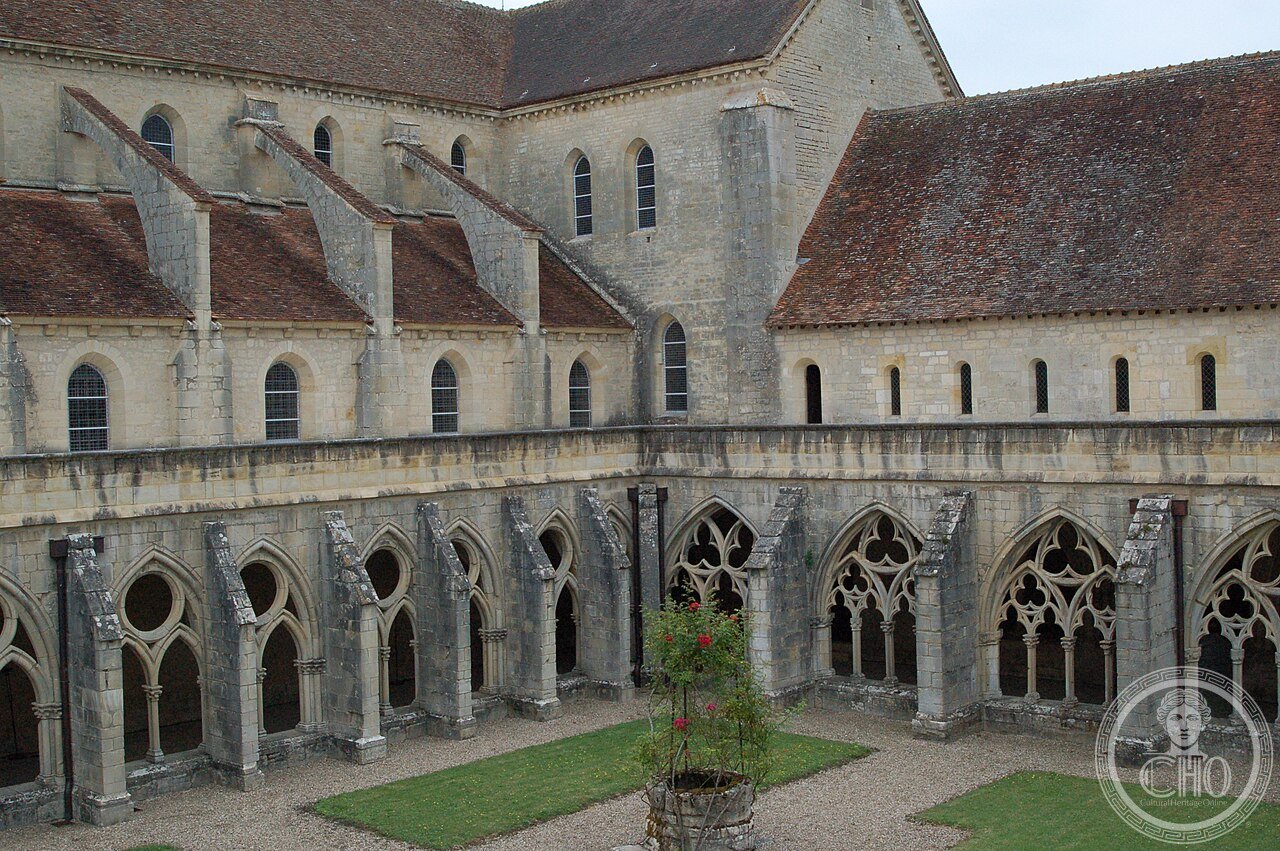
Founded in 1136 by twelve monks from Clairvaux, on land given by Ebbes de Charenton, Lord of Meillant, the abbey of Noirlac went through centuries of surprising transformations: national property confiscated in 1791, a porcelain factory for much of the nineteenth century, then a rural hospital and a reception centre for refugees, before becoming, from 2008, a Cultural Meeting Centre after a restoration that lasted thirty years.
About Noirlac Abbey
Noirlac Abbey was founded in 1136 by twelve monks from Clairvaux Abbey, its establishment made possible by land donated by Ebbes de Charenton, Lord of Meillant. Built from 1150 onward by this small community of Clairvaux monks, Noirlac directly embodies the monastic asceticism of the Cistercian order founded by Saint Robert and developed by Bernard of Clairvaux, reflecting the order’s guiding principle of stark simplicity in art, architecture, and religious ceremony. Set at the heart of the Berry region, in a serene wooded landscape on the banks of the Cher river, Noirlac is today considered — according to the Michelin Green Guide — one of the most complete and best-preserved monastic complexes anywhere in France. In 1791, the abbey was confiscated during the French Revolution to become a National Asset, and it was subsequently occupied by a porcelain factory for much of the 19th century. The Cher department acquired the abbey in 1909, and a remarkable restoration between 1950 and 1980 recovered its authentic original character in line with the abbey’s medieval plans. Throughout its long and eventful history, Noirlac has repeatedly demonstrated a capacity for institutional adaptation: successively a monastery, a factory, a country hospital, and a refugee centre — before becoming, since 2008, a Cultural Encounter Centre (Centre Culturel de Rencontre) organising a year-round calendar of artistic performances.
Key facts
- Foundation: 1136, by 12 monks from Clairvaux, on land donated by Ebbes de Charenton, Lord of Meillant
- Construction: from 1150, embodying Cistercian architectural asceticism
- Recognition: among the most complete, best-preserved monastic complexes in France (Michelin Green Guide)
- 1791: confiscated as a National Asset during the French Revolution
- 19th century: occupied by a porcelain factory
- 1909: acquired by the Cher department
- 1950-1980: extensive restoration recovering the abbey’s original medieval plan
- Successive uses: monastery, factory, country hospital, refugee centre, Cultural Encounter Centre (since 2008)
History
Noirlac’s founding as a direct daughter house of Clairvaux, staffed by just twelve monks sent from Bernard of Clairvaux’s own rapidly expanding community, situates the abbey within the extraordinary institutional momentum the Cistercian order achieved during the 12th century, when Clairvaux alone generated over sixty daughter houses within Bernard’s own lifetime. Noirlac’s subsequent reputation as one of France’s most complete and authentically preserved Cistercian complexes owes directly to the specific sequence of post-Revolutionary secular reuse it underwent — porcelain factory, then country hospital and refugee centre — which, while transforming the buildings’ function, evidently avoided the kind of wholesale demolition or aggressive architectural alteration that permanently compromised many other former French monasteries during the same period.
The 1950-1980 restoration’s specific goal of recovering the abbey’s authentic original medieval plan reflects a particular mid-20th-century French heritage-preservation philosophy favouring historically accurate reconstruction over either continued industrial reuse or simple picturesque ruin-preservation — a thirty-year restoration commitment that ultimately produced the exceptionally complete Cistercian ensemble visible today. Noirlac’s final transformation into a Cultural Encounter Centre in 2008, hosting a regular programme of artistic performances within its restored medieval architecture, represents a further, more recent adaptive reuse, extending the site’s centuries-long pattern of institutional flexibility into an actively curated contemporary cultural role.
What you see
The cloister and abbey church, both extensively restored to their original medieval plan between 1950 and 1980, offer visitors an unusually complete and authentic example of pure Cistercian architectural asceticism. The abbey’s setting on the wooded banks of the Cher river gives the complex a serene rural landscape context typical of Cistercian siting principles. The site’s continuing role as a Cultural Encounter Centre, hosting artistic performances within its historic buildings, extends Noirlac’s significance into an actively living contemporary cultural institution.
Practical information
- Opening hours: generally open daily during the visitor season, check current hours before visiting; admission fee
- Address: Bruère-Allichamps, 18200 Saint-Amand-Montrond, France
Getting there
Noirlac Abbey is reachable by car from Saint-Amand-Montrond (approximately 10 minutes) and Bourges (approximately 40 minutes) in the Cher department, Centre-Val de Loire. GPS: 46.7678° N, 2.4313° E.
Nearby
- Saint-Amand-Montrond — approximately 10 minutes away; a historic Berry town
- Bourges — approximately 40 minutes away; a UNESCO World Heritage cathedral city
- Route Jacques-Cœur — a regional heritage route through the Berry châteaux, including Noirlac
Sources
- Wikipedia — “Noirlac Abbey” (en.wikipedia.org)
- Abbaye de Noirlac — official portal, “History” (abbayedenoirlac.fr)
- Council of Europe — “Noirlac Abbey” Cultural Routes (coe.int)
Find it on the map
See this place and what’s around it →📷 Become a Cultural Heritage Online photographer
Share your photos of places: they stay published under your name as the author. The more they're seen, the more you get noticed — and soon a contest will reward the most appreciated photos.
Log in or sign up free to add a photo