
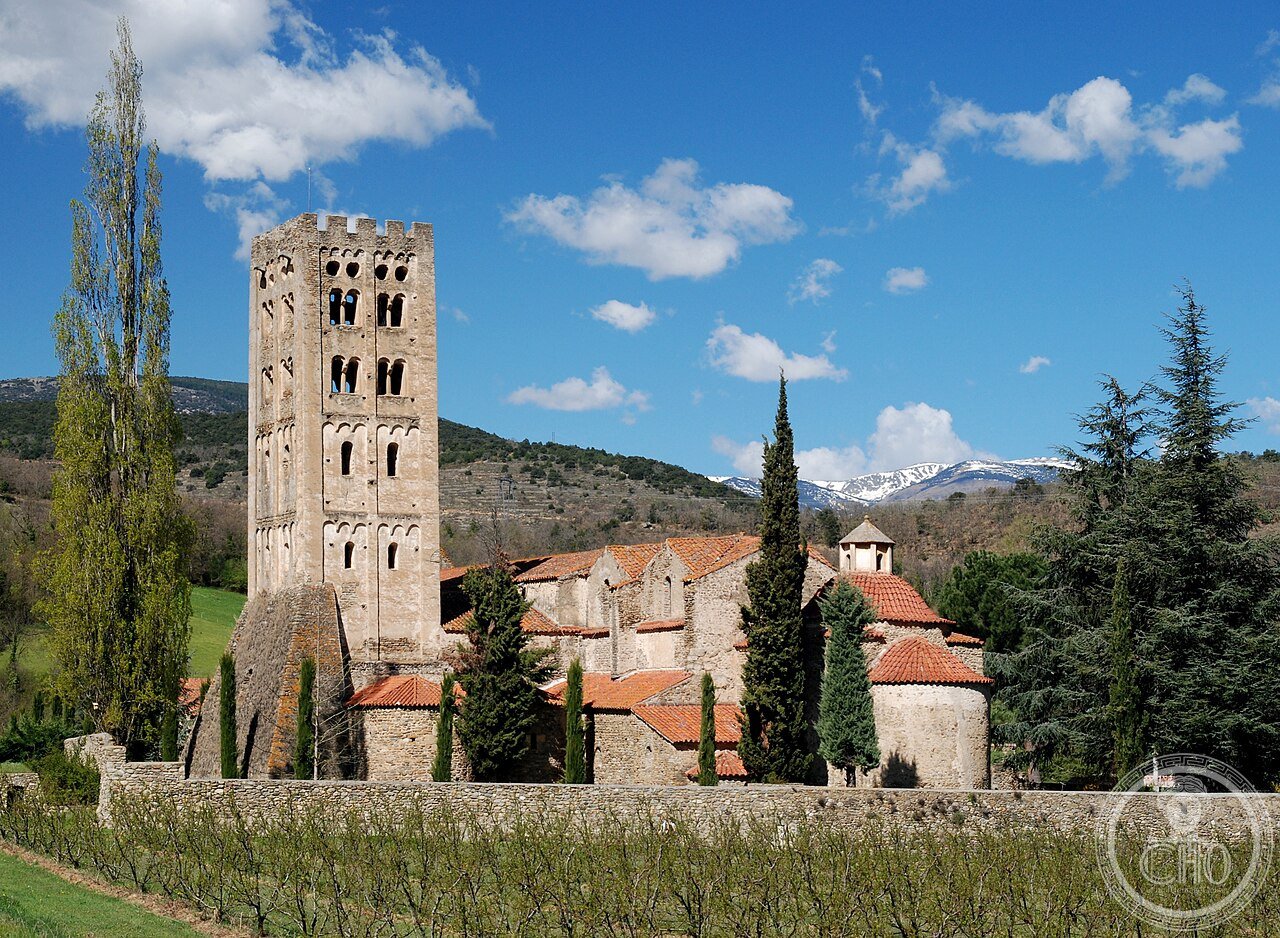
After the post-revolutionary dispersal of the monastery’s stones, in 1907 the American sculptor George Barnard paid 100,000 dollars to buy the twelfth-century Romanesque cloister, take it apart stone by stone and ship it to New York. Today some 460 original fragments form the heart of The Cloisters, the medieval branch of the Metropolitan Museum of Art, while at Codalet a community of monks has returned to live in what is left of the abbey.
About Saint-Michel-de-Cuxa Abbey
The Abbey of Saint-Michel-de-Cuxa, a Benedictine abbey in southwestern France at the foot of Mount Canigou in the northeast Pyrenees, was initially founded in 840 and then refounded at its present site in 878, after a flood destroyed the original buildings. In 1791, in the wake of the French Revolution, Cuxa’s monks departed, and much of the monastery’s stonework — including its celebrated 12th-century cloister — was subsequently dispersed across the region, sold or repurposed as building material. The American sculptor George Barnard, observing the abbey’s continuing degradation, resolved to save the cloister from further destruction, and in 1907 paid $100,000 to purchase what remained of it; the cloister was then disassembled stone by stone and shipped to New York City. Barnard opened his own “Cloisters” exhibit on Fort Washington Avenue in 1914, incorporating sculpture from several medieval French sites, before John D. Rockefeller Jr. rebuilt and substantially expanded the collection in 1938 at Fort Tryon Park in Upper Manhattan — the resulting museum remains a significant medieval branch of the Metropolitan Museum of Art. The reconstructed Cuxa Cloister, the museum’s centrepiece and namesake, comprises some 460 original fragments, with additional replacement elements carved from the same pink Languedoc marble originally quarried for the medieval cloister. Back in France, the Cuxa abbey itself was refounded in 1919 and subsequently restored under Cistercian monks; part of the original cloister survives on-site at the monastery, which once again houses an active community.
Key facts
- Foundation: 840; refounded at the present site 878 after a flood
- 1791: monks departed following the French Revolution; stonework dispersed
- 1907: George Barnard purchased the remaining 12th-century cloister for $100,000, dismantling and shipping it to New York
- 1914: Barnard’s “Cloisters” exhibit opened on Fort Washington Avenue
- 1938: John D. Rockefeller Jr. rebuilt and expanded The Cloisters at Fort Tryon Park, Upper Manhattan
- Cuxa Cloister today: c. 460 original fragments, centrepiece of The Cloisters museum, Metropolitan Museum of Art
- 1919: Cuxa abbey refounded, later restored under Cistercian monks; part of the cloister remains on-site
History
George Barnard’s 1907 rescue of Cuxa’s cloister, motivated by genuine alarm at the ongoing physical destruction of a major surviving Romanesque monument, exemplifies a specific and consequential pattern of early-20th-century American collecting in which wealthy individuals and institutions actively purchased and relocated entire architectural ensembles from Europe — a practice that, whatever its debatable ethics by contemporary heritage-preservation standards, in Cuxa’s specific case demonstrably saved genuine medieval fabric that might otherwise have continued disintegrating or being scattered as ordinary building material across rural France. John D. Rockefeller Jr.’s subsequent 1938 expansion, transforming Barnard’s original private exhibit into the fully institutionalised Cloisters museum within the Metropolitan Museum of Art, situates the Cuxa cloister within one of the most historically significant assemblages of relocated medieval European architecture anywhere in North America.
The abbey’s own 1919 refoundation and subsequent Cistercian restoration, occurring in parallel with its most famous architectural feature’s permanent relocation to New York, gives Saint-Michel-de-Cuxa a genuinely unusual dual identity: a still-active French monastic community occupying a partially reconstructed medieval site, while the cloister’s most celebrated original stonework remains permanently installed thousands of miles away as a major American museum’s namesake centrepiece — two institutions, one in rural Pyrenean France and one in Manhattan, both claiming meaningful connection to the same medieval monastic heritage.
What you see
The abbey’s surviving on-site architecture, including the portion of the original cloister that remained at Cuxa, offers visitors direct access to the monastery’s medieval fabric within its authentic Pyrenean setting. The bell tower and surrounding Romanesque structures, restored following the 1919 refoundation, give the abbey its present visible character. Visitors specifically interested in the dispersed cloister’s fate can pair a visit to Cuxa with a visit to The Cloisters museum in New York, where the majority of the original 12th-century stonework now stands reassembled.
Practical information
- Opening hours: generally open daily during the visitor season, check current hours before visiting; admission fee
- Address: Route de Saint-Michel, 66500 Codalet, France
Getting there
Saint-Michel-de-Cuxa is reachable by car from Prades (approximately 10 minutes) in the Pyrénées-Orientales department, Occitanie. GPS: 42.5949° N, 2.4172° E.
Nearby
- Prades — approximately 10 minutes away; a Pyrenean town known for its music festival
- Saint-Martin-du-Canigou Abbey — another significant mountain monastery in the same region
- Mount Canigou — the iconic Pyrenean peak overlooking both abbeys
Sources
- Wikipedia — “Abbey of Saint-Michel-de-Cuxa” (en.wikipedia.org)
- The Metropolitan Museum of Art — “Cuxa Cloister” and “Building Stories: Contextualizing Architecture at the Cloisters” (metmuseum.org)
- Conflent Canigó Tourisme — “Saint-Michel de Cuxa Abbey” (tourisme-canigo.com)
Find it on the map
See this place and what’s around it →📷 Become a Cultural Heritage Online photographer
Share your photos of places: they stay published under your name as the author. The more they're seen, the more you get noticed — and soon a contest will reward the most appreciated photos.
Log in or sign up free to add a photo