

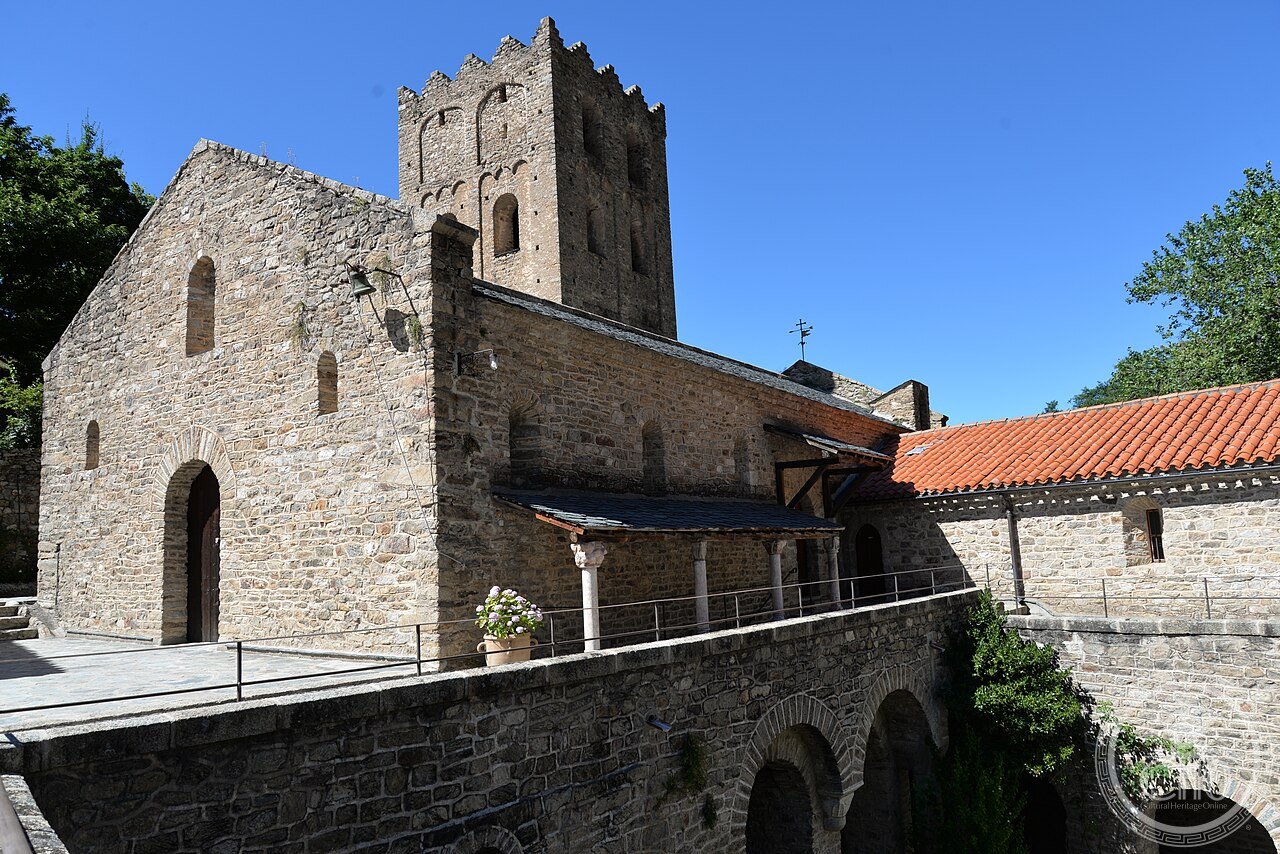
Guifred II, Count of Cerdanya, had this Romanesque monastery built between 1005 and 1009, at over a thousand metres in the Pyrenees, as an act of atonement for the murder of his son. Secularised in 1782 and reduced to a stone quarry during the revolutionary Terror, the abbey lay in ruins until in 1902 the bishop of Elne and Perpignan began a radical restoration, completed only in 1932.
About Saint-Martin-du-Canigou Abbey
The Abbey of Saint-Martin-du-Canigou, a Romanesque monastery built in the Pyrenees of Northern Catalonia on Mount Canigou in present-day southern France near the Spanish border, was constructed between 1005 and 1009 by Guifred II, Count of Cerdanya, specifically in atonement for the murder of his own son, and was populated by Benedictine monks. The abbey sits at roughly 1,065 metres above sea level in the richly forested Pyrenees, within the commune of Casteil in the Pyrénées-Orientales department. The monastery was secularised in 1782 by Louis XVI, and its monks abandoned the site between 1783 and 1785, leaving it to fall into disrepair. During the Reign of Terror in 1793-1794, the abbey was closed entirely, its contents scattered, and its buildings reduced to serving as a stone quarry. The ruins remained in this state for over a century until 1902, when the Bishop of Elne and Perpignan, drawing on his own Catalan heritage, began a radical restoration of the abbey — work that continued until its completion in 1932. Today, the restored abbey is occupied by the Catholic Community of the Beatitudes.
Key facts
- Construction: 1005-1009, by Guifred II, Count of Cerdanya, in atonement for his son’s murder
- Setting: roughly 1,065 metres above sea level on Mount Canigou, Pyrénées-Orientales
- Secularisation: 1782, by Louis XVI; monks abandoned the site 1783-1785
- Reign of Terror (1793-1794): abbey closed, contents scattered, buildings used as a stone quarry
- Restoration: begun 1902 by the Bishop of Elne and Perpignan; completed 1932
- Current occupants: the Catholic Community of the Beatitudes
History
Guifred II’s decision to found a monastery specifically as an act of personal atonement for murdering his own son gives Saint-Martin-du-Canigou an unusually direct and dramatic founding motivation compared to the more typical medieval pattern of monastic foundation as broader territorial or dynastic patronage — the count’s choice of a genuinely difficult, remote mountain site for his penitential foundation may itself reflect the severity of the atonement he sought to perform. The abbey’s location within the historic County of Cerdanya, part of the medieval Catalan-speaking territories straddling the modern French-Spanish border, situates the monastery within the specific cultural and political world of the medieval Pyrenean counties, distinct from both the wider French kingdom to the north and the emerging Kingdom of Aragon to the south.
The abbey’s near-total destruction during the French Revolutionary period — secularised, abandoned, and then physically quarried for stone during the Terror — reflects the particularly severe treatment religious institutions faced during this period, especially isolated rural monasteries with limited local political protection. The 1902 restoration’s specific motivation, driven by a bishop’s personal Catalan cultural identification with the site, illustrates how regional cultural and linguistic identity — Catalan heritage straddling the French-Spanish border — could motivate 20th-century ecclesiastical restoration projects independent of purely religious considerations, reclaiming a specifically Catalan medieval monument for renewed devotional and cultural significance.
What you see
The Romanesque church and cloister, substantially restored between 1902 and 1932, give visitors direct access to early-11th-century Pyrenean monastic architecture despite the building’s near-total Revolutionary-era destruction. The abbey’s dramatic mountainside setting, reached via a steep approach path, rewards visitors with commanding views over the surrounding Pyrenean landscape. The site’s continuing active religious community, the Catholic Community of the Beatitudes, gives Saint-Martin-du-Canigou a genuinely living character alongside its historical and architectural significance.
Practical information
- Opening hours: generally open daily during the visitor season, check current hours before visiting; admission fee; reached via a steep uphill walk from Casteil
- Address: Chemin de l’Abbaye, 66820 Casteil, France
Getting there
Saint-Martin-du-Canigou is reachable by car to Casteil (near Vernet-les-Bains, approximately 45 minutes from Perpignan), followed by a steep uphill walk of roughly 45 minutes to the abbey itself. GPS: 42.5283° N, 2.4015° E.
Nearby
- Vernet-les-Bains — a historic spa town near Casteil
- Mount Canigou — the iconic Pyrenean peak, a symbol of Catalan identity, offering extensive hiking
- Saint-Michel-de-Cuxa Abbey — another significant Catalan Romanesque monastery in the same region
Sources
- Wikipedia — “Abbey of Saint-Martin-du-Canigou” (en.wikipedia.org)
- Sacred Destinations — “St-Martin-Du-Canigou Abbey” (sacred-destinations.com)
- Abbaye St Martin du Canigou — official portal, “A Thousand Years of History” (stmartinducanigou.org)
Find it on the map
See this place and what’s around it →📷 Become a Cultural Heritage Online photographer
Share your photos of places: they stay published under your name as the author. The more they're seen, the more you get noticed — and soon a contest will reward the most appreciated photos.
Log in or sign up free to add a photo