
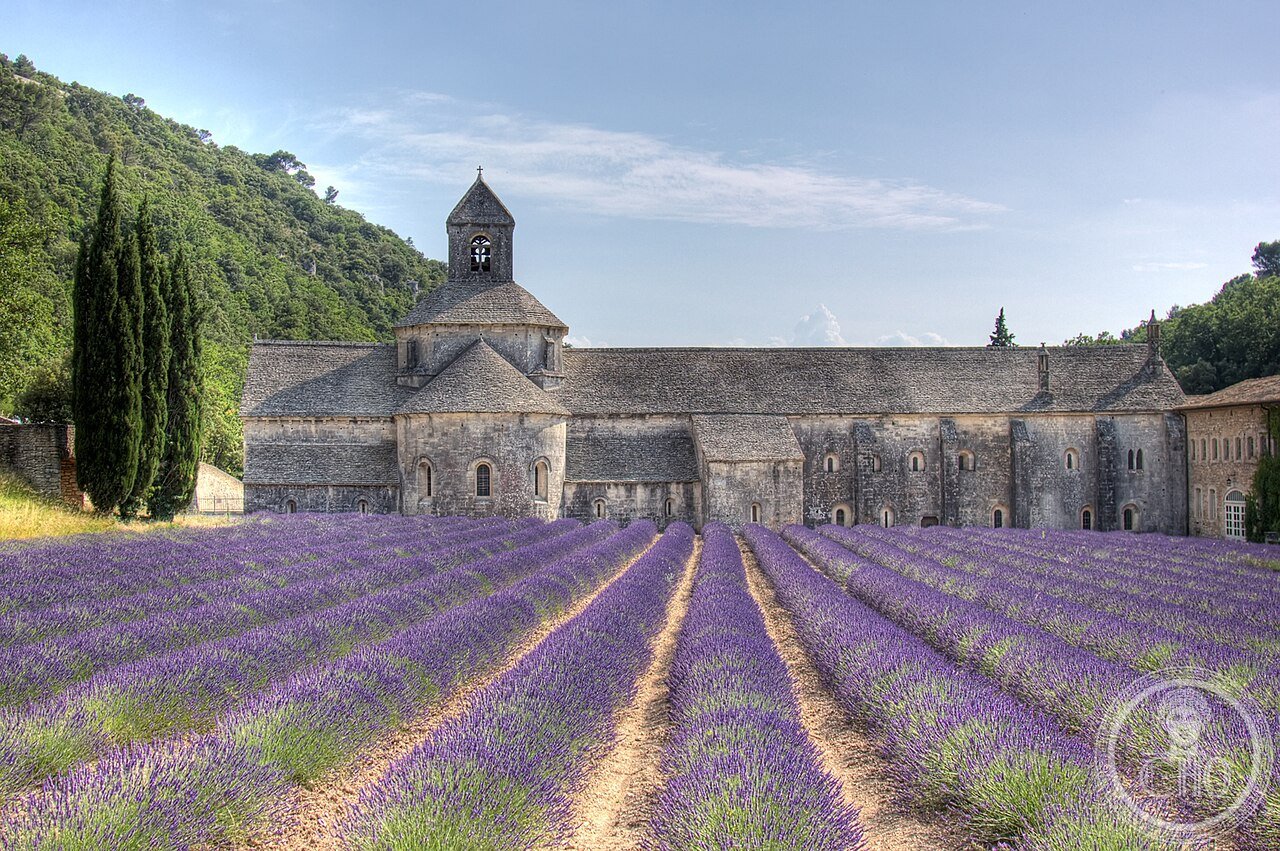
Founded in 1148 by Cistercian monks from the abbey of Mazan, in the Ardèche, Sénanque was expelled from the site in 1903 and returned only in 1988, as a priory of the abbey of Lérins. Today the monks grow lavender and keep bees for their own support: every summer, between mid-June and July, the valley turns into a purple sea that makes this one of the most photographed scenes in all of France.
About Sénanque Abbey
Sénanque Abbey, a Cistercian abbey in the Sénancole valley near the village of Gordes in the Vaucluse department of Provence, was founded in 1148 under the patronage of Alfant, Bishop of Cavaillon, and Ramon Berenguer II, Count of Barcelona and Count of Provence, by Cistercian monks who arrived from Mazan Abbey in the Ardèche. Temporary huts housed the first community of impoverished monks before they found patrons in the seigneurs of Simiane, whose support enabled construction of the abbey church, consecrated in 1178. At its peak in the 13th and 14th centuries, Sénanque owned extensive properties across Provence, including four water mills, seven granges, and four or five hospices, alongside fields, forests, and pastures. The community was expelled from the site in 1903, departing for the Cistercian order’s headquarters at Lérins Abbey on the island of Saint-Honorat near Cannes; a small community only returned to Sénanque in 1988, as a priory of Lérins. Today, the resident monks grow lavender — visible directly in front of the abbey — and tend honeybees for their livelihood, continuing an agricultural tradition central to the community’s economic self-sufficiency. Each summer, typically from mid-June through July, the surrounding valley transforms into a sea of purple bloom, creating one of the most photographed monastic scenes in all of France. Along with Le Thoronet and Silvacane, Sénanque is one of the “Three Sisters of Provence,” the three Cistercian abbeys celebrated together as premier examples of the order’s architectural spirit.
Key facts
- Foundation: 1148, under Bishop Alfant of Cavaillon and Ramon Berenguer II, Count of Provence; monks from Mazan Abbey, Ardèche
- Church consecration: 1178, funded through patronage of the seigneurs of Simiane
- Medieval peak (13th-14th c.): extensive Provençal properties — 4 water mills, 7 granges, 4-5 hospices
- 1903 expulsion: community relocated to Lérins Abbey, Saint-Honorat island near Cannes
- 1988: a small community returned to Sénanque as a priory of Lérins
- Lavender and honey: grown and tended by the monks for their livelihood
- “Three Sisters of Provence”: Sénanque, Le Thoronet, and Silvacane
History
Sénanque’s 1903 expulsion, part of the broader wave of anticlerical measures under the French Third Republic that targeted religious congregations across the country in the early 20th century, forced the community into an 85-year exile at Lérins before its eventual, comparatively small-scale 1988 return as a dependent priory rather than a fully independent abbey — a diminished institutional status reflecting the genuinely long interruption the community had suffered. This pattern of Republican-era religious expulsion, followed by eventual partial restoration decades later, situates Sénanque within a broader 20th-century story of French Catholic monastic institutions navigating the country’s complex, often adversarial relationship between secular Republican governance and religious communities.
The abbey’s continuing lavender cultivation, now the site’s single most internationally recognisable visual signature, represents both a genuine continuation of Cistercian agricultural self-sufficiency traditions and a specific, highly successful adaptation to Provence’s particular agricultural and touristic economy — the deliberate access restriction to the lavender fields themselves, preserving the monks’ actual harvest from tourist foot traffic, reflects the community’s need to balance its genuine agricultural livelihood against the site’s now-enormous popular photographic appeal. Sénanque’s status alongside Le Thoronet and Silvacane as one of the “Three Sisters of Provence” situates the abbey within a specifically curated regional grouping celebrating pure Cistercian architectural achievement, even as Sénanque’s own visual fame today owes at least as much to its agricultural lavender fields as to its architecture alone.
What you see
The lavender fields in front of the abbey, at their peak from mid-June through July, offer one of the most photographed monastic landscapes in France, though access to the fields themselves is restricted to preserve the monks’ harvest. The Cistercian abbey church, consecrated in 1178, and its surrounding cloister give visitors direct access to pure 12th-century Romanesque Cistercian architecture largely unchanged since construction. The abbey’s continuing active priory status, following its 1988 return after 85 years of exile, gives the site a genuinely living religious character alongside its architectural and agricultural significance.
Practical information
- Opening hours: generally open daily during the visitor season, check current hours before visiting; admission fee; lavender fields best viewed mid-June to July
- Address: Chemin de l’Abbaye de Sénanque, 84220 Gordes, France
Getting there
Sénanque Abbey is reachable by car from Gordes (approximately 5 minutes) and Avignon (approximately 45 minutes) in the Vaucluse, Provence. GPS: 43.9313° N, 5.1890° E.
Nearby
- Gordes — a few minutes away; one of the most picturesque hilltop villages in Provence
- Roussillon — a nearby ochre-cliff village, within the Luberon
- Avignon — approximately 45 minutes away; historic papal city on the Rhône
Sources
- Wikipedia — “Sénanque Abbey” (en.wikipedia.org)
- Sacred Destinations — “Senanque Abbey – Gordes, France” (sacred-destinations.com)
- The Good Life France — “The history of the Abbaye de Senanque, Provence” (thegoodlifefrance.com)
Find it on the map
See this place and what’s around it →📷 Become a Cultural Heritage Online photographer
Share your photos of places: they stay published under your name as the author. The more they're seen, the more you get noticed — and soon a contest will reward the most appreciated photos.
Log in or sign up free to add a photo