

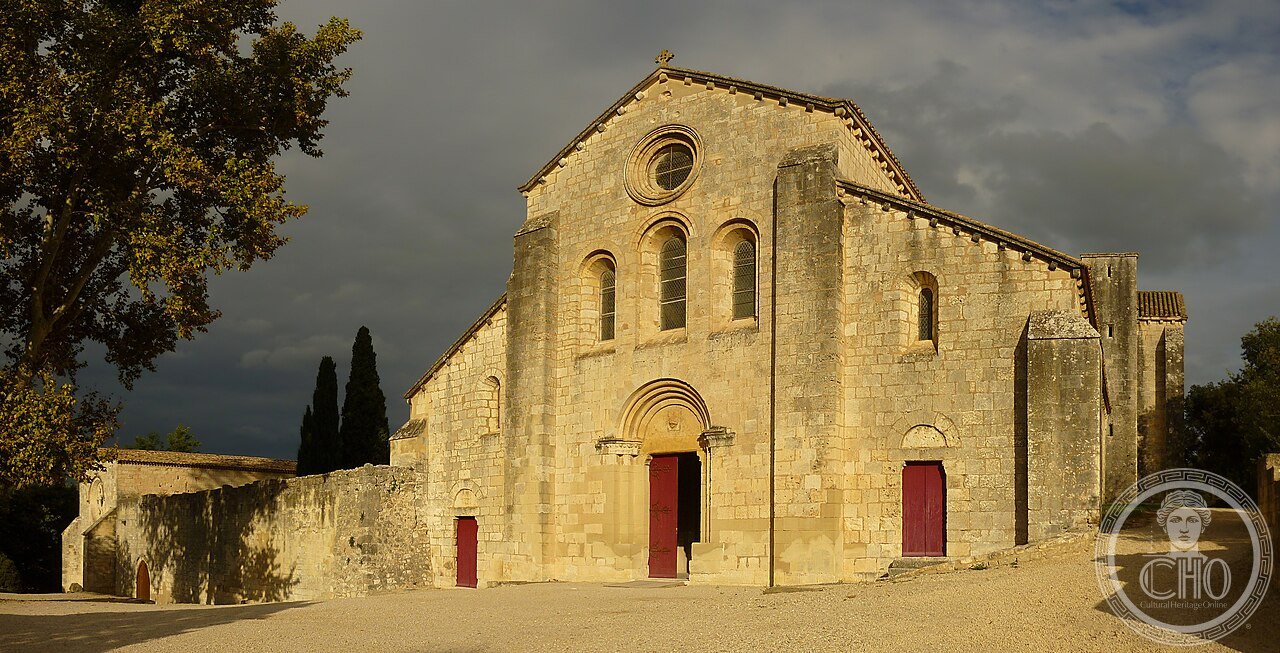
The name itself, Silvacane, means “forest of reeds”: here lay marshy ground overrun by reed beds on the banks of the Durance, typical of Cistercian settlement in remote places. After a period of prosperity in the late twelfth century, the abbey entered an unstoppable decline — raids, frosts, floods — until in 1443 the monks were forced to abandon it for good.
About Silvacane Abbey
Silvacane Abbey, a former Cistercian monastery in the commune of La Roque-d’Anthéron in the Bouches-du-Rhône department of Provence, was founded around 1144 as a daughter house of Morimond Abbey. Like all Cistercian monasteries of the period, Silvacane was deliberately sited in a remote location beside a river or stream — in this case the Durance river, in an area overgrown with reeds, which gave the abbey its name: “Silvacane” means “reed forest.” The community became genuinely prosperous toward the end of the 12th century, receiving valuable endowments from Guillaume de Fuveau and Raimond de Baux. From the end of the 13th century onward, however, Silvacane entered a sustained and ultimately terminal decline, marked by conflicts with the neighbouring abbey of Montmajour, outright plundering — notably in 1358, when the abbey was sacked by the troops of the army of Aubignan — and repeated natural disasters, including a severe freeze in 1364 and floods in 1440. The abbey’s financial position deteriorated steadily from the 1358 plundering onward, and its annexation to the chapter of Aix-en-Provence in 1450 followed directly from the monks’ forced abandonment of the site in 1443, when the community could no longer sustain itself there. Silvacane is one of the three Cistercian abbeys in Provence celebrated together as the “Three Sisters of Provence” (les trois sœurs provençales), alongside Sénanque Abbey and Le Thoronet Abbey.
Key facts
- Foundation: c. 1144, daughter house of Morimond Abbey
- Name origin: “Silvacane” (“reed forest”), from the reed-covered marshland beside the Durance river
- Prosperity: late 12th century, through endowments from Guillaume de Fuveau and Raimond de Baux
- Decline: from the late 13th century — conflicts with Montmajour, the 1358 plundering by Aubignan’s troops, a 1364 freeze, 1440 floods
- Abandonment: 1443, monks forced to leave the site entirely
- 1450: annexed to the chapter of Aix-en-Provence
- “Three Sisters of Provence”: Silvacane, alongside Sénanque and Le Thoronet
History
Silvacane’s ultimate abandonment in 1443, following a century and a half of accumulating disasters — armed plundering, extreme weather, and institutional conflict with a rival abbey — offers a genuinely instructive counter-example to the more familiar narrative of Cistercian monastic endurance and continuity: while institutions like Rein Abbey or Heiligenkreuz survived continuously for nearly a millennium, Silvacane demonstrates how a combination of specific, compounding misfortunes — military violence, climate disaster, and financial exhaustion — could ultimately overwhelm even a well-established medieval monastic community, forcing outright abandonment rather than mere institutional decline. The 1358 sacking by Aubignan’s forces, occurring during the broader chaos of the Hundred Years’ War period across France, situates Silvacane’s specific misfortune within the wider pattern of ecclesiastical institutions suffering direct military violence during this turbulent century.
The abbey’s eventual 1450 annexation to the Aix-en-Provence chapter, following directly from the 1443 abandonment, represents the formal administrative conclusion of Silvacane’s independent monastic existence — its buildings and remaining assets absorbed into a different ecclesiastical structure entirely, rather than the community simply relocating intact as happened at other displaced Cistercian houses. This distinguishes Silvacane’s fate specifically from comparable cases like Sénanque’s own later 1903-1988 exile and return, since Silvacane’s medieval community never resumed independent monastic life at the site after 1443.
What you see
The abbey’s surviving Cistercian church and cloister, dating substantially to the community’s 12th-century foundation and its subsequent late-12th-century prosperity, give visitors direct access to pure Cistercian architectural form despite the site’s eventual medieval abandonment. The building’s riverside setting near the Durance, reflecting the reed-marsh origins of its name, situates Silvacane within the classic Cistercian pattern of remote, water-adjacent monastic siting. As one of the “Three Sisters of Provence,” Silvacane rewards direct comparison with its sister abbeys at Sénanque and Le Thoronet, each illustrating a distinct institutional fate within the same regional architectural tradition.
Practical information
- Opening hours: generally open daily during the visitor season, check current hours before visiting; admission fee
- Address: Route d’Eyguières au Puy-Sainte-Réparade, 13640 La Roque-d’Anthéron, France
Getting there
Silvacane Abbey is reachable by car from Aix-en-Provence (approximately 30 minutes) in the Bouches-du-Rhône department, Provence. GPS: 43.7159° N, 5.3289° E.
Nearby
- La Roque-d’Anthéron — the surrounding village, known for its annual international piano festival
- Aix-en-Provence — approximately 30 minutes away; a major Provençal cultural centre
- Luberon — the regional natural park, within reach for hiking and villages
Sources
- Wikipedia — “Silvacane Abbey” (en.wikipedia.org)
- Aleteia — “Silvacane Abbey: One of the ‘Three Sisters’ of Provence” (aleteia.org)
- Avignon et Provence — “Silvacane Abbey in la Roque d’Anthéron” (avignon-et-provence.com)
Find it on the map
See this place and what’s around it →📷 Become a Cultural Heritage Online photographer
Share your photos of places: they stay published under your name as the author. The more they're seen, the more you get noticed — and soon a contest will reward the most appreciated photos.
Log in or sign up free to add a photo