
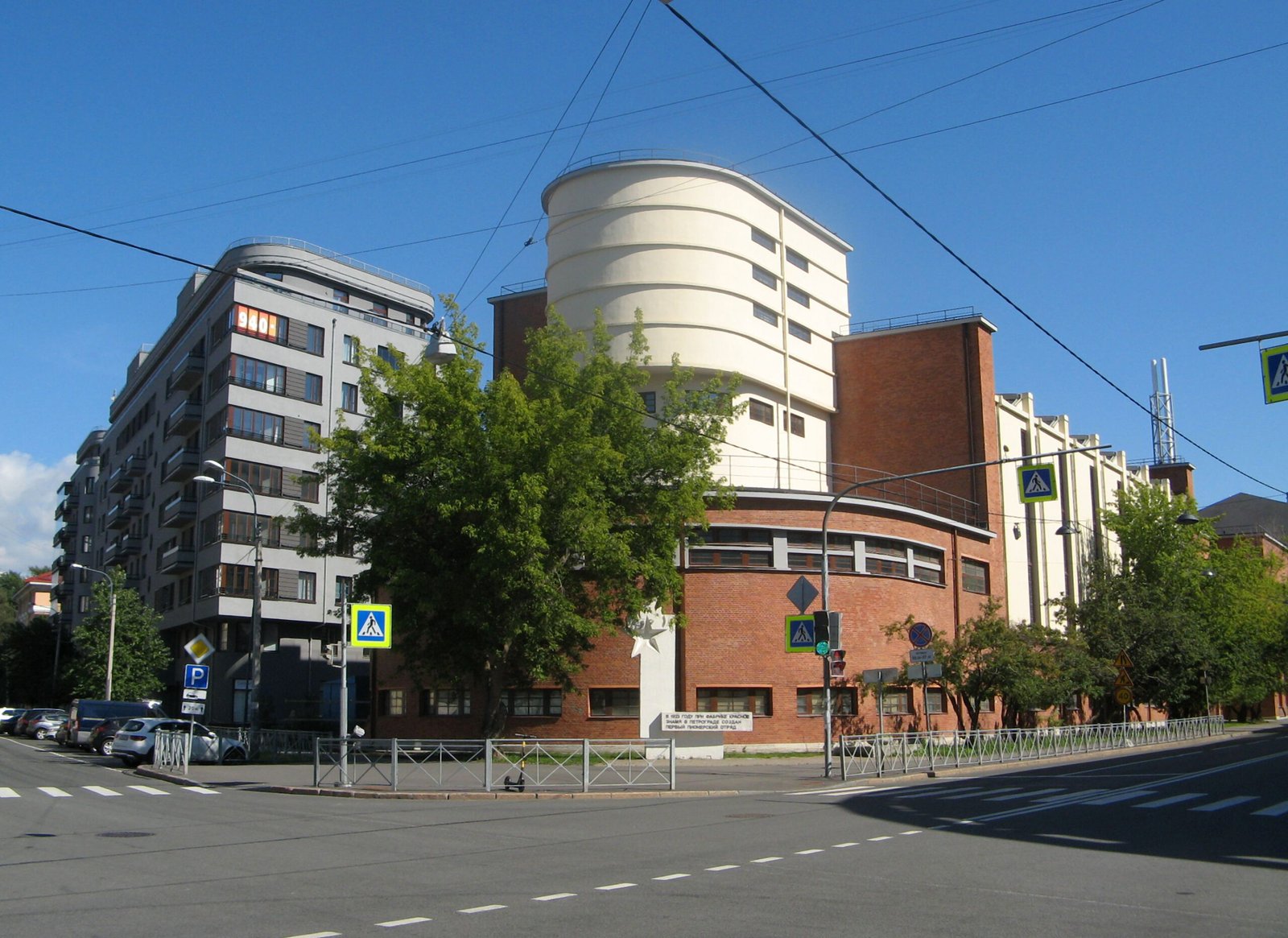
A landmark of early Soviet industrial architecture, designed by pioneering modernist Erich Mendelsohn and refined by Russian architects, this textile factory exemplifies the bold collision between Expressionist vision and Soviet constructivist reality.
At a glance
Located on Pionerskaya ulitsa in the Petrogradsky District, the Red Banner Textile Factory stands as a testament to international architectural exchange during the Soviet era. Built between 1926 and 1937, it represents one of the earliest commissions by a foreign architect in the young USSR. The complex remains partly in use today, recently restored on its exterior.
History
In 1925, Erich Mendelsohn became the first foreign architect invited to design a building in the Soviet Union. His reputation for dynamic, futuristic Expressionist design—evident in works like the Luckenwalde hat factory—made him a compelling choice for Soviet planners eager to project modernity.
Mendelsohn participated actively only in the first phase (1925–1926), drawing initial plans and designing the factory’s power station. He visited the USSR multiple times during construction, absorbing influences from Soviet Constructivism and later publishing his observations in Russland-Europa-Amerika. However, primitive construction techniques forced significant compromises to his original design.
Russian architects S. O. Ovsyannikov, E. A. Tretyakov, and senior architect Hyppolit Pretreaus completed the remaining buildings in two phases: 1926–1928 and 1934–1937. Mendelsohn notably disowned the finished factory, though he continued using its model to illustrate his industrial approach.
What you see
The power station, designed by Mendelsohn himself, exemplifies the architect’s geometric, forward-looking aesthetic. The broader factory complex reflects a functionalist interpretation of Expressionist principles—a hybrid born from compromise between European innovation and Soviet construction capacity.
By 2017, weathering had taken its toll: the chimney had been removed and vegetation covered the roof. Early 2018 brought exterior restoration under new ownership, though the interior remained unrestored when it opened for tours in mid-2019.
Cultural significance
The factory marks a pivotal moment when Soviet leaders sought international architectural expertise to build their industrial future. Mendelsohn’s involvement—brief though it was—bridged Weimar modernism and Soviet ambition, making the site a rare physical record of that exchange.
The complex earned recognition as a newly revealed object of historical and cultural heritage by Saint Petersburg’s government in 2001, with additions in 2006, affirming its importance to Russian architectural history.
Key facts
- Country: Russia
- City: Petrogradsky District, St Petersburg
- Coordinates: 59.96138889, 30.28166667
- Constructed: 1926–1937
- Designer: Erich Mendelsohn (power station and initial plan); completed by S. O. Ovsyannikov, E. A. Tretyakov, and Hyppolit Pretreaus
- Status: Russian object of historical and cultural heritage (2001); partly in use as storage space
Practical information & getting there
The factory is located at 53 Pionerskaya ulitsa in St Petersburg’s Petrogradsky District. While the complex remains partly active and its exterior has been restored, access may be limited. Check current conditions and tour availability before visiting. The power station stands as the most significant element to observe.
Sources & resources
Find it on the map
See this place and what’s around it →📷 Become a Cultural Heritage Online photographer
Share your photos of places: they stay published under your name as the author. The more they're seen, the more you get noticed — and soon a contest will reward the most appreciated photos.
Log in or sign up free to add a photoIs this page about you?
This page is read by travellers and heritage enthusiasts who find it on Google. Tell us how you are connected to this place and we will take it from there.