
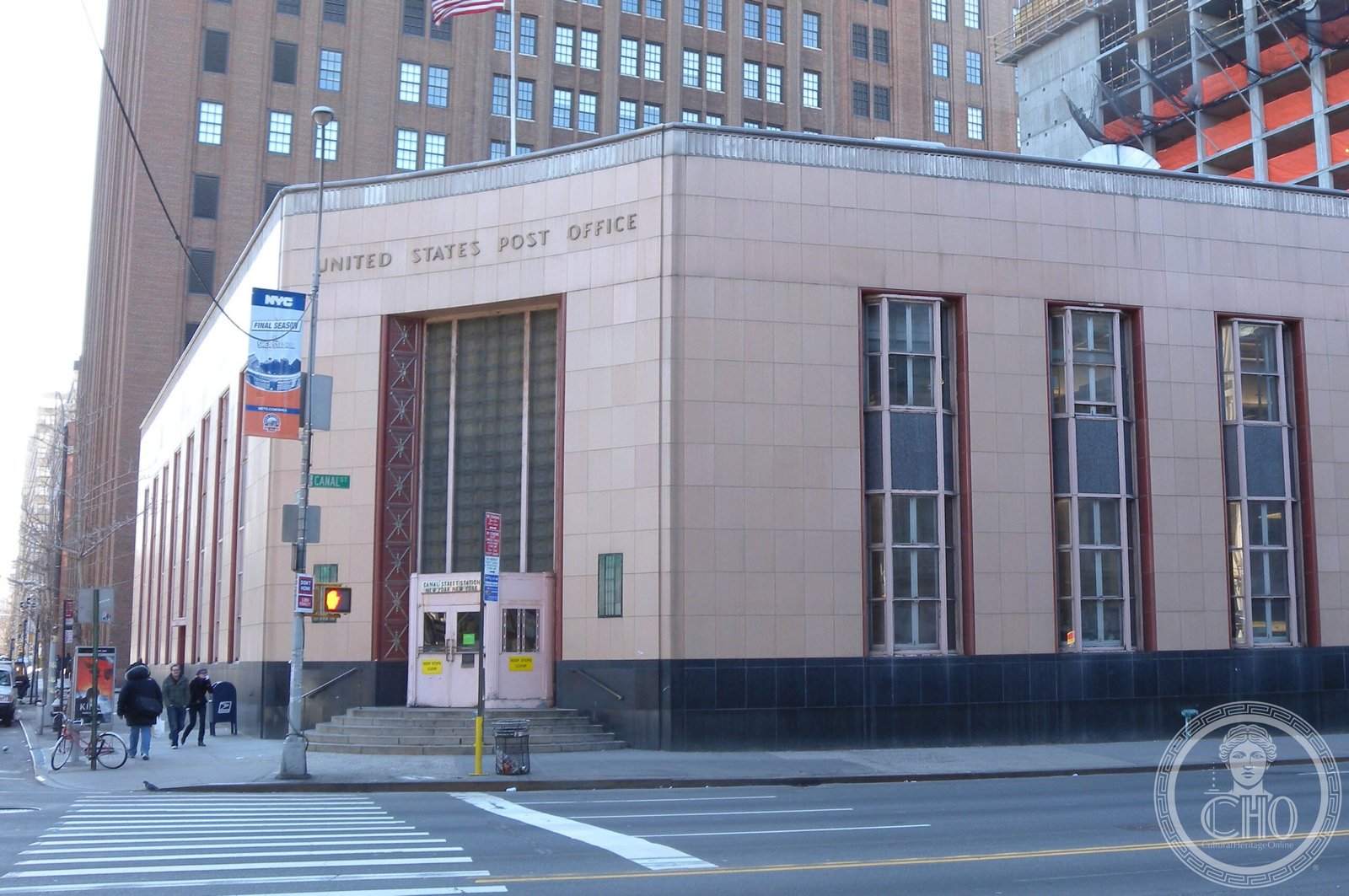
United States Post Office Canal Street Station
A streamlined Moderne post office where terra cotta and geometric precision frame one of lower Manhattan’s busiest intersections. Designed by Alan Balch Mills for the Treasury Department, this 1937 landmark exemplifies Depression-era civic architecture at its most refined.
At a glance
A two-story federal post office clad in buff terra cotta with sculptural detailing. Originally designated “Station B,” the building occupies the corner of Canal and Church Streets in Tribeca, a neighborhood that preserves much of lower Manhattan’s 19th and 20th-century character.
History
Built in 1937 under the New Deal’s federal building programs, the Canal Street Station was designed by consulting architect Alan Balch Mills working for the Office of the Supervising Architect of the United States Department of the Treasury. The structure reflects the government’s commitment to functional beauty during the economic crisis. The interior features a 1938 relief sculpture titled “Indian Bowman,” executed by artist Wheeler Williams, commissioned to enliven the public spaces within.
What you see
The building’s Moderne vocabulary—clean lines, symmetrical massing, and material elegance—defines its presence. Buff terra cotta panels form the primary skin, contrasted by a black terra cotta base. The most striking feature runs across the Church Street elevation: articulated inset bay windows that project and recede, creating visual rhythm and suggesting movement along the bustling thoroughfare.
A fluted terra cotta frieze with tarnished silver finish completes the exterior composition. According to the AIA Guide to New York City, these inset bays possess “wonderful mannerism” that “give[s] the allusion of scanning the streets north and south, and add plasticity to the building.”
Cultural significance
The Canal Street Station exemplifies how American civic architecture during the 1930s elevated utilitarian buildings to the level of public art. Rather than mere function, federal post offices became symbols of national permanence and dignity. This building’s restrained Moderne aesthetic—avoiding both ornament and austerity—captures the era’s optimism about modern design serving democratic institutions.
Key facts
- Location: 350 Canal Street (corner of Church Street), Manhattan, New York City, United States
- Built: 1937
- Architect: Alan Balch Mills (consulting architect, Office of the Supervising Architect, U.S. Department of the Treasury)
- Style: Moderne
- Material: Buff terra cotta with black terra cotta base and fluted frieze
- Interior sculpture: “Indian Bowman” (1938) by Wheeler Williams
- National Register of Historic Places: Listed 1989
- Coordinates: 40.72055556, -74.00388889
Practical information & getting there
The building remains an active post office in lower Manhattan. It is readily accessible by multiple subway lines serving the Canal Street and Church Street stations. The Tribeca neighborhood offers walking tours and nearby dining and retail.
Sources & resources
Find it on the map
See this place and what’s around it →📷 Diventa un fotografo di Cultural Heritage Online
Condividi le tue foto dei luoghi: restano pubblicate con la tua firma come autore. Più vengono viste, più ti fai conoscere — e presto un concorso premierà le foto più apprezzate.
Accedi o registrati gratis per aggiungere una fotoDo you manage this place?
This page is read by travellers and heritage enthusiasts who find it on Google. Keep it accurate — and make it work for you. Free for non-profit heritage institutions.