
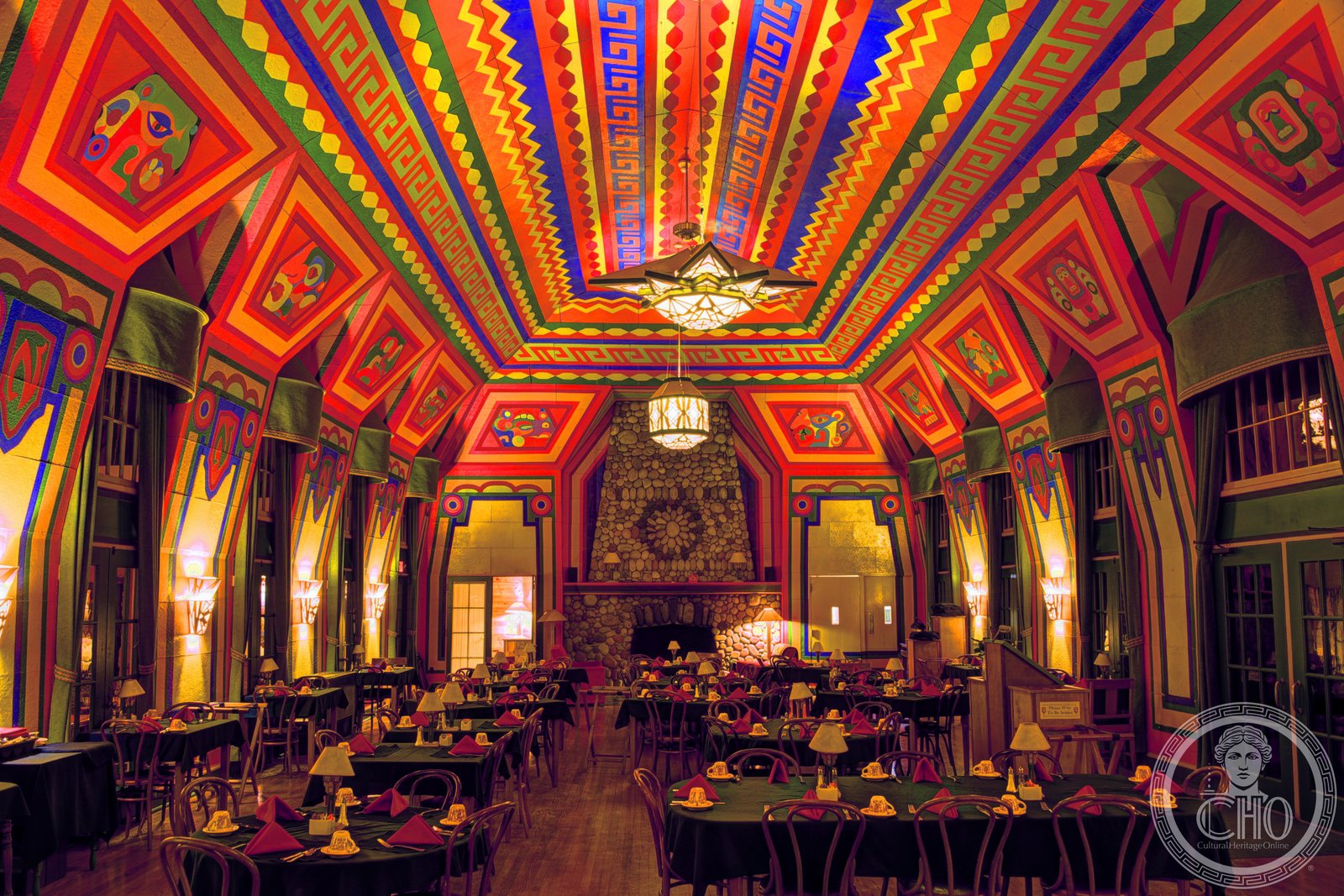
Fifteen miles east of Grand Marais on Lake Superior’s North Shore, the Naniboujou Club Lodge opened in 1929 with Babe Ruth and Jack Dempsey among its founding members and an interior described as “a psychedelic marriage of Art Deco and traditional Cree Indian patterns” — the Great Depression ended the grand plan; the lodge endured.
At a glance
The Naniboujou Club Lodge stands on the North Shore of Lake Superior in Cook County, Minnesota, approximately 15 miles northeast of Grand Marais. Built in 1928–1929 to designs by Holstead and Sullivan of Duluth, it was conceived as the centerpiece of a 3,330-acre private resort — of which only this single clubhouse was ever completed. Its defining feature is the great hall, now the dining room, whose walls and vaulted ceiling were entirely painted by French artist Antoine Gouffe in an Art Deco/Cree fusion scheme centered on a 200-ton native rock fireplace. Named for a spirit of the Cree, the lodge has been on the National Register of Historic Places since 1982 and still operates today as a hotel and restaurant.
Key facts
- Built: 1928; opened 1929
- Architect: Holstead & Sullivan, Duluth, MN
- Style: Art Deco with Cree Native American decorative program
- Painter: Antoine Gouffe (French, trained in Paris)
- Founding members: Babe Ruth, Jack Dempsey, Ring Lardner (complimentary memberships)
- Fireplace: native water-rounded rock, approx. 200 short tons (~180 tonnes), ~12 ft high
- Planned site: 3,330 acres; only the clubhouse was built
- Foreclosure: 1935; sold 1939
- NRHP: October 21, 1982 (ref. 82000558)
- Current: Naniboujou Lodge and Restaurant, privately owned and operating
History
In 1927, a group of wealthy Duluth businessmen announced plans for an exclusive private club on a 3,330-acre parcel along the newly opened North Shore Highway. The name they chose — Naniboujou — came from a spirit of the Cree people, and the membership sales pitch was rooted in indigenous legend. To attract paying members, complimentary memberships were issued to prominent figures: Babe Ruth, Jack Dempsey, and writer Ring Lardner were among those enrolled as celebrity anchors of the enterprise.
Ground was broken in 1928, and the clubhouse opened in 1929. Plans had included a golf course, swimming pool, tennis courts, a marina, a 150-room clubhouse, and an inland hunting lodge — but the Great Depression made the grander vision unattainable. The Naniboujou Holding Company went into foreclosure in 1935. The facility was sold in 1939 and has passed through several owners since, operating as part of a hotel chain, as a family resort, and briefly under religious ownership (Campus Church, 1980–1985) before being acquired by Tim and Nancy Ramey in 1985, the current operators.
Most of the club’s original land eventually became Judge C.R. Magney State Park — including the celebrated Devil’s Kettle waterfall, where one branch of the Brule River disappears into a rock pothole and has never been found to emerge. The lodge property, on a separate lakeshore parcel, remained in private hands throughout.
What you see
The exterior of the Naniboujou Lodge presents a composed lakeside composition: polygonal towers, cedar shake siding, a gambrel roof pierced by dormers, and French doors topped by sashes with pointed crowns. A later solarium addition in the center continues the Cree decorative theme set by the main building; the sleeping wings extend discreetly to either side.
The great hall — now the dining room — is the building’s extraordinary achievement. At the center of the far wall stands the fireplace of native water-rounded rock, approximately 200 short tons, rising about 12 feet. Above the hearth, inset in the same stone, a native sunburst symbol serves as welcome sign. Everywhere else: Antoine Gouffe’s paintings cover every wall and the vaulted ceiling from cornice to peak. Gouffe, who had trained as an artist in Paris, applied bold geometry, earth tones, and Cree-inflected zigzag interlocks across thousands of square feet — creating what the New York Times described in 2000 as “a psychedelic marriage of Art Deco and traditional Cree Indian patterns.” The painting was completed without scaffolding; Gouffe reportedly worked from improvised platforms hung from the roof structure. The original decoration has been maintained intact and is the building’s primary reason for National Register listing.
Practical information
- Address: 20 Naniboujou Trail, Grand Marais, MN 55604 (approximately 15 miles east on MN-61)
- Status: Operating hotel and restaurant; seasonal — check naniboujou.com for current hours
- Reservations: required for overnight stays; recommended for dining
- Restaurant: serves breakfast, lunch, and dinner in the original hall
- Adjacent park: Judge C.R. Magney State Park — Devil’s Kettle trail begins across the highway
Getting there
Naniboujou Lodge is on Minnesota State Highway 61, approximately 15 miles northeast of Grand Marais and 110 miles northeast of Duluth. No public transportation reaches this remote North Shore location; a car is essential. Duluth International Airport (DLH) is the nearest commercial airport, roughly 90 miles southwest. The lodge is accessible year-round; winter brings dramatic Lake Superior ice formations and cross-country skiing on the lodge’s own trails.
Nearby
- Judge C.R. Magney State Park — immediately across MN-61; Devil’s Kettle waterfall (one branch vanishes underground, destination unknown)
- Grand Portage National Monument — 35 miles northeast; Ojibwe homeland and fur-trade hub on the Canadian border
- Superior National Forest and Boundary Waters Canoe Area Wilderness — beginning 15 miles inland; premier North American wilderness paddling
- Grand Marais — 15 miles southwest; artists’ colony and natural harbor with galleries, breweries, and restaurants
Sources
- Wikipedia: Naniboujou Club Lodge
- Denis Gardner, Minnesota Treasures (Minnesota Historical Society Press, 2004), pp. 266–268
- Douglas Martin, “Rustic Retreat on Gitche Gumee,” New York Times, August 13, 2000
- National Register of Historic Places nomination form (ref. 82000558, October 21, 1982)
- Chris Welsch, “Naniboujou Lodge embraces old-fashioned appeal,” Minneapolis StarTribune, June 5, 2008
Find it on the map
See this place and what’s around it →Record researched and written by Luigi De Marchi for Cultural Heritage Online, 2026.
📷 Become a Cultural Heritage Online photographer
Share your photos of places: they stay published under your name as the author. The more they're seen, the more you get noticed — and soon a contest will reward the most appreciated photos.
Log in or sign up free to add a photoIs this page about you?
This page is read by travellers and heritage enthusiasts who find it on Google. Tell us how you are connected to this place and we will take it from there.