
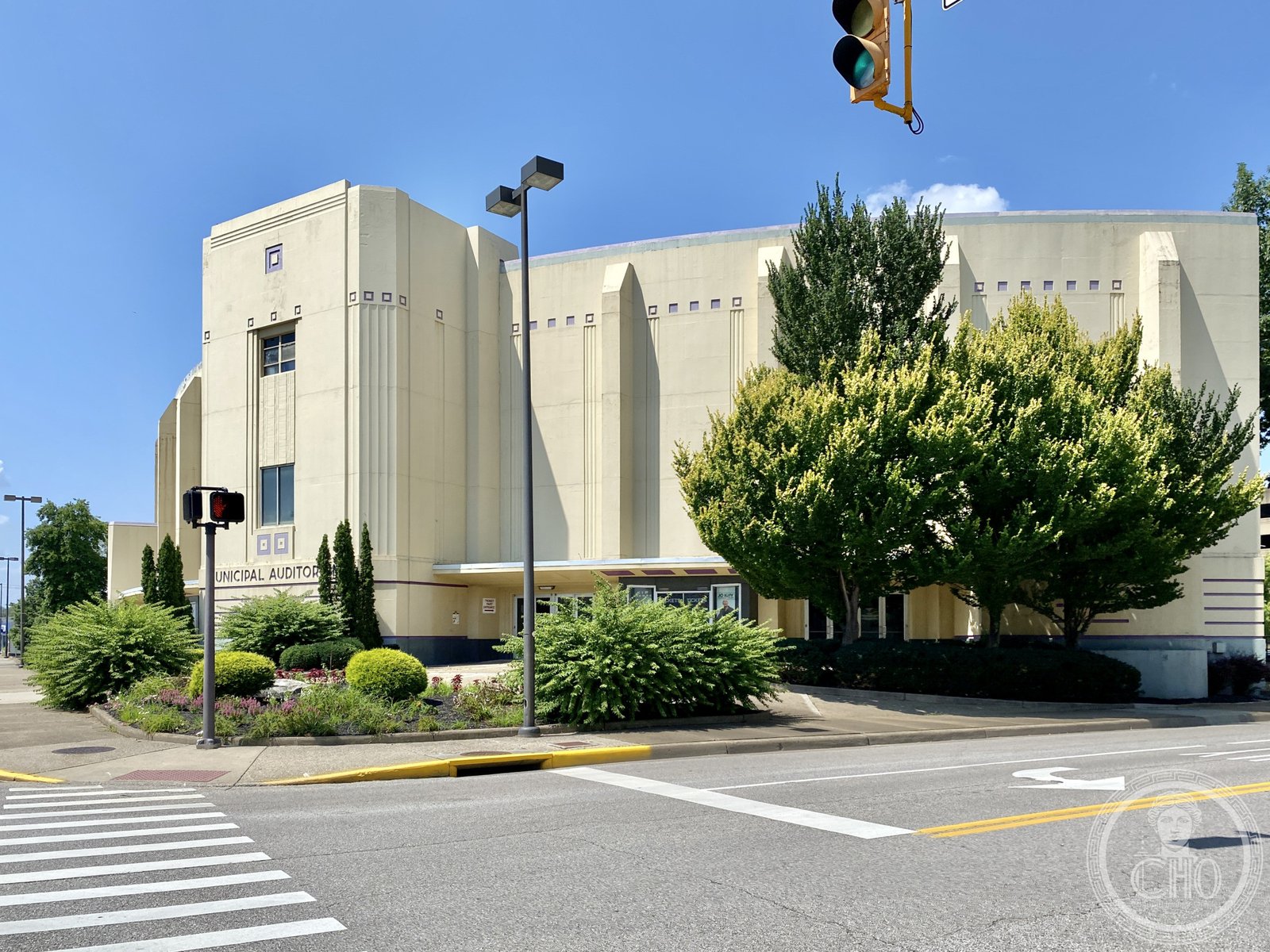
West Virginia’s largest theater, built with New Deal funds and dedicated to 5,000 citizens in 1939, where Hank Williams was scheduled to play the night he died — an Art Deco civic monument now closed after structural concerns emerged in 2024.
At a glance
The Charleston Municipal Auditorium at 224 Virginia Street East is the largest theater in West Virginia, seating 3,483 across orchestra and balcony levels. Designed by architect Alphonso Wysong in the Art Deco style and built between 1937 and 1939 with $212,000 in Public Works Administration funding as part of Franklin Roosevelt’s New Deal, it opened on November 4, 1939 in a ceremony attended by approximately 5,000 people. For eight decades it served as Charleston’s principal venue for concerts, conventions, and Broadway touring productions. It is listed on the National Register of Historic Places (1999) and was closed in February 2024 following structural concerns.
Key facts
- Opened: November 4, 1939
- Architect: Alphonso Wysong
- Style: Art Deco
- Built: 1937–1939
- Construction cost: $500,000 total ($212,000 PWA grant + city share)
- Capacity: 3,483 (2,377 orchestra + 1,106 balcony) — largest theater in West Virginia
- Stage: 65 × 85.5 feet
- Address: 224 Virginia St. E., Charleston, WV 25301
- NRHP: November 22, 1999 (ref. 99001398)
- Status: Closed February 2024; future under study as of 2025
History
By the mid-1930s, Charleston’s growth as West Virginia’s capital city had outpaced its available assembly halls. Larry Silverstein of the Community Music Association organized a successful bond referendum on December 29, 1936, securing the city’s contribution toward a $500,000 auditorium. The project advanced as a Public Works Administration project, and the PWA ultimately contributed $212,000. Construction lasted from 1937 to 1939; the opening ceremony on November 4, 1939 drew thousands to what the regional PWA administrator called a facility that “compared favorably with some of the finest auditoriums in the United States.”
The auditorium became one of the South’s notable concert stops. Ray Charles performed here in 1951, 1956, and 1960; Chuck Berry played from 1955 through 1961; Johnny Cash appeared in 1959 and 1968; AC/DC, Billy Joel, and Fleetwood Mac all took its stage. The building carries a poignant footnote in music history: Hank Williams was booked for a New Year’s Eve show on December 31, 1952, but bad weather prevented his flight from Nashville. En route by car to a New Year’s Day show in Canton, Ohio, Williams died of heart failure near Oak Hill, West Virginia — never having played the Charleston engagement he had been due to headline that night.
In February 2024, engineers conducting a routine structural assessment identified safety concerns serious enough to warrant closure. The City Council allocated $1 million in January 2025 to fund a detailed study of the building’s future. Whether the auditorium will be restored, repurposed, or demolished remains an open question.
What you see
Alphonso Wysong’s design applies Art Deco vocabulary to the challenge of a large public civic building: the Virginia Street facade presents a balanced, symmetrical composition in masonry with the restrained geometric ornament characteristic of late 1930s institutional Art Deco. The influence of the PWA’s preference for durable, dignified public architecture — stripped classical in spirit, Moderne in detail — is evident in the building’s massing and material quality.
Inside, the auditorium’s principal achievement is scale disciplined by proportion: at 3,483 seats, it is large enough for major touring productions yet designed so that the balcony maintains proximity to the stage. The 65-by-85.5-foot stage accommodated full Broadway companies and major orchestras equally. The interior decorative language follows the exterior in applying Deco geometry to surfaces where an earlier generation would have used historicist ornament.
Practical information
- Address: 224 Virginia St. E., Charleston, WV 25301
- Current status: Closed since February 2024; interior not accessible to the public
- Exterior viewing: The Virginia Street facade is visible from the sidewalk
- Future: The City of Charleston commissioned a feasibility study in 2025 to determine the building’s future
Getting there
The Charleston Municipal Auditorium stands on Virginia Street in downtown Charleston, the state capital. Yeager Airport serves the city with connections to Atlanta, Charlotte, and Chicago. Downtown Charleston is compact and walkable from the Capitol complex. The Amtrak Cardinal stops at the Charleston station; the building is a short drive from the Kanawha River waterfront.
Nearby
- West Virginia State Capitol — 0.6 miles east; Cass Gilbert’s gold-domed capitol on the Kanawha River
- Sunrise Museum (Sunrise Mansion) — 1 mile southeast; art museum in a 1905 Neoclassical mansion
- Clay Center for the Arts and Sciences — 0.3 miles; contemporary arts and science complex on the riverfront
- Hank Williams Memorial (Oak Hill, WV) — 40 miles south on US-19; near the site where Williams died on January 1, 1953
Sources
- Wikipedia: Charleston Municipal Auditorium
- National Register of Historic Places nomination form (ref. 99001398, November 22, 1999)
- West Virginia Division of Culture and History — National Register nomination PDF
- Charleston Gazette; Charleston Daily Mail (1936–1939 construction reporting)
Find it on the map
See this place and what’s around it →Record researched and written by Luigi De Marchi for Cultural Heritage Online, 2026.
📷 Become a Cultural Heritage Online photographer
Share your photos of places: they stay published under your name as the author. The more they're seen, the more you get noticed — and soon a contest will reward the most appreciated photos.
Log in or sign up free to add a photoIs this page about you?
This page is read by travellers and heritage enthusiasts who find it on Google. Tell us how you are connected to this place and we will take it from there.