
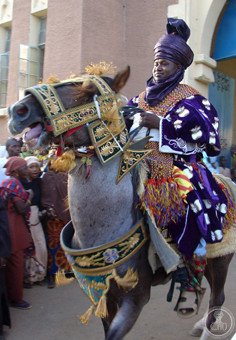
An annual equestrian festival of mounted parades, ceremonial homage, and Hausa royal tradition, celebrated across Northern Nigeria following Ramadan and the Islamic feast days.
In UNESCO’s words
In Nigeria, Durbar is a procession of about 10,000 men on horses, and men and women on foot. It takes place during the ninth and twelfth months of the Muslim calendar to mark the Eid el-Fitr and Eid el-Kabir every year. The central figure of the Durbar procession is the Emir and his palace courtiers, officials and bodyguards. There are four processions, each serving a specific purpose and having its own timing and costumes. Each procession begins with gun salutes at one of the three gates to the Emir’s palace and ends with the same gun salutes at a different gate. Much of the knowledge and skills related to Durbar – including leather work, weaving, dyeing, embroidery and blacksmithing – are transmitted through informal training and hands-on practice within groups. Certain skills, such as horse preparation, riding and drumming, are taught on a weekly basis and intermittently. Durbar unites people of all ethnicities, genders and ages, and is an opportunity to showcase the skills and practices of the different tribes of the community. The Emir’s procession passes through the various quarters to acknowledge their contributions to community development. By paying homage to their Emir, the people express their acceptance and support.
Official description, UNESCO Intangible Cultural Heritage List — Durbar in Kano
At a glance
Durbar is a procession involving approximately 10,000 people—riders on horses and participants on foot—that takes place in Nigeria during the Muslim calendar months that mark Eid el-Fitr and Eid el-Kabir. The Emir leads the procession, accompanied by palace courtiers, officials, and bodyguards. Four separate processions occur, each with distinct purposes, timing, and costumes. Each procession begins and ends with gun salutes at different gates of the Emir's palace.
Origins & history
Durbar dates back over 200 years, emerging when horses were first deployed in warfare in Kano, the largest city in Northern Nigeria and former capital of the Kingdom of Kano. The festival transformed that martial tradition into a cultural anchor—a ceremonial reaffirmation of rulership and community identity that has remained central to Hausa life across the emirate cities of Arewa.
The practice
Durbar consists of four distinct processions, each serving specific purposes and featuring unique costumes. Gun salutes mark the beginning and end of each procession at the gates of the Emir's palace. The knowledge and skills that support Durbar—leather work, weaving, dyeing, embroidery, and blacksmithing—are passed on through informal training and hands-on practice within community groups. Specialized skills such as horse preparation, riding, and drumming receive structured instruction through weekly lessons and periodic teaching.
Cultural significance
Durbar unites people of all ethnicities, genders, and ages, providing a platform to display the different skills and practices of the community's various tribes. The Emir's procession passes through different quarters, acknowledging each area's contributions to community development. Through paying homage to the Emir, participants express their acceptance and support, reinforcing social bonds and collective identity.
Key facts
- Country: Nigeria
- Inscribed: 2024
- UNESCO list: Representative List of the Intangible Cultural Heritage of Humanity
- UNESCO reference: 01895
- UNESCO vocabulary: Costumes; Procession; Religious practice
- Map: Kano — the locality named in UNESCO’s official description of this element
Where to experience it
Durbar processions take place in Nigeria during the ninth and twelfth months of the Muslim calendar, marking Eid el-Fitr and Eid el-Kabir. The spectacle features approximately 10,000 participants on horseback and on foot, with the Emir at the centre accompanied by palace officials and courtiers. Four distinct processions, each with specific purposes and costumes, begin and end with gun salutes at different gates of the Emir's palace. Visitors can witness the intricate craftsmanship displayed throughout the celebration – leather work, weaving, dyeing, embroidery and blacksmithing – all integral to the tradition. The processions pass through various quarters of the community, offering an opportunity to observe how different tribes contribute their skills and practices to this unifying cultural event.
Sources & resources
- UNESCO — official element page: Durbar in Kano
- UNESCO — open data record: Intangible Heritage List, reference 01895
- UNESCO — official video: UNESCO film on this element — embedded on this page
- UNESCO — official photograph: The women and palace musicians ushering the Emir of Kano to the outer court of the palace for the bodyguards prepare him for the horse ride — Ibrahim Ado Kurawa, 2021
- Reference — Wikipedia (secondary): Durbar festival — consulted as a secondary reference, not as confirmation
- Cultural Heritage Online: Our archive and city guides

Find it on the map
See this place and what’s around it →📷 Become a Cultural Heritage Online photographer
Share your photos of places: they stay published under your name as the author. The more they're seen, the more you get noticed — and soon a contest will reward the most appreciated photos.
Log in or sign up free to add a photo