

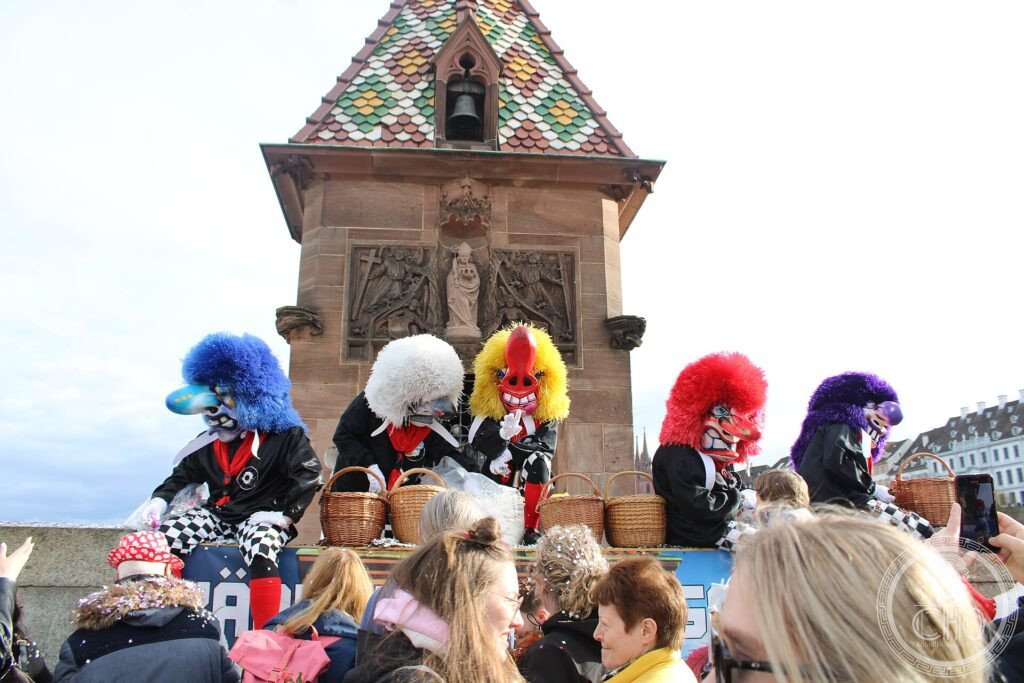
Each February and March, Basel’s streets pulse with masked processions, brass bands, and centuries-old tradition. The Carnival of Basel is Switzerland’s largest carnival—a three-day celebration of music, satire, and community that transforms the city into a living stage.
In UNESCO’s words
Beginning on the Monday following Ash Wednesday and lasting exactly 72 hours, Basel Carnival is the largest carnival in Switzerland. Two parades take place on the Monday and Wednesday, bringing together 11,000 costumed carnivalists in parades of fife and drum cliques, floats and carriages. Tuesday is dedicated to children, with concerts and lantern exhibitions, while other events also punctuate the festival. The carnival can be compared to a huge satirical magazine where all visual or rhetorical means are used to make fun of flaws and blunders. Around 20,000 people of any age, social status, origin and political persuasion actively participate in the festival, which attracts around 200,000 Swiss and foreign visitors. The bearers and practitioners form associations of different types, composed equally of men and women. The carnival contributes to social cohesion, promotes tolerance through social criticism and helps safeguard the local dialect. Transmission occurs informally in families taking part for several generations. The ‘cliques’ also play an important role in this regard, with several having a section dedicated to encouraging the next generation. Several pre-carnival events are also organized, allowing for transmission beyond the carnival. The carnival has been successfully safeguarded over past decades thanks to measures taken by the communities as well as the authorities’ constant support.
Official description, UNESCO Intangible Cultural Heritage List — Basel Carnival
At a glance
Basel Carnival is Switzerland's largest carnival, unfolding over exactly 72 hours beginning the Monday after Ash Wednesday. Around 20,000 people of any age, social status, origin and political persuasion actively participate, while approximately 200,000 Swiss and foreign visitors attend. The festival functions as an enormous satirical outlet, using visual and rhetorical means to mock flaws and blunders. Two major parades on Monday and Wednesday feature 11,000 costumed carnivalists organized in fife and drum cliques, floats and carriages, while Tuesday focuses on children with concerts and lantern exhibitions.
Origins & history
The carnival's transmission occurs informally through families who have participated for several generations. The cliques, which are associations composed equally of men and women, play an important role in passing the tradition forward, with several maintaining dedicated sections for younger members. Pre-carnival events organized before the festival itself extend opportunities for learning and participation beyond the main celebration. The carnival has been successfully safeguarded over past decades through community measures and consistent support from authorities.
The practice
Participants organize into associations of different types, equally composed of men and women, and parade in costume. The Monday and Wednesday parades bring together 11,000 costumed carnivalists performing in fife and drum cliques, floats and carriages. Tuesday programming for children includes concerts and lantern exhibitions. Other events punctuate the festival throughout the 72-hour period. The carnival employs visual and rhetorical means to create its satirical commentary.
Cultural significance
The carnival contributes to social cohesion and promotes tolerance through social criticism directed at local and broader concerns. It helps safeguard the local dialect among participants and communities. The festival strengthens bonds across generations and neighborhoods, reinforcing shared identity and values among people of all ages, social statuses, origins and political persuasions. For the community, the carnival serves as a vital expression of collective life and cultural continuity.
Key facts
- Country: Switzerland
- Inscribed: 2017
- UNESCO list: Representative List of the Intangible Cultural Heritage of Humanity
- UNESCO reference: 01262
- UNESCO vocabulary: Carnival; Masks
- Map: Basel — the locality named in UNESCO’s official description of this element
Where to experience it
Basel Carnival takes place across the city's streets, squares, and indoor venues during the three-day period beginning the Monday after Ash Wednesday, typically in late February or March. Visitors can experience two major parades on Monday and Wednesday featuring 11,000 costumed carnivalists, fife and drum cliques, floats and carriages. Tuesday offers children's concerts and lantern exhibitions. The festival attracts around 200,000 Swiss and foreign visitors annually who come to witness this satirical celebration where costumed participants and associations mock social flaws and current events through costume, music and rhetoric.
Sources & resources
- UNESCO — official element page: Basel Carnival
- UNESCO — open data record: Intangible Heritage List, reference 01262
- UNESCO — official photograph: Photograph of this element — Gabi Christ — Fasnachts-Comité, 2015
- Reference — Wikipedia (secondary): Carnival of Basel — consulted as a secondary reference, not as confirmation
- Cultural Heritage Online: Our archive and city guides

Find it on the map
See this place and what’s around it →📷 Become a Cultural Heritage Online photographer
Share your photos of places: they stay published under your name as the author. The more they're seen, the more you get noticed — and soon a contest will reward the most appreciated photos.
Log in or sign up free to add a photo