
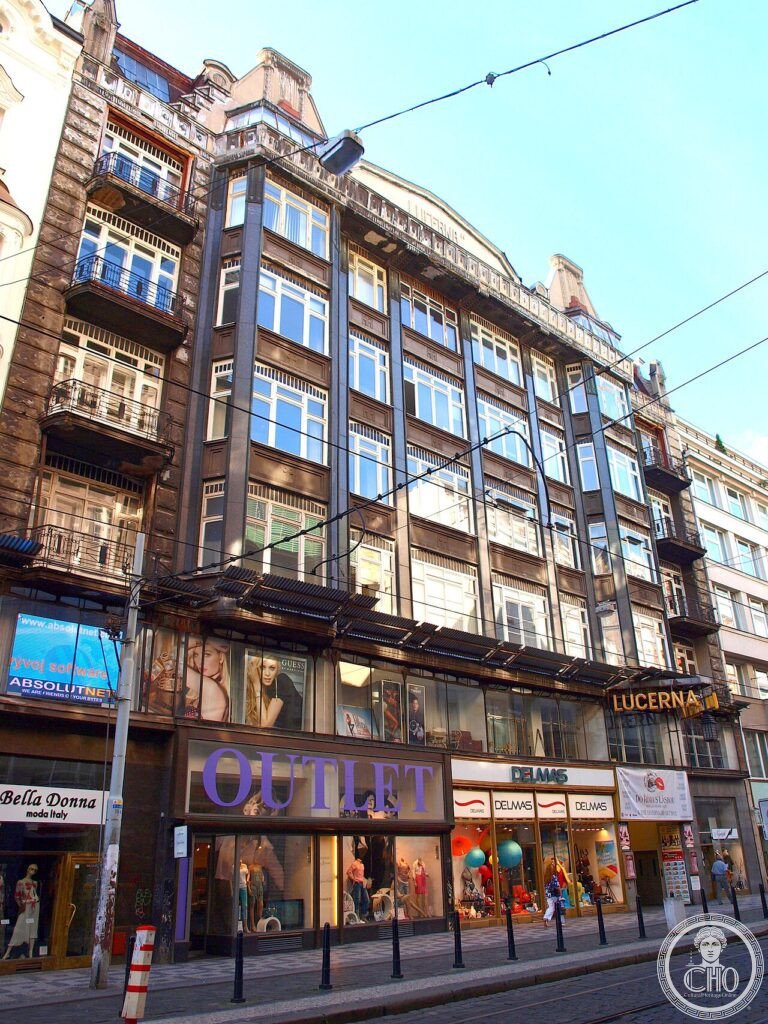

A city under one roof, built by the president’s grandfather: the Lucerna Palace threads cinema, ballroom, café and shops along a marble passage — with Saint Wenceslas riding an upside-down horse above the crowd.
At a glance
Lucerna Palace fills a whole block between Štěpánská and Vodičkova streets, a step off Wenceslas Square. Built in stages between 1907 and 1921 by the construction engineer and developer Vácslav Havel — grandfather of the playwright-president Václav Havel — it was among the first reinforced-concrete buildings in Prague: the structural engineer Stanislav Bechyně drew up one of the earliest reinforced-concrete skeletons in Europe for it. Lucerna invented a building type for the city: the palace of passages, where entertainment, commerce and cafés share a glazed interior street.
Key facts
- Built: 1907–1921, in stages
- Developer-designer: Vácslav Havel, with structural engineer Stanislav Bechyně
- Structure: Among the first reinforced-concrete buildings in Prague; one of the earliest such skeletons in Europe
- Inside: Great Hall, Marble Hall, Lucerna cinema, Lucerna Music Bar, cafés and shops along the passage
- Passage: Connects Štěpánská and Vodičkova streets
- Modern icon: David Černý’s Kůň (1999) — Saint Wenceslas astride an upside-down horse — hangs in the atrium
- GPS: 50.08113, 14.42582 — View on Google Maps
- Today: Working cultural complex, partly returned to the Havel family after 1989
History
Vácslav Havel senior conceived Lucerna as speculative entertainment infrastructure on a scale Prague had never seen — and financed, built and named it himself (lucerna means lantern). Opened in stages from 1907 and completed in 1921, its Great Hall became the city’s premier venue for balls, boxing matches, jazz concerts and political rallies; the cinema screened premieres for a century; the café fed the New Town’s daily theatre. The palace stayed in family hands until nationalisation in 1948 and returned in restitution after 1989 — the president’s family recovering the building their grandfather built. Today the Lucerna Music Bar, the cinema and the halls keep the original programme running, and the passage remains what it was designed to be: a covered piece of the city, open to anyone walking through.
What you see
Outside, Lucerna wears the late Secession soberly — bay windows, restrained stucco, big glazed surfaces on Vodičkova. The event is inside: the passage runs through the block under glass, lined in marble and brass, swelling into the domed atrium where David Černý’s upside-down horse has hung since 1999, deadpanning at the equestrian Saint Wenceslas up on the square. Stairs descend to the Great Hall — a concrete-framed ballroom that was engineering news in its day — and the Marble Hall above. The reinforced-concrete frame is the invisible protagonist: it is what allowed halls of this span to stack inside a city block in 1910s Prague.
Practical information
- The passage is open daily as a public route; cinema, café and music bar keep independent hours
- Černý’s horse hangs in the atrium near the Vodičkova entrance — free to see
- The rooftop terrace opens seasonally with guided access — check current arrangements locally
- Concerts at Lucerna Music Bar and the Great Hall are the way to see the interiors at full tilt
Getting there
Enter from Vodičkova (trams 3, 9, 14, 24 stop at Václavské náměstí/Vodičkova) or from Štěpánská. Můstek and Muzeum metro stations are both within five minutes; the palace sits mid-block on the south side of Wenceslas Square.
Nearby
- Koruna Palace — the crown-topped geometric Secession palace at the foot of the square
- Grand Hotel Evropa — the great floral facade across the square
- U Nováků Building — Polívka’s mosaic department store, two minutes along Vodičkova
- Peterka House — Jan Kotěra’s slender Secession facade on the square
Sources
- Radio Prague International — construction history, Bechyně’s reinforced-concrete skeleton, Havel family
- Wikipedia: “Lucerna Palace” — dates, halls, passage, Černý sculpture
- expats.cz / Insight Cities — centenary history and current cultural use
- Wikidata Q3272106 — coordinates and 1907 start date
Find it on the map
See this place and what’s around it →Record researched and written by Luigi De Marchi for Cultural Heritage Online, 2026.
📷 Become a Cultural Heritage Online photographer
Share your photos of places: they stay published under your name as the author. The more they're seen, the more you get noticed — and soon a contest will reward the most appreciated photos.
Log in or sign up free to add a photoIs this page about you?
This page is read by travellers and heritage enthusiasts who find it on Google. Tell us how you are connected to this place and we will take it from there.