
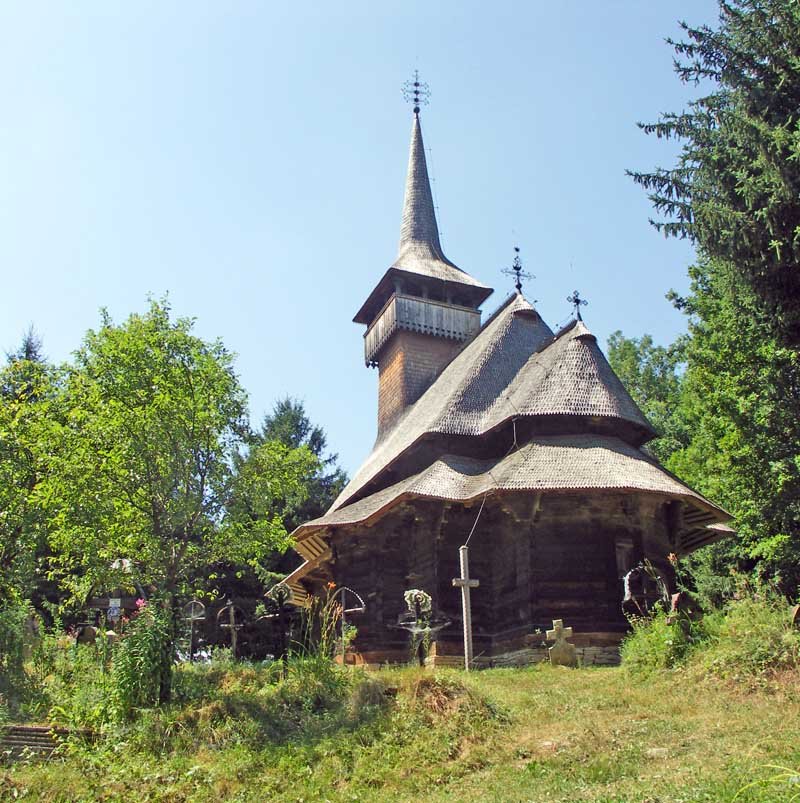
Nearly one hundred Orthodox and Greek-Catholic timber churches rise from the villages of northern Transylvania, their soaring bell towers and intricate Biblical frescoes embodying centuries of folk tradition and religious resilience.
At a glance
The wooden churches of Maramureș represent a distinctive vernacular architecture spanning nearly three centuries. Built from thick logs with characteristically tall, slender bell towers at their western ends, these structures emerged as a creative response to political constraint. The region itself—autonomous since the Middle Ages—preserves one of Europe’s most living cultural landscapes, where traditional dress, village life, and wooden architecture remain integral to daily practice.
History
Construction of these churches began in the 17th century and continued through the 19th, often replacing older structures on sacred sites. They were built in response to prohibitions imposed by Catholic Austro-Hungarian authorities against erecting stone Orthodox churches. This architectural compromise—timber construction as spiritual defiance—allowed communities to maintain their faith while respecting imperial restrictions. Eight churches were designated UNESCO World Heritage Sites in 1999 for their religious and construction significance: Bârsana, Budești, Desești, Ieud, Plopiș, Poienile Izei, Rogoz, and Șurdești.
What you see
The churches present a unified yet varied aesthetic across different periods and villages. Their most striking feature is the massive, steep roof that appears disproportionate to the main body—a structural response to heavy mountain snowfall. Interiors, though sometimes modest in size and light, showcase “naïve” Biblical scenes painted by local artists, their spiritual directness conveying doctrine and devotion in accessible visual language. The tall tower above each entrance serves both spiritual and practical functions, visible across village landscapes.
Cultural significance
These churches embody the cultural identity of Maramureș and represent a unique fusion of Orthodox theology, folk aesthetics, and timber-working tradition. They document a period when architectural constraints became creative opportunities, allowing communities to express faith through locally available materials and inherited craftsmanship. The survival of these structures alongside traditional villages, dress, and customs makes the region an exceptional example of continuous cultural transmission in contemporary Europe.
Key facts
- Country: Romania
- Region: Maramureș, northern Transylvania
- Approximate number of churches: nearly 100
- Building period: 17th–19th century
- UNESCO World Heritage Sites: 8 churches (inscribed 1999)
- Coordinates: 47.8194, 24.0558
Practical information & getting there
Maramureș is accessible by road from Cluj-Napoca or Baia Mare in northern Romania. Several of the eight UNESCO-listed churches are open to visitors; local tourism offices in major villages provide current hours and access information. The region’s small villages are best explored by car or with a local guide. Respectful dress is appropriate when entering active places of worship.
Sources & resources
Find it on the map
See this place and what’s around it →
📷 Become a Cultural Heritage Online photographer
Share your photos of places: they stay published under your name as the author. The more they're seen, the more you get noticed — and soon a contest will reward the most appreciated photos.
Log in or sign up free to add a photoIs this page about you?
This page is read by travellers and heritage enthusiasts who find it on Google. Tell us how you are connected to this place and we will take it from there.