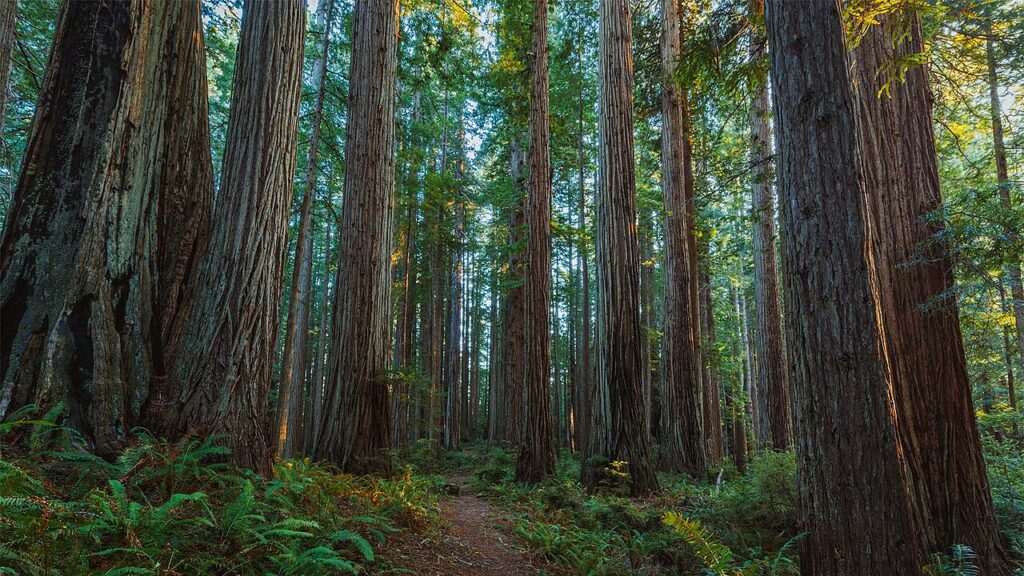
Redwood National and State Parks — inscribed by UNESCO in 1980 — protect the world’s tallest living organisms and the largest remaining old-growth coast redwood forest on Earth: a complex of four protected areas on the northern California coast (Del Norte County and Humboldt County) encompassing approximately 56,000 hectares of ancient coastal redwood (Sequoia sempervirens) forest, with individual trees reaching heights of 115.61 metres (the Hyperion tree, discovered in 2006 CE and confirmed as the world’s tallest known living organism), diameters of up to 7 metres, ages of up to 2,200 years, and a total biomass per hectare that represents the highest of any forest type on Earth.
The coastal redwood, the old-growth forest, and the ecology of the tallest trees on Earth Prairie Creek Redwoods State Park (Fern Canyon, Elk Prairie, Newton B. Drury Scenic Parkway) · Jedediah Smith Redwoods State Park (Stout Grove, the Boy Scout Tree) · Del Norte Coast Redwoods State Park (Damnation Creek Trail) · Redwood National Park (Tall Trees Grove, Lady Bird Johnson Grove, Gold Bluffs Beach) · Avenue of the Giants (outside the UNESCO area but in Humboldt Redwoods State Park) — Del Norte and Humboldt Counties, California
The coastal redwood (Sequoia sempervirens — “ever-living” in Latin, a reference to the species’ extraordinary longevity) is one of two surviving species of the genus Sequoia (the other being the giant sequoia, Sequoiadendron giganteum, which grows in the Sierra Nevada and produces the largest trees by volume but not by height). The coastal redwood evolved approximately 240 million years ago (in the Triassic period) when the redwood family (Taxodiaceae) was distributed across the northern hemisphere; today it exists only in a narrow coastal strip approximately 700 km long and 50 km wide along the Northern California and Southern Oregon coast, between the Oregon border and Monterey Bay — a range determined by the coastal fog (the primary source of moisture for the trees during the dry California summers, when fog drip from the dense canopy supplements the limited summer rainfall and maintains the forest floor in a near-constantly moist condition), the mild coastal temperatures (redwoods require frost-free or very-low-frost conditions and cannot survive in the colder interior), and the deep, alluvial soils of the coastal river valleys (where the largest and oldest redwoods grow, in the floodplains of the Smith, Klamath, Mad, and Eel Rivers). The extraordinary height of the tallest coastal redwoods (Hyperion at 115.61 metres, Helios at 114.58 metres, Icarus at 113.14 metres — all in Redwood National Park’s Tall Trees area, discovered and measured by naturalists Chris Atkins and Michael Taylor in 2006 CE using laser rangefinders) results from a combination of factors: the species’ genetic capacity for indeterminate height growth (redwoods do not appear to have a genetically encoded maximum height, continuing to grow upward as long as the hydraulic system can deliver water to the crown), the extraordinary water availability provided by coastal fog (fog drip in the densest redwood groves can add the equivalent of 25–40 cm of precipitation per year to the approximately 100–150 cm of winter rainfall), the deep alluvial soils that provide unlimited root expansion, the fog-buffered temperature regime that extends the growing season, and the resistance of the redwood’s bark (which contains tannins that make it highly resistant to fire, insects, and fungal decay — allowing trees to survive for centuries without the structural failures that limit the height of less durable trees). The old-growth redwood ecosystem (the ancient, multi-aged forest with trees of varying ages from seedlings to 2,000-year-old giants, abundant standing dead wood and fallen logs, and a complex understorey of ferns, sorrel, mosses, and shade-tolerant plants) provides habitat for a suite of species including the Northern spotted owl (Strix occidentalis caurina — the federally threatened subspecies whose 1990 CE listing under the Endangered Species Act triggered the most contentious environmental conflict in the Pacific Northwest’s history, the “timber wars” of the 1990s CE), the marbled murrelet (Brachyramphus marmoratus — the only seabird in North America known to nest in old-growth forests, laying its single egg directly on large horizontal limbs of old-growth trees many kilometres from the ocean), the Roosevelt elk (Cervus canadensis roosevelti — the largest subspecies of elk in North America, with herds of 30–100+ animals visible in the Elk Prairie area of Prairie Creek Redwoods State Park and in Gold Bluffs Beach), and the Pacific giant salamander (Dicamptodon tenebrosus — one of the largest terrestrial salamanders in North America). The old-growth redwood forests that now constitute the protected areas represent only approximately 5% of the original old-growth redwood range: between 1850 and 1980 CE, approximately 95% of the original coastal redwood forest (estimated at approximately 800,000 hectares of old-growth at the time of European contact) was logged, leaving the most accessible and commercially valuable stands — the flat valley bottoms and gentle slopes accessible by railroad — almost entirely clearcut. The national park (created in 1968 CE, incorporating three existing state parks created in the 1920s–1940s CE as a result of the Save-the-Redwoods League’s advocacy beginning in 1918 CE) protected approximately 35,000 hectares; a major expansion in 1978 CE added approximately 20,000 hectares of cleared land adjacent to the old-growth, much of which has been in active restoration since the 1980s CE.
Practical information
Redwood National and State Parks are located along US Highway 101 (the Pacific Coast Highway) in the far north of California, approximately 480 km north of San Francisco and approximately 160 km south of the Oregon border. The nearest airports are Arcata/Eureka Airport (ACV, approximately 80 km south of the southern park boundary) and Crescent City’s Jack McNamara Field (CEC, approximately 20 km north of the northern park boundary). There is no scheduled public transport to the parks. The park complex includes four connected areas: from south to north, Redwood National Park (the Thomas H. Kuchel Visitor Center on US 101 at Orick is the main orientation point; the Tall Trees Grove requires a free permit obtainable from the visitor center; Lady Bird Johnson Grove, a 1.6 km loop through old-growth flat, is 13 km from Orick); Prairie Creek Redwoods State Park (the Newton B. Drury Scenic Parkway, a 16 km alternative to US 101 through pristine old-growth, passing the Elk Prairie and the Prairie Creek Visitor Center; Fern Canyon, a 15 metre deep canyon whose walls are covered floor-to-ceiling in five-finger ferns, accessible by a 2 km loop trail and recognized internationally after appearing in Jurassic Park 2); Del Norte Coast Redwoods State Park (the Damnation Creek Trail, a steep 7 km round-trip descending through old-growth to a secluded beach, considered one of the most beautiful hikes in Northern California); and Jedediah Smith Redwoods State Park (Stout Grove, the most impressive easily accessible old-growth grove, accessed by a short trail from the Howland Hill Road; the Boy Scout Tree Trail, a 10 km round-trip through ancient forest). Gold Bluffs Beach (ocean beach within Prairie Creek, accessible via Davison Road, where Roosevelt elk frequently walk the beach) is a unique experience combining old-growth forest with Pacific coast wildlife. The parks are open year-round; summer (June–August) is peak season with the warmest and driest weather but significant crowds. The best season for solitude and coastal fog atmosphere is October–April, when the parks are quiet, the ferns are lush, and the Roosevelt elk are highly visible.
Frequently Asked Questions
How tall can a coastal redwood grow and what determines the maximum height of a tree?
The tallest known coastal redwood (the Hyperion tree, measured at 115.61 metres in 2006 CE by Chris Atkins and Michael Taylor using a laser rangefinder and verified by subsequent measurements) is taller than the Statue of Liberty including its pedestal (93 metres total), taller than Big Ben clock tower (96 metres), and approximately two-thirds the height of the Eiffel Tower (330 metres). The theoretical maximum height of a tree is determined by the hydraulic limits of the tree’s water-transport system: as a tree grows taller, the gravitational potential that water must overcome to reach the crown increases proportionally, requiring either a corresponding increase in the negative pressure (tension) generated by evaporation from the leaves to pull water up through the xylem (the water-conducting tissue of the trunk and branches) or a reduction in the rate of water delivery. Research by George Koch and colleagues (published in Nature in 2004 CE) investigated the water potential at various heights in the tallest coastal redwoods and concluded that the leaves at the tops of the tallest trees were already operating near the minimum water potential that would allow photosynthesis without causing cavitation (the formation of air bubbles in the xylem, which would interrupt the water column) — suggesting that the tallest redwoods were close to the theoretical hydraulic height limit. Koch et al. calculated a theoretical maximum height of approximately 122–130 metres for the coastal redwood, based on the hydraulic properties of the species’ xylem and the typical water availability in the fog-rich coastal environment. This prediction suggests that the existing tallest trees (approximately 115 metres) are within 10–15 metres of the species’ maximum possible height. The reason no tree reaches its theoretical maximum is that trees rarely achieve optimum growing conditions throughout their entire lifetime: wind damage, branch failure, lightning strikes, drought episodes, insect infestations, and fungal infections periodically remove the top of growing trees before they can reach maximum height, requiring regrowth from lateral branches. The discovery of the Hyperion tree in 2006 CE (14 years after the 1978 expansion of the national park protected the area in which it grows) demonstrated that trees of near-maximum height can survive in protected old-growth forest — suggesting that further growth toward the theoretical maximum is possible if the trees remain undisturbed. The NPS has chosen not to publicise the precise location of the Hyperion and other record-breaking trees in order to prevent the soil compaction and vegetation damage that would result from large numbers of visitors attempting to reach them.
What were the “timber wars” and why did logging of old-growth redwoods generate such intense conflict?
The “timber wars” (the conflict over old-growth forest logging in the Pacific Northwest from approximately the mid-1980s CE through the late 1990s CE) were one of the most intense and sometimes violent environmental conflicts in American history, involving federal court injunctions, criminal prosecutions, direct actions (tree-sitting, road blockades, equipment sabotage), mass arrests, the use of pepper spray on non-violent protesters, and the murder of Earth First! organiser Judi Bari (whose car was bombed in 1990 CE in a case that was never solved). The ecological conflict at the centre of the timber wars was the 1990 CE listing of the Northern spotted owl (Strix occidentalis caurina) as a threatened species under the Endangered Species Act, which required federal agencies (primarily the US Forest Service and Bureau of Land Management, which manage the vast majority of remaining old-growth forest on federal lands in Washington, Oregon, and Northern California outside the national parks) to protect the owl’s habitat — primarily old-growth Douglas fir, western hemlock, and Sitka spruce forest with large trees, abundant dead wood, and closed canopy — from logging. The spotted owl listing effectively required a dramatic reduction in old-growth logging on federal lands, from approximately 5 billion board feet per year in the late 1980s CE to approximately 1 billion board feet per year by the mid-1990s CE, which the timber industry and its workers argued would destroy the regional economy and eliminate tens of thousands of jobs. The 1994 CE Northwest Forest Plan (the Clinton administration’s resolution of the conflict, developed by a team of federal scientists under the leadership of Jack Ward Thomas) attempted to balance spotted owl protection with a sustainable level of timber harvest on federal lands, establishing a system of late-successional reserves (areas of old-growth and mature forest set aside permanently from logging) covering approximately 7.4 million hectares, while maintaining limited logging on a smaller portion of the federal forest. In the private sector, the most contentious battle was over Headwaters Forest (a 3,000-hectare old-growth redwood grove in Humboldt County owned by Pacific Lumber Company, which had been purchased in a hostile takeover by Charles Hurwitz in 1986 CE and was being logged at accelerating rates); the Headwaters Forest Preserve Agreement (1999 CE) transferred the core old-growth to federal and state ownership in exchange for $480 million paid to Pacific Lumber Company, resolving the most heated direct conflict. The spotted owl’s habitat has continued to decline since the Northwest Forest Plan, primarily due to invasion by the barred owl (Strix varia), a larger and more aggressive species native to eastern North America that has spread rapidly through the Pacific Northwest, displacing spotted owls from their territories.
What is the Save-the-Redwoods League and how did it lead to the creation of the redwood parks?
The Save-the-Redwoods League (founded 1918 CE in San Francisco by Madison Grant, John C. Merriam, Henry Fairfield Osborn, and Frederick Russell Burnham — naturalists and conservationists who had witnessed the rapid pace of old-growth redwood logging and concluded that the most accessible and spectacular groves would be completely logged within a generation without protective action) is the primary conservation organisation responsible for the creation of the California state and national redwood parks, through a combination of land purchase, advocacy, and public fundraising spanning over a century. The League’s core strategy in its early decades (1918–1960 CE) was the purchase of threatened old-growth grove from private timber companies and donation to the California State Park System for permanent protection: the League raised money through public subscription and major private donations, then paid market rate for the land (typically the commercial timber value of the trees) to prevent the argument that conservation represented a taking of private property without compensation. The Save-the-Redwoods League’s first major acquisition (the Bull Creek–Dyerville Grove, now the Avenue of the Giants in Humboldt Redwoods State Park — the largest old-growth redwood grove remaining in any California state park) was completed in the 1920s–1930s CE through a combination of donations from John D. Rockefeller Jr. ($2 million), state bond funds, and league fundraising. The three state parks that were later incorporated into the national park complex (Prairie Creek, Del Norte, and Jedediah Smith) were established through League advocacy in the 1920s–1940s CE. The creation of Redwood National Park in 1968 CE and its major expansion in 1978 CE (which the League strongly supported and which added approximately 20,000 hectares of recently logged and partially logged land for ecological restoration) represented the culmination of fifty years of League work. The League remains active today, having purchased and donated to public ownership approximately 89,000 hectares of redwood forest since 1918 CE — an area equivalent to the entire Redwood National and State Parks complex.
EXCERPT: Redwood National and State Parks (UNESCO 1980) — home of the world’s tallest trees: coastal redwoods (Sequoia sempervirens) reaching 115.61 metres (the Hyperion tree, the tallest living organism on Earth), up to 2,200 years old, in ancient old-growth forest representing 5% of the original range, home to Roosevelt elk, Northern spotted owls, and marbled murrelets.
META: UNESCO World Heritage Sites near Redwood National Parks California USA: Yosemite National Park 600 km south, Glacier Bay Wrangell-St. Elias 2500 km north — California-Oregon-Alaska wilderness circuit from the coastal redwoods to the Sierra Nevada granite and the Alaskan glacial wilderness.
Sources
- S1 — UNESCO World Heritage Centre — Redwood National and State Parks (Ref. 134) — https://web.archive.org/web/20230601000000/https://whc.unesco.org/en/list/134/
- S2 — National Park Service — Redwood National and State Parks — https://www.nps.gov/redw/
Spotted an error? Write to the editors and we correct it the same day.