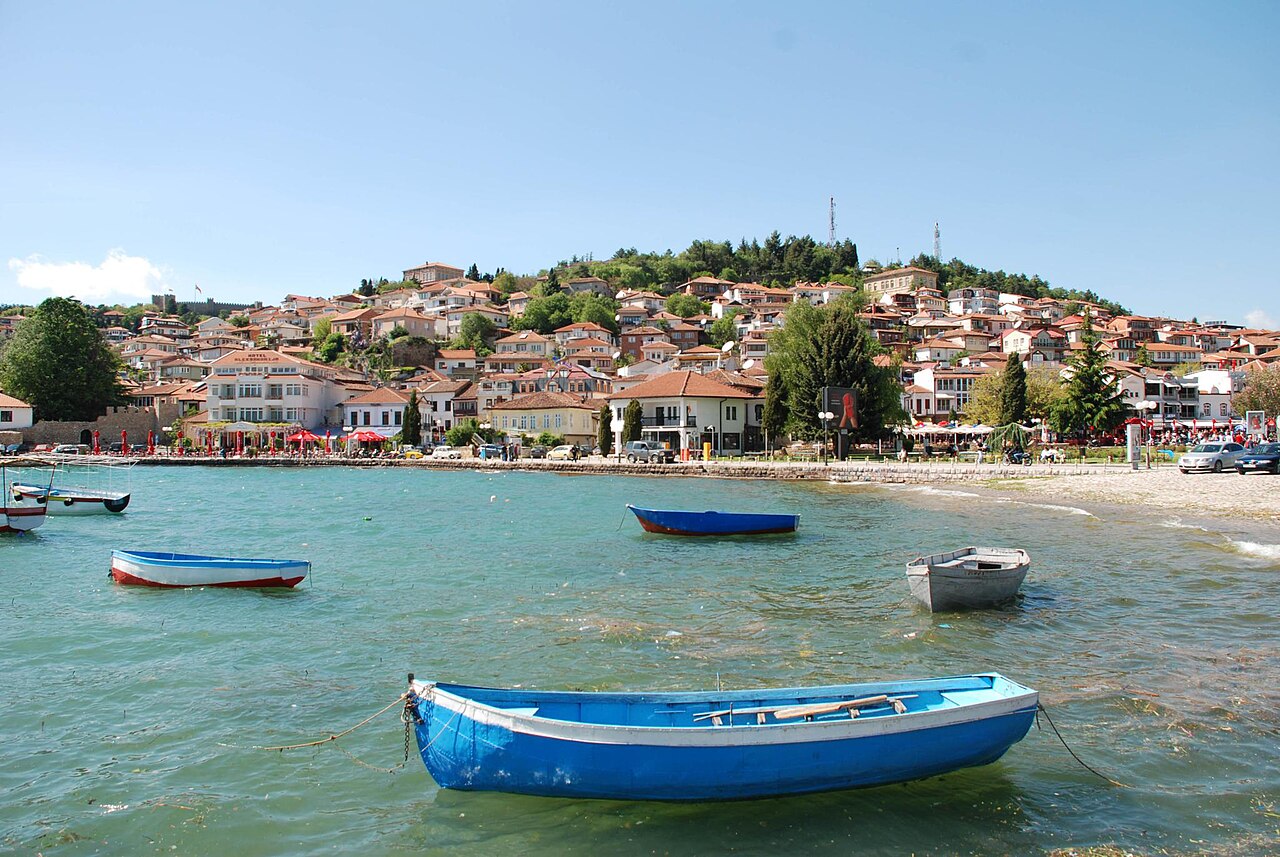
The Natural and Cultural Heritage of the Ohrid Region, inscribed in 1979 and extended in 1980 and 2019, is one of the few UNESCO sites in the world where natural and cultural values are so completely fused — a Macedonian lake city of extraordinary Byzantine heritage (365 churches, the first Slavic university, the Cyrillic alphabet’s origin) set on the shores of Lake Ohrid, one of the oldest and most biodiverse lakes in the world at 1–3 million years of age.
Ohrid: The Byzantine Jerusalem of the Balkans Southwestern North Macedonia, on Lake Ohrid
The Natural and Cultural Heritage of the Ohrid Region, inscribed in 1979 under criteria (i), (ii), (iii), and (iv) (extended in 1980 to include Lake Ohrid and its Albanian shores as a natural site under criteria (vii)), is one of the oldest UNESCO World Heritage Sites in the Balkans — a recognition of the exceptional concentration of Byzantine religious art and architecture in the city of Ohrid and the extraordinary natural antiquity of Lake Ohrid. Ohrid (ancient Greek Lychnidos, “city of lights”) was one of the most important cities of the medieval Balkans: under the Byzantine Emperor Basil I, the missionary monks Clement and Naum (disciples of Cyril and Methodius, the creators of the Glagolitic script and precursors of the Cyrillic alphabet) established the Ohrid Literary School in 886 CE — the first Slavic-language educational institution and the birthplace of the Cyrillic alphabet as a distinct script (the Glagolitic script of Cyril and Methodius was systematised by Clement of Ohrid into a more accessible form, the Cyrillic script, named for Cyril but substantially developed by Clement). The city also served as the capital of the First Bulgarian Empire under Tsar Samuel (r. 997–1014), who built the fortress (Tsar Samuel’s Fortress, 976–1014) that still stands above the lake, and was the seat of the Ohrid Archbishopric — one of the most important Orthodox ecclesiastical centres in the Balkans until its suppression by the Ottoman-controlled Ecumenical Patriarchate of Constantinople in 1767.
365 Churches and Byzantine Frescoes Ohrid old city and lakeside
Ohrid has traditionally been said to have 365 churches (one for every day of the year) — a hyperbole that reflects the extraordinary density of Byzantine religious buildings in a small area. The actual count is approximately 40–50 surviving churches from the medieval period (ninth to fourteenth centuries), which is nonetheless the highest concentration of Byzantine churches in any city outside Constantinople and Thessaloniki. The most significant are: the Church of Saint Sophia (originally the cathedral of the Ohrid Archbishopric, eleventh century, containing the most complete cycle of eleventh-century Byzantine frescoes in North Macedonia); the Church of Saint Panteleimon (the site of Clement of Ohrid’s original monastery, 886 CE, now a museum); the Church of Saint John at Kaneo (thirteenth century, the most photographed monument in Ohrid — a small domed church on a cliff above the lake, whose position against the water is the iconic image of Ohrid); and the Church of Saint Clement and Saint Panteleimon (rebuilt 1295, the monastery of Plaoshnik, on the hilltop above the lake, with some of the finest Byzantine frescoes in the country). The National Museum of Ohrid (Robevci House, a nineteenth-century Ottoman merchant house) contains the best archaeological collection in North Macedonia, including gold and silver treasures from the Ohrid necropolis.
Lake Ohrid: One of the World’s Oldest Lakes Lake Ohrid, shared between North Macedonia and Albania
Lake Ohrid is one of the oldest and deepest lakes in Europe — estimated to be 1–3 million years old (making it one of the ancient lakes of the world, comparable to Lake Baikal, Lake Tanganyika, and Lake Titicaca), with a maximum depth of 288 metres and extraordinary clarity (Secchi depth up to 22 metres — visibility through the water column, one of the clearest freshwater lakes in the world). The lake’s age has allowed the evolution of an extraordinary number of endemic species (found nowhere else on Earth): over 200 endemic species including the Ohrid trout (Salmo letnica), the Ohrid lake snail (Ohridohauffenia sp.), and dozens of endemic sponge, snail, and invertebrate species. The lake floor at shallow depths contains endemic species of sponge (Ochridospongia rotunda) that grow nowhere else; at depth, relic populations of invertebrates that are the last surviving relatives of ancient Tethys Sea fauna (the ocean that predated the Mediterranean) persist in the cold anaerobic deep waters. The lake is shared between North Macedonia (two-thirds) and Albania (one-third); the Albanian side (including the Lini Peninsula, the ancient city of Pogradec, and the Lin mosaic site — a sixth-century floor mosaic recently discovered) was added to the UNESCO inscription in 2019.
Practical information
Ohrid is 170 km south of Skopje (North Macedonia’s capital); the road journey takes 2.5–3 hours by bus (regular service from Skopje South Bus Station). Ohrid Airport (OHD) has seasonal charter and low-cost flights from several European cities (primarily in summer). The old city and lakeside are walkable; the Church of Saint John at Kaneo (30-minute walk from the main square along the lake promenade) and Tsar Samuel’s Fortress (stairway from the old city) are the principal sights. The summer season (July–August) is the most visited (Ohrid Summer Festival, July–August, music and theatre performances in the ancient theatre and lakeside venues). Boat trips on Lake Ohrid to the Monastery of Saint Naum (29 km south, at the Albanian border, daily boat service in summer) are the most popular day trip. The best season is May–June and September (spring and autumn, warm and uncrowded). North Macedonia uses the denar (MKD); no Schengen requirement.
Frequently Asked Questions
Is Ohrid a UNESCO World Heritage Site?
Yes. The Natural and Cultural Heritage of the Ohrid Region was inscribed in 1979 (cultural values: Ohrid city) and extended in 1980 (natural values: Lake Ohrid). The Albanian shore of Lake Ohrid was added to the inscription in 2019. The site was placed on the UNESCO World Heritage in Danger list in 2017 due to concerns about overdevelopment, inadequate urban management, and the construction of a marina in the protected zone; it was removed from the Danger list in 2021 after North Macedonia implemented protective measures. North Macedonia has 1 UNESCO World Heritage Site (Ohrid). Albania has 4: Butrint (1992/1999), the Historic Centres of Gjirokastra and Berat (2005), the Natural and Cultural Heritage of the Ohrid Region (2019, shared), and the Ancient and Primeval Beech Forests of the Carpathians and Other Regions of Europe (2017/2021, shared).
What is the connection between Ohrid and the Cyrillic alphabet?
The Cyrillic alphabet (used today for Russian, Bulgarian, Serbian, Macedonian, Ukrainian, and many other languages) was developed in Ohrid in the ninth century CE by Saint Clement of Ohrid (840–916), a disciple of Saints Cyril and Methodius. Cyril and Methodius had created the Glagolitic alphabet (c. 862 CE) to write the Old Church Slavonic language for the liturgical and missionary needs of the Slavic peoples; after Methodius’s death (885 CE) and the expulsion of their disciples from Moravia, Clement and Naum came to Ohrid under the protection of Boris I of Bulgaria, where Clement established the Ohrid Literary School and systematised the Glagolitic script into a more accessible form now called Cyrillic (named retrospectively after Cyril, though Clement is credited with its development). The Ohrid Literary School trained an estimated 3,500 clergy and scholars in the Slavic-language liturgy during Clement’s tenure; it is recognised as the oldest Slavic university and the institution from which the Cyrillic alphabet spread across the Slavic world.
Why is Lake Ohrid considered one of the world’s ancient lakes?
Lake Ohrid is classified as an “ancient lake” — a term used for lakes that have persisted for over one million years without complete desiccation or major geological disruption. Most lakes in the world are geologically recent (formed after the last Ice Age, 10,000–15,000 years ago); only 20–30 lakes worldwide are classified as ancient. The ancient lakes are exceptional for biodiversity because their longevity has allowed speciation — the evolution of species unique to that lake that cannot be found anywhere else. Lake Ohrid’s 200+ endemic species (including the Ohrid trout, the Lake Ohrid sardine Alburnus scoranzoides, dozens of snail and sponge species, and relic invertebrate fauna from the ancient Tethys Sea) are the product of its 1–3 million year isolation. The lake’s exceptional clarity (Secchi depth up to 22 metres) results from its deep, well-stratified water column and the absence of significant agricultural runoff; threats to clarity include increased tourist development on the shores, wastewater, and Albanian and North Macedonian agricultural runoff that is now being monitored under the UNESCO management plan.
Sources
- S1 — Grozdanov, Cvetan. Ohrid: Architectural and Cultural Heritage. Macedonian Academy of Sciences, 1990. ISBN 978-86-7244-012-6.
- S2 — Fine, John V. A. The Early Medieval Balkans. University of Michigan Press, 1983. ISBN 978-0-472-08149-3.
Spotted an error? Write to editorial@culturalheritageonline.com and we correct it the same day.