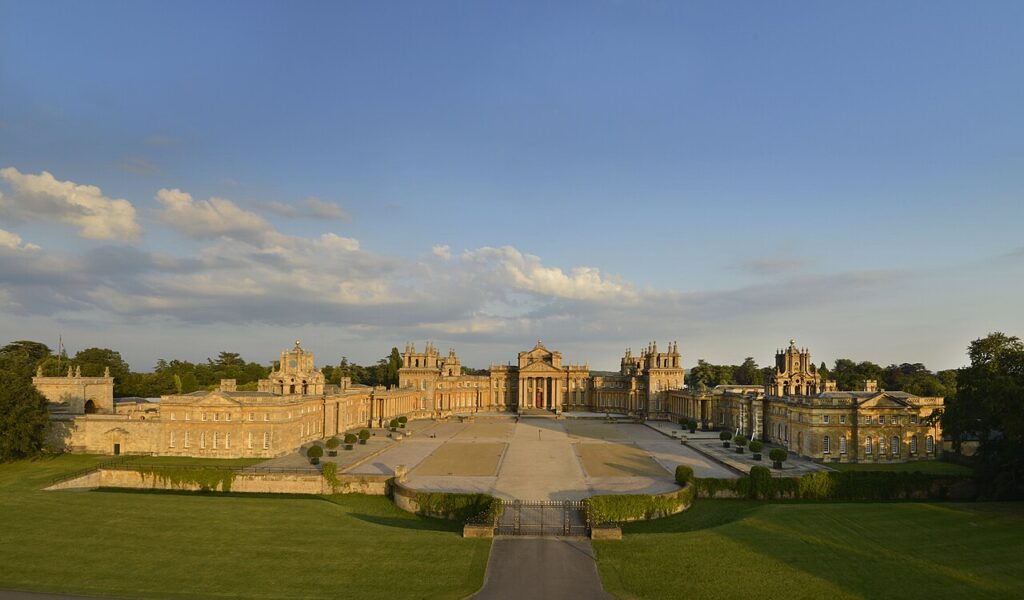
Blenheim Palace — inscribed by UNESCO in 1987 — is the great Baroque palace built at Woodstock, Oxfordshire, as a gift from Queen Anne and the English nation to John Churchill, 1st Duke of Marlborough, following his decisive victory at the Battle of Blenheim (1704 CE) against the French and Bavarian forces of Louis XIV: the only non-royal, non-episcopal country house in England to bear the title “palace,” designed by John Vanbrugh and Nicholas Hawksmoor (1705–1722 CE) in a monumental Baroque style unique in England, set in a landscape garden remodelled by Lancelot “Capability” Brown (1764–1774 CE), and the birthplace of Sir Winston Churchill (1874 CE).
Vanbrugh’s Baroque architecture, the landscape park, and Churchill’s birthplace Great Hall and Saloon (Vanbrugh/Hawksmoor, 1705–1722 CE) · Long Library and First State Room · Capability Brown’s landscape (1764–1774 CE) · Churchill Exhibition — Woodstock, Oxfordshire
Blenheim Palace (its name derived from the German village of Blindheim/Blenheim on the Danube in Bavaria, where the Duke of Marlborough’s combined British-Dutch-German-Austrian army defeated the French and Bavarian forces of Louis XIV on 13 August 1704 CE in the most decisive British military victory since Agincourt) was the product of a specific act of national gratitude: Queen Anne and the Tory government, wishing to commemorate and reward the victory, granted the Duke the royal manor of Woodstock (a medieval royal hunting ground in Oxfordshire) together with the funds to build a palace on it. The commission was given to John Vanbrugh (1664–1726 CE), a playwright turned architect who had recently completed the baroque Castle Howard in Yorkshire (his first major architectural work, still one of the most impressive Baroque buildings in England) in partnership with Nicholas Hawksmoor (1661–1736 CE), who had been trained by Christopher Wren and was the most technically accomplished architect in England at the time, responsible for much of the detailed design and construction management that Vanbrugh’s dramatic but imprecise drawings required. The palace they designed (1705–1722 CE, a building process fraught by the political downfall of Marlborough in 1711 CE, his dismissal from all offices, and his exile — during which construction halted — before his partial rehabilitation after Queen Anne’s death in 1714 CE) is the most ambitious and idiosyncratic Baroque building in England: a building of enormous scale (the main facade is approximately 260 metres wide, the total floor area approximately 18,700 square metres) whose dominant aesthetic is not the graceful ornament of the French Baroque (the direct model for the English aristocracy’s country house ambitions in the early 18th century) but rather a monumental austerity — massive towers, emphatic rustication, heavy cornices, and giant-scale architectural elements that give the palace the visual weight of a military fortification. Vanbrugh was famously interested in what he called “the military manner” in architecture, and Blenheim Palace is its supreme expression: a building that reads as a monument to military victory before it reads as a private house. The interior programme (principally the work of Hawksmoor and the decorative painter Louis Laguerre, whose ceiling paintings in the Saloon — the principal reception room, directly behind the Great Hall — depict Marlborough in triumph surrounded by allegorical figures of the nations he defeated) is more conventional Baroque, with fine English Baroque plasterwork (by Edward Goudge and others), tapestries depicting the campaigns of Marlborough, and state rooms of the kind expected in an aristocratic Baroque palace. The Long Library (from the original scheme a room for the Duchess of Marlborough’s library, converted from a picture gallery in the 19th century CE, 55 metres long — the longest room in any English country house) and the adjacent organ are among the most impressive interior spaces in the palace. Blenheim Palace is the birthplace of Sir Winston Churchill (born 30 November 1874 CE in the first-floor bedroom in the east wing, during his mother’s unexpected early labour while she was attending a house party at the palace — his grandfather was the 7th Duke of Marlborough) and houses a permanent Churchill Exhibition in the palace’s stable block.
The landscape park (approximately 850 hectares, surrounding the palace and accessible to the public) was remodelled in two campaigns: the formal gardens (parterres, cascade, and kitchen garden) laid out by the French garden designer Henry Wise in approximately 1705–1716 CE alongside the palace’s construction, and the radical naturalistic remodelling by Lancelot “Capability” Brown (1764–1774 CE) that swept away almost all of the formal gardens and replaced them with the flowing naturalistic landscape of rolling grass, clumped trees, and the artificial Great Lake (created by damming the River Glyme, flooding the formal canal garden and the lower valley to create a 40-hectare lake with the Column of Victory — a 41-metre stone column topped with a statue of Marlborough — reflected in the water). Brown’s Blenheim landscape is considered one of his masterworks, creating the “natural” English landscape that became the template for landscape design across Europe in the late 18th and early 19th centuries CE. The formal gardens on the east and west sides of the palace were re-created in the French formal style in the early 20th century CE (water terraces on the west, Italian garden on the east) under the 9th Duke of Marlborough and the garden designer Achille Duchêne.
Practical information
Blenheim Palace is located at Woodstock, Oxfordshire, approximately 13 km north of Oxford city centre. By public transport: frequent S3 bus service from Oxford Gloucester Green bus station to Woodstock (approximately 30 minutes), with the palace entrance approximately 5 minutes’ walk from the bus stop in Woodstock town centre. By rail: Oxford railway station (from London Paddington approximately 55 minutes, from Birmingham New Street approximately 1 hour); connecting S3 bus from Oxford. Entry to the palace and gardens requires a ticket (significant discount for pre-booking online; National Trust members have discounted entry but the palace is independently managed by the Duke of Marlborough’s estate and NT membership does not provide free entry). Allow 2–3 hours for the palace interior (state rooms, Long Library, Churchill Exhibition) and 2–3 hours for the landscape park (lake walk, walled gardens, pleasure gardens). The palace and park are open year-round, but the formal gardens and some palace rooms are closed in winter (November–March). Woodstock town itself (medieval market town with the Oxfordshire Museum) is worth an hour. Best season: May–September for the formal gardens in flower; October for autumn colour in the park.
Frequently Asked Questions
Who was the Duke of Marlborough and what was the Battle of Blenheim?
John Churchill, 1st Duke of Marlborough (1650–1722 CE), was the most successful British military commander between the Duke of Wellington and the Duke of Marlborough himself — a confusing formulation that reflects his essentially unique standing in British military history as the commander who broke French military supremacy in Europe in a series of battles (Blenheim 1704 CE, Ramillies 1706 CE, Oudenarde 1708 CE, Malplaquet 1709 CE) during the War of the Spanish Succession (1701–1714 CE, a conflict over the succession to the Spanish throne that pitted England, the Dutch Republic, and the Holy Roman Empire against France and Spain). The Battle of Blenheim (13 August 1704 CE, near the village of Blindheim/Blenheim on the Danube in Bavaria) was the most decisive of these victories: the combined Anglo-Dutch-German-Austrian army under Marlborough and the Holy Roman Emperor’s commander Prince Eugene of Savoy defeated the main French-Bavarian army, capturing the French commander Marshal Tallard and approximately 13,000 French soldiers — the largest French military disaster since the Hundred Years War and the defeat that confirmed the limits of Louis XIV’s power to dominate Europe. Marlborough was rewarded with the Woodstock estate and the parliamentary grant of funds to build Blenheim Palace, an unusually direct political commemoration of a military victory that was modelled on the French tradition of celebrating royal victories through architecture (most notably Versailles, which was itself a monument to the martial glories of Louis XIV — the enemy whom Marlborough had defeated). Marlborough’s political influence declined sharply after 1710 CE (he was accused of prolonging the war for personal profit and dismissed from all offices by Queen Anne in 1711 CE, going into exile with his wife Sarah), and the construction of Blenheim Palace was interrupted during his exile before his partial rehabilitation after Queen Anne’s death in 1714 CE.
Who was John Vanbrugh and what makes Blenheim Palace unique among English country houses?
Sir John Vanbrugh (1664–1726 CE) is one of the most remarkable figures in the history of English architecture: a man who came to architecture late (his first major architectural commission, Castle Howard in Yorkshire, was in 1699 CE, when he was 35 years old and had been a playwright for the previous decade, with no formal architectural training) and who developed a style of Baroque architecture so personal and idiosyncratic that it has never been fully categorised within the standard histories of English architecture. Vanbrugh’s Baroque (sometimes called the “English Baroque,” though Vanbrugh’s work is quite different from the more direct translations of Italian or French Baroque practiced by his contemporary rivals) is characterised by: enormous scale (both Castle Howard and Blenheim Palace are substantially larger than any previous English country house); dramatic massing (the complex silhouette of towers, cupolas, wings, and colonnades creating a theatrical skyline unlike the relatively simple profiles of most Baroque palaces); aggressive rustication (the heavy channelled stonework of the lower courses suggesting a military fortification); and a deliberate dramatic obscuring of the approach (so that the full facade of the building is not revealed until the visitor is close — a deliberate surprise rather than the gradual revelation of most French Baroque garden design). Vanbrugh described his own aesthetic preference as “the Castle Air” — the quality of massiveness, irregular silhouette, and historical association he admired in medieval castles — and Blenheim Palace is unique among English country houses in combining this castle-like aesthetic with Baroque symmetry and scale. The palace is also unique in its explicit political-commemorative function: no other English country house was built as a national monument to a specific military victory, and this commemorative function explains the emphasis on architectural grandeur over domestic comfort that made the building notoriously difficult to inhabit (the Duchess of Marlborough complained bitterly throughout the construction that Vanbrugh had sacrificed comfort to grandeur at every opportunity).
How did Capability Brown transform the Blenheim landscape and what is his significance in garden history?
Lancelot “Capability” Brown (1716–1783 CE, nicknamed “Capability” because of his habit of telling clients that their estates had “great capabilities for improvement”) is the most influential landscape designer in British history and the creator of what became the dominant international paradigm of “the English landscape garden” — a designed landscape made to look entirely natural, with undulating grass, scattered groups of trees, and a serpentine lake or river, as distinct from the geometric formality of the French or Dutch garden styles that had previously dominated European garden design. Brown’s work at Blenheim (1764–1774 CE) is considered one of his two or three masterworks (along with the grounds at Petworth, Harewood, and Chatsworth): his transformation of the formal garden complex created by Henry Wise and the Duchess of Marlborough in the early 18th century CE involved the removal of virtually all the formal parterres, cascades, and canal garden, and their replacement with the current naturalistic landscape of rolling grass sward, carefully placed tree clumps, and — most dramatically — the creation of the Great Lake (approximately 40 hectares of open water) by damming the River Glyme with a causeway that still carries the main drive through the park. The dam raised the water level of the Glyme sufficiently to flood the formal canal garden entirely and to create a landscape in which Vanbrugh’s original bridge (a massive stone bridge of 33-metre central span, originally an almost comically over-scaled structure crossing a modest canal) became the dramatic focal point of a lake view: the bridge now looks exactly right framed by water and parkland, one of the most celebrated views in English landscape design. Brown’s Blenheim landscape was widely published and visited in the late 18th and early 19th centuries CE and directly influenced the “landscape garden” movement that spread across Europe and North America: the principle of making a designed landscape appear natural was adopted by German, Danish, Swedish, Russian, and American designers as the dominant model for park and garden design throughout the 19th century CE.
EXCERPT: Blenheim Palace (UNESCO 1987) — England’s only non-royal palace, built as a national gift to the Duke of Marlborough after the Battle of Blenheim (1704 CE): John Vanbrugh’s monumental Baroque architecture (1705–1722 CE), Capability Brown’s sweeping naturalistic landscape park with the Great Lake (1764–1774 CE), and Winston Churchill’s 1874 birthplace.
META: UNESCO World Heritage Sites near Blenheim Palace Oxfordshire UK: Stonehenge Avebury 90 km southwest, Palace of Westminster London 90 km southeast — central England heritage circuit from the Baroque palace to the prehistoric sacred landscape and the Gothic parliamentary palace on the Thames.
Sources
- S1 — UNESCO World Heritage Centre — Blenheim Palace (Ref. 394) — https://web.archive.org/web/20230601000000/https://whc.unesco.org/en/list/394/
- S2 — Blenheim Palace Official Estate Portal — https://www.blenheimpalace.com/
Spotted an error? Write to the editors and we correct it the same day.