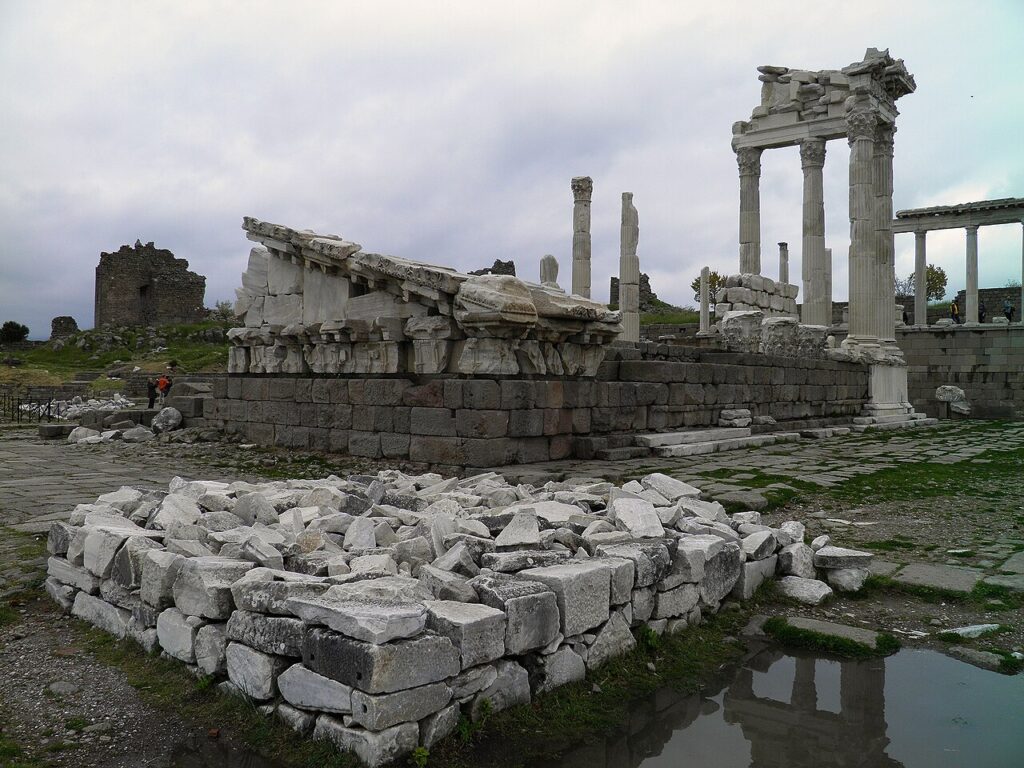
Pergamon and its Multi-Layered Cultural Landscape — inscribed by UNESCO in 2014 — encompasses the ancient city of Pergamon (Greek Pergamon, Latin Pergamum, modern Turkish Bergama) in Izmir Province, northwestern Turkey: a Hellenistic royal capital (241–133 BCE under the Attalid dynasty), a major Roman provincial city (133 BCE–3rd century CE), and a Christian and Byzantine heritage site, built on and around a dramatic 335-metre-high acropolis hill above the Kaikos River valley, whose library (the second-largest in antiquity), the Pergamon Altar (now in Berlin), the Asclepion healing sanctuary, and the Red Basilica constitute the most historically layered archaeological landscape in Aegean Turkey.
The Attalid kingdom, the library, the Pergamon Altar, and the acropolis programme Theatre (steepest in the ancient world) · Trajaneum (Temple of Trajan) · Temple of Athena · Altar of Zeus terrace — within the Upper Acropolis
The Attalid dynasty came to power at Pergamon when Philetaerus, the treasurer of Lysimachus (one of Alexander the Great’s successors), defected to the Seleucid king Antiochus I in 281 BCE, retaining control of the Pergamon treasury of 9,000 talents and establishing an independent dynastic base that expanded over the following century into the Kingdom of Pergamon. The Attalid kings (Philetaerus, Eumenes I, Attalus I, Eumenes II, Attalus II, Attalus III) transformed Pergamon from a modest hilltop fortification into one of the most magnificently planned and monumentally built cities of the Hellenistic world — a royal capital that consciously competed with Alexandria in scholarly and architectural prestige. The most celebrated of the Attalid building programmes was the Library of Pergamon, founded by Eumenes II (197–159 BCE): the second-largest library in the ancient world after the Library of Alexandria (estimated at 200,000 scrolls in the ancient sources), whose collection was housed in a building complex adjacent to the Temple of Athena Polias on the upper acropolis. The library was so famous and its collection so prized that, according to the ancient geographer Strabo and the Roman writer Pliny the Elder, the Ptolemaic kings of Egypt banned the export of papyrus to Pergamon to prevent the library from growing further — forcing the Pergamenes to develop an alternative writing material from treated animal skins, which the Romans called “pergamena” (parchment) in honour of its place of origin. The development of parchment at Pergamon (if the ancient story is accurate) represents one of the most consequential technological contributions to Western civilisation: the codex book form (replacing the papyrus scroll) became possible only because parchment could be cut into rectangular leaves and sewn into quires, enabling the bound book format that replaced the scroll as the dominant book form in late antiquity and preserved the written heritage of classical civilisation through the medieval period. The actual library building (identified as a four-room structure with thick outer walls providing humidity control, attached to the Temple of Athena complex) is one of the few ancient library buildings identified archaeologically; the remains are visible on the acropolis.
The Pergamon Altar (Altar of Zeus, circa 166–156 BCE, built by Eumenes II after the Attalid victory over the Galatians to commemorate the defeat of the barbarian threat to Greek civilisation) was the largest altar in the Greek world: a raised platform approximately 36.44 × 34.20 metres with a projecting western porch accessed by a monumental stairway, its entire base platform (2.30 metres high) decorated with a continuous high-relief sculptural frieze of 113 metres total length depicting the Gigantomachy (the battle between the Olympian gods and the Giants, interpreted as an allegory for the Attalid victory over the Galatians). The quality of the Gigantomachy frieze — with figures of extraordinary dynamism and anatomical detail, individual groupings of gods fighting specific Giants, all carved at nearly three-quarter-round relief depth — represents the summit achievement of Hellenistic baroque sculpture, comparable in ambition to the later Laocoön group. The altar was transported to Berlin in 1878–1879 CE by the German archaeologist Carl Humann (with permission from the Ottoman government) and is now the centrepiece of the Pergamon Museum (Pergamonmuseum) in Berlin, one of Germany’s most visited museums. Turkey has periodically requested the return of the Pergamon Altar; the German government has declined. The altar’s base remains visible at Pergamon as a large stepped platform, but the frieze itself can only be experienced in Berlin. The Theatre at Pergamon — a Hellenistic theatre of approximately 10,000-person capacity, cut directly into the steep acropolis hillside at a slope angle of approximately 30° (the steepest surviving ancient theatre in the world) and offering a dramatic view over the Kaikos valley — was originally designed with a detachable wooden stage building (skene) that was erected for performances and removed afterward to preserve the view; the surviving stone theatre is impressive primarily for its engineering — the way the cavea has been carved from the natural rock of the extremely steep hillside, requiring massive terrace supports on the downhill side.
The Asclepion, Galen of Pergamon, and the Roman-Byzantine healing sanctuary Asclepion healing sanctuary (2 km south of acropolis) · Red Basilica (Kızıl Avlu, Egyptian sanctuary converted to Byzantine church) · Bergama city bazaar — 2 km to 1 km
The Asclepion of Pergamon — a healing sanctuary dedicated to Asclepius (the Greek god of medicine, whose serpent-entwined staff is the medical symbol still in use today) located approximately 2 km south of the acropolis in the lower city — was one of the most important therapeutic institutions of the Greco-Roman world, particularly prominent in the 2nd century CE when it attracted celebrity patients and physicians from across the empire. The Asclepion complex developed over several centuries from a small sacred spring (with Asclepius’s healing waters attributed to a miraculous discovery in the 4th century BCE) into a comprehensive healing institution combining sacred spring bathing, sleep temples (incubation halls where patients slept hoping for a healing dream from Asclepius), a library, a theatre for therapeutic performances, and a round temple to Telesphorus (son of Asclepius, associated with recovery from illness). The most significant figure associated with the Pergamon Asclepion is Galen of Pergamon (Claudius Galenus, 129–216 CE) — the most influential physician in the history of Western medicine, whose synthesis of Hippocratic, Aristotelian, and empirical medical knowledge was the authoritative reference for Western and Islamic medicine for approximately 1,400 years (until the 16th-century anatomical revisions of Vesalius). Born in Pergamon, educated in Alexandria, and appointed physician to the Pergamon gladiatorial school (whose trauma surgery experience was invaluable for his understanding of anatomy), Galen eventually rose to become personal physician to Emperor Marcus Aurelius in Rome. The Red Basilica (Kızıl Avlu, “Red Courtyard”) — the most dramatically visible standing structure at Pergamon after the theatre, located in the lower city of modern Bergama — is an enormous brick hall (approximately 60 metres long, 26 metres wide, 19 metres high, with flanking circular towers) built in the 2nd–3rd century CE as a temple to the Egyptian gods Serapis, Isis, and Harpocrates (the Egyptian divine family brought to the Roman world by Ptolemaic cultural influence), later converted to a Christian church (a basilica form created within the Egyptian temple hall) in the 4th–5th centuries CE. The sheer scale of the Red Basilica — visible from across modern Bergama — and the river (the Selinos) that passes underneath it through ancient arched tunnels make it one of the most memorable surviving Roman structures in Turkey.
Practical information
Pergamon (modern Bergama) is located 100 km north of Izmir (İzmir) in Izmir Province, accessible by road from Izmir (approximately 1.5 hours on the O-32 motorway and D565 national road), by bus from Izmir’s Otogar (approximately 1.5–2 hours, regular services), or by bus from Çanakkale (approximately 3 hours). The nearest airport is Izmir Adnan Menderes Airport (ADB, approximately 130 km south of Bergama, with extensive international connections). The archaeological site of Pergamon has three principal visitor areas: the Upper Acropolis (accessed by cable car — teleferik — from the city, or by road, approximately 20 minutes’ walk from the cable car drop point to the Theatre; admission fee for the site and separate fee for the cable car); the Asclepion (approximately 2 km south of the acropolis, accessible on foot or by taxi, with separate admission fee); and the Red Basilica (in the modern Bergama city centre, free exterior viewing; interior access with separate ticket). The Bergama Archaeological Museum in the city centre holds finds from the Pergamon excavations, including a replica of the Pergamon Altar’s Gigantomachy frieze (a scaled model allowing visitors to understand the altar’s original appearance; the originals are in Berlin). Allow a full day for Pergamon (Upper Acropolis + Asclepion + Red Basilica + museum). The Pergamon excavation programme — ongoing since 1878 CE under German Archaeological Institute direction, making it the longest continuously active major excavation in Turkey — operates during summer months; the excavation teams are sometimes visible on the acropolis during visitor hours. Best season: April–June and September–November (lower temperatures; the acropolis is exposed and hot in summer). Bergama city centre has adequate hotel and restaurant accommodation.
Frequently Asked Questions
What is the Pergamon Altar and why is it in Berlin rather than Turkey?
The Pergamon Altar (Altar of Zeus and Athena, circa 166–156 BCE) was excavated from the Pergamon acropolis by the German railway engineer Carl Humann beginning in 1878 CE, in the context of a survey for a potential railway route through the region. Humann recognised the sculptural significance of the frieze fragments he found being used as building material in the medieval defensive walls of the Byzantine-Ottoman city built on the acropolis, and arranged for a systematic excavation of the altar site, with the permission of the Ottoman government (represented by the governor of the Aydin Vilayet). The export agreement reached in 1878–1879 CE — by the terms of which Germany paid for the excavation costs and the Ottoman government received a portion of the less significant finds while Germany retained the major sculptural pieces — was a standard arrangement of the period (comparable to the arrangements under which the British Museum acquired the Elgin Marbles and the Xanthos sculptures). The altar’s architectural elements and the complete Gigantomachy and Telephus friezes (the latter telling the mythological founding story of Pergamon) were shipped to Berlin, where they were installed in the specially built Pergamon Museum (opened 1930 CE, designed to house the altar in its original spatial arrangement with the monumental stairway approach preserved). The Pergamon Museum (Pergamonmuseum, on Berlin’s Museum Island, itself a UNESCO World Heritage Site) is Germany’s most visited museum, with the Pergamon Altar as its central attraction. The Turkish government has requested the return of the altar, and negotiations between the Turkish and German governments on a possible loan or rotating display arrangement have occurred periodically without resolution. The German position holds that the legal export agreement of 1878–1879 was valid under the laws then applicable and that the altar is now best preserved and most accessible to international visitors in Berlin; the Turkish position holds that the agreement was inequitable and that significant cultural property should be returned to its country of origin. The debate about the Pergamon Altar’s location is one of several high-profile cases (including the Elgin Marbles/Parthenon sculptures between Greece and Britain) in which the legal validity of 19th-century export agreements is contested against the ethical principle of cultural property repatriation.
Why is parchment named after Pergamon and what made it a breakthrough writing material?
Parchment (animal skin prepared as a writing surface, from the Latin “pergamena” or “membrana pergamena,” literally “Pergamon skin” or “Pergamon membrane”) is named after the city of Pergamon because the ancient sources — primarily Pliny the Elder in his Natural History (written circa 77 CE, Book XIII.70) and the geographer Strabo — attribute its development to the Pergamene kings’ need for an alternative writing surface when the Ptolemaic kings of Egypt imposed an embargo on papyrus exports. The story (which modern historians consider plausible though not definitively verified) is that the Ptolemaic rulers, alarmed by the growth of the Pergamon Library as a rival to the Library of Alexandria, banned the export of papyrus to Pergamon circa 190 BCE, forcing the Pergamene craftsmen to develop an alternative from the skins of sheep and calves. The technique of treating animal skin to produce a smooth, stable writing surface actually predates the Pergamene story (treated skins had been used as writing material in the Near East for centuries) but the scale of production and the specific finishing techniques (scraping the skin while still taut on a frame to reduce it to a thin, flat, uniform surface, and treating the surface with pumice to produce the final writing smoothness) associated with Pergamon produced a significantly higher-quality product than previous skin-based materials. The crucial advantage of parchment over papyrus for book production was its durability and its behaviour when cut: papyrus, being made from layered plant stem sections, cannot be folded across the grain without cracking; parchment, being a continuous animal membrane, can be folded in any direction and then sewn at the fold — enabling the codex form (the bound book with pages) that could not be made with papyrus and had to wait for parchment’s availability. The transition from the scroll (volumen) to the codex (codex) as the dominant book form happened primarily between the 2nd and 5th centuries CE, coinciding with the spread of Christianity (which strongly favoured the codex for its scriptures, possibly because the codex allowed easier navigation to specific passages than the scroll form) and the parallel adoption of parchment over papyrus in the Roman Empire’s Latin-language literary tradition. Parchment continued to be the primary book material in Europe from approximately 400 CE until the introduction of paper from China via the Islamic world (reaching European production in the 12th–13th centuries CE) gradually replaced it from the 14th century onward. The finest parchment (vellum, from the Latin vitulum, “calf”) was made from the skin of newborn or stillborn calves and was used for the most prestigious manuscripts throughout the medieval period.
Who was Galen of Pergamon and why does his influence on medicine matter today?
Galen of Pergamon (Claudius Galenus, 129–216 CE) was the most prolific and influential physician of the ancient world: approximately 600 of his treatises survive (out of an estimated 600–1,000 original texts), covering anatomy, physiology, pathology, pharmacology, diet, and medical philosophy in a systematic synthesis that became the definitive authority for Western and Islamic medicine for approximately 1,400 years. Born into a wealthy intellectual family in Pergamon (his father Nicon was an architect and mathematician who encouraged the young Galen’s education in philosophy and medicine), Galen studied at the medical schools of Pergamon, Corinth, and Alexandria before returning to Pergamon where he served as physician to the gladiatorial school — a position that gave him unparalleled experience in trauma surgery, wound treatment, and anatomy (gladiatorial wounds providing natural experiments in anatomy that the social prohibition on human dissection in Greco-Roman culture otherwise prevented). After establishing his Pergamon reputation, Galen moved to Rome where he became physician to Emperor Marcus Aurelius (whom he treated during the Antonine Plague of 165–180 CE), Commodus, and Septimius Severus. Galen’s influence on subsequent medicine derived from several factors: the systematic scope of his writings (covering virtually every aspect of medical theory and practice), the persuasiveness of his teleological physiology (all body structures are perfectly adapted to their functions — a framework that fitted comfortably with both Platonic philosophy and later Christian theology), and the authority of the Galenic tradition established by his Islamic commentators (particularly Hunayn ibn Ishaq, who translated the Galenic corpus into Arabic in the 9th century CE, and Ibn Sina/Avicenna, whose Canon of Medicine systematised Galenic doctrine into the authoritative medical reference of the medieval Islamic world, subsequently retranslated into Latin for European medical education). The Galenic paradigm was not seriously challenged until Andreas Vesalius’s De Humani Corporis Fabrica (1543 CE) demonstrated through systematic human dissection that Galen’s anatomical descriptions (based largely on pig and primate dissection, since Roman culture prohibited human cadaver dissection) contained significant errors — and William Harvey’s demonstration of the circulation of the blood (1628 CE) overturned the Galenic theory of blood production in the liver and one-way blood flow. The degree to which Galen’s influence persisted even after these challenges demonstrates how thoroughly his framework had been institutionalised in European and Islamic medical education: his texts were required reading in European medical schools well into the 17th century.
EXCERPT: Pergamon and its Multi-Layered Cultural Landscape (UNESCO 2014) — the Attalid Hellenistic royal capital on a 335-metre acropolis near Bergama, Izmir Province, where the second-largest library of antiquity gave its name to parchment, the Pergamon Altar’s 113-metre Gigantomachy frieze is now in Berlin, and Galen of Pergamon trained before becoming the most influential physician in Western history.
META: UNESCO World Heritage Sites near Pergamon Turkey: Ephesus 75 km south, Archaeological Site of Troy 200 km north — northern Aegean Turkey heritage circuit from the Hellenistic library-and-altar acropolis to the Ionian port metropolis and the Bronze Age city of the Trojan War.
Sources
- S1 — UNESCO World Heritage Centre — Pergamon and its Multi-Layered Cultural Landscape (Ref. 1457) — https://web.archive.org/web/20230601000000/https://whc.unesco.org/en/list/1457/
- S2 — Ministry of Culture and Tourism Republic of Türkiye — https://muze.gov.tr/
Spotted an error? Write to the editors and we correct it the same day.