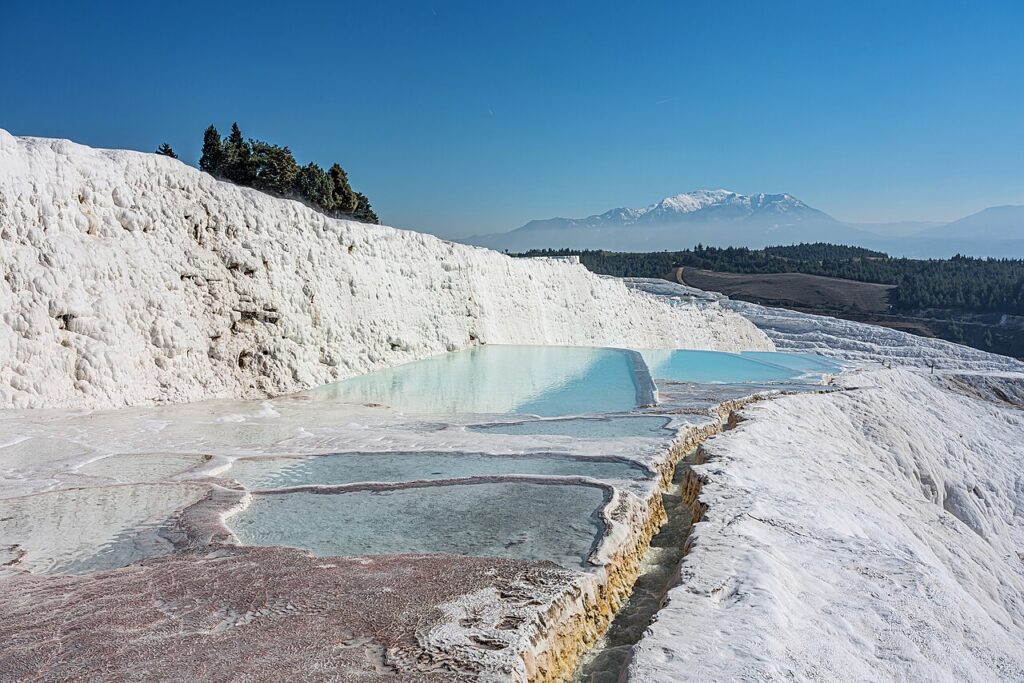
Hierapolis-Pamukkale — inscribed by UNESCO in 1988 as a mixed natural and cultural World Heritage Site — combines two distinct outstanding universal values on a single spectacular hillside above the Çürüksu valley in Denizli Province, southwestern Turkey: the Hellenistic-Roman spa city of Hierapolis (founded circa 190 BCE, populated through the Byzantine period until an earthquake destroyed much of the city in 1354 CE) and the Pamukkale travertine terraces (the “Cotton Castle”), a 160-metre limestone cliff covered in an extraordinary deposit of white calcium carbonate left by thermal mineral springs that have been flowing across the hillside for at least 400,000 years.
The travertine terraces of Pamukkale: geology, thermal springs, and the Cotton Castle landscape Pamukkale village access · Karahayıt springs (red travertine, 3 km) · Sacred Pool (Antique Pool, within Hierapolis ruins) — within the inscription
The Pamukkale travertine system is the product of a specific combination of geological conditions: the Çürüksu valley (a graben, or rift valley, bounded by active normal faults in the seismically active Denizli basin) contains numerous thermal springs whose water — heated by the geothermal gradient at depth and enriched in calcium bicarbonate by its passage through limestone formations — emerges at the surface at approximately 35°C and with a calcium carbonate concentration of approximately 1,200–1,400 mg per litre. As the spring water cascades down the cliff face and flows across the travertine terraces, it loses carbon dioxide to the atmosphere, causing the dissolved calcium carbonate to precipitate as solid calcite — the white mineral that has accumulated over hundreds of thousands of years to depths of several metres in the terrace basins and tens of metres in the cliff face itself. The active deposition creates the characteristic formations: the travertine terraces (natural basins averaging 0.3–0.7 m deep, with slightly curved forward-pointing rims of white calcite), the cascades between basins, and the stalactite-like formations at the cliff edge where water drops off the terrace into free fall. The white colour of the calcite against the blue sky and the surrounding green valley gives the site its visual character — one of the most photographed natural formations in the world — and its Turkish name Pamukkale (“Cotton Castle” or “Cotton Fortification”), with the white cliff resembling, at a distance, a castle covered in white cotton. The thermal springs emerge at approximately 15–17 points along the cliff top and are partially managed by the Pamukkale tourism infrastructure (water is periodically diverted between terrace areas to allow controlled rehydration and active deposition — the active terraces are white; areas starved of water turn grey). Entry to the travertine terraces requires removal of shoes (to protect the calcite surface) and visitors walk barefoot in the shallow warm water of the active terrace basins — a sensory experience combining the visual spectacle of the white landscape with the physical sensation of 35°C mineral water underfoot. The nearby Karahayıt springs (3 km north) produce red-and-orange travertine deposits from iron-rich water — a secondary attraction that extends the thermal landscape of the inscription area.
The Sacred Pool (Antique Pool, Kleopatra’s Pool) within the Hierapolis archaeological zone is a thermal spring pool where ancient architectural elements — column drums, Corinthian capitals, architectural blocks — lie scattered on the pool floor, visible through the warm clear mineral water: the pool is now operated as a swimming attraction, allowing visitors to bathe in the same thermal water that ancient Romans bathed in, amid the submerged remains of the colonnaded building (possibly a Roman bath-gymnasium) that was demolished in the 7th-century CE earthquake. The temperature is approximately 36°C and the mineral content gives the water its distinctive buoyancy and slight tingling sensation. The Antique Pool is within a short walk of the Hierapolis archaeological site; it charges a separate entry fee and operates as a private attraction within the UNESCO inscription area. The red iron-stained rock formations of Karahayıt (3 km north of Pamukkale village) offer an alternative thermal experience and are frequented by the medical tourism community that has developed around Denizli’s thermal springs — a continuation, at a modern scale, of the ancient Roman spa tradition that originally made Hierapolis one of the most prosperous cities of Asia Minor.
Hierapolis: the Hellenistic spa city, the Pluto’s Gate, and the necropolis Apollo Temple · Theatre (12,000 seats) · Ploutonion/Pluto’s Gate · Extensive necropolis — within the Hierapolis ruins
Hierapolis was founded circa 190 BCE by the Seleucid king Antiochus II (or, according to some sources, by Eumenes II of Pergamon after 188 BCE when the Seleucid territory was ceded to Pergamon by the Treaty of Apamea) and named after Hiera, the legendary wife of Telephus, the mythological son of Hercules and founder of the Mysian people. The city’s prosperity derived from its position as a thermal resort — the mineral springs that create the Pamukkale terraces were used for medicinal bathing from the earliest settlement, and Hierapolis developed into one of the major thermal resort cities of Asia Minor, attracting wealthy Roman citizens seeking cures for rheumatism, gout, and respiratory conditions in the thermal baths. The commercial wealth derived from the wool-dyeing industry (the calcium-rich thermal water was particularly effective for fixing certain dyes to wool, and Hierapolis became a major centre of the Anatolian wool trade) and from its position on the road connecting Ephesus on the Aegean coast to the interior of Asia Minor. The archaeological site preserves a well-articulated Roman urban plan: the main colonnaded street (Frontinus Street, named after the Roman senator and water engineer Sextus Julius Frontinus who was proconsul of Asia circa 84–86 CE) runs the length of the upper plateau from the north gate to the south gate, with bath complexes, gymnasiums, and public buildings flanking it. The theatre (2nd century CE, 12,000-person capacity) is one of the best-preserved Roman theatres in Turkey, with a well-preserved scaenae frons (stage building facade) showing relief panels of mythological scenes. The Apollo Temple (2nd century BCE, rebuilt in the 3rd century CE) stands immediately above the Ploutonion (Pluto’s Gate), a cave in the hillside that emits toxic volcanic carbon dioxide — the ancient Greeks and Romans identified it as an entrance to the underworld, and priests of the cult of Pluto demonstrated the lethal power of Hades by leading animals into the cave and releasing them to die from the CO₂. Modern measurements confirm the cave still emits significant concentrations of CO₂ from magmatic volcanic activity at depth, with concentrations sufficient to kill small animals at ground level. The necropolis of Hierapolis — one of the largest ancient cemeteries in Asia Minor, extending for approximately 2 km along the road approaching the city from the north — contains hundreds of sarcophagi (some still in position), tumuli, and mausolea dating from the Hellenistic through Roman and early Byzantine periods; several inscribed examples document the professions and origins of the dead, including Jewish inscriptions and some of the earliest identified Christian grave inscriptions in Asia Minor (the city had a significant early Christian community — the apostle Philip reportedly died and was buried at Hierapolis, and a martyrion octagonal building on the hill above the city is identified as his martyrium).
Practical information
Hierapolis-Pamukkale is located 20 km north of Denizli city in Denizli Province. Access: Denizli Airport (DNZ, with regular connections to Istanbul, approximately 1 hour) or by bus/train from Izmir (approximately 3 hours), Antalya (approximately 3 hours), or Istanbul (approximately 8–9 hours by overnight bus). From Denizli city, regular dolmuş (shared minibus) services run to Pamukkale village (30–40 minutes). Pamukkale village at the base of the travertine cliff is the main tourist base, with hotels (cave/pool hotels built into the Hierapolis ruins area), restaurants, and guesthouses. The travertine terraces are accessible from two main entry points: the lower south gate (accessible directly from the village) and the upper north gate (accessible by road to the Hierapolis ruins). Barefoot walking on the terraces is mandatory (shoes must be removed at the entry points; shoe storage is available). The Hierapolis archaeological site (including the theatre, necropolis, and Apollo Temple) requires a separate ticket from the travertine terraces entry; both are usually included in a combined ticket. The Hierapolis Archaeological Museum (in the former Roman bath building at the site’s centre) houses sculptures from the theatre scaenae frons, sarcophagi, and other finds. Best season: April–June and September–November (lower temperatures; July–August is very hot and very crowded at the terraces). The water level in the travertine basins varies seasonally and year to year depending on spring flow management; the most active, white, and water-filled terraces are visible from approximately October to March. Allow a full day for Hierapolis ruins + travertine terraces + Sacred Pool.
Frequently Asked Questions
How were the Pamukkale travertine terraces formed and why are they white?
The Pamukkale travertine terraces formed through a geological process called travertine precipitation — the deposition of solid calcium carbonate (calcite, CaCO₃) from calcium-bicarbonate-saturated thermal spring water as it flows over the cliff surface and degasses carbon dioxide. The process begins deep underground: rainwater and groundwater percolate through the limestone and dolomite formations of the surrounding mountains, dissolving calcium and bicarbonate ions as they go; the groundwater is heated by the geothermal gradient as it descends to depths of 1–3 km, where temperatures of 60–200°C accelerate the dissolution of minerals. The heated, mineral-saturated water then rises along fault zones — Pamukkale sits directly above a network of active faults associated with the East Anatolian Fault System — and emerges at the surface at approximately 35°C with calcium bicarbonate concentrations approximately 400–500 times higher than typical river water. When this saturated water reaches the surface and flows over the cliff, it loses carbon dioxide to the atmosphere (CO₂ becomes less soluble at lower pressure and as the water cools slightly); the loss of CO₂ shifts the chemical equilibrium and causes the dissolved calcium bicarbonate to convert to solid calcium carbonate, which precipitates out of solution as white calcite crystals on every surface the water touches. The deposition rate varies with water flow, temperature, pH, and the rate of CO₂ degassing — active travertine areas grow by approximately 1–4 cm of calcite per year under optimal conditions. The white colour of the terraces is the colour of pure calcite (the same mineral as white marble); where the water is rich in iron (as at the Karahayıt springs 3 km north), the travertine is coloured orange-red by iron oxide. The total volume of travertine deposited at Pamukkale by the active springs over the geological timescale is estimated at several billion cubic metres — one of the largest travertine systems in the world, comparable to the Mammoth Hot Springs of Yellowstone National Park (USA) and the travertine terraces of Huanglong in China.
What is the Ploutonion (Pluto’s Gate) at Hierapolis and why was it considered an entrance to the underworld?
The Ploutonion at Hierapolis (also Plutonium in Latin, or “Pluto’s Gate”) is a natural cave at the base of the Temple of Apollo slope from which volcanic carbon dioxide (CO₂) at dangerous concentrations emerges from the ground — a geological phenomenon associated with the active volcanic degassing that also heats the thermal springs of Pamukkale. The ancient Greeks and Romans identified concentrations of toxic volcanic gases emerging from the earth as sacred to Pluto (Hades), the god of the underworld, interpreting them as the breath of the underworld realm below. The Hierapolis Ploutonion was one of the most famous of these sacred spots in the ancient world: the geographer Strabo (circa 64 BCE – 24 CE) described it in detail in his Geographica, noting that the priests of Cybele could enter the cave holding their breath and survive, while animals (sparrows in Strabo’s account) died almost immediately upon being lowered into the cave interior. The ancient explanation was divine protection of the priests; the scientific explanation is that CO₂ (being heavier than air at approximately 1.5 times the density of atmospheric air) accumulates at ground level in the cave interior, while humans, standing upright with their heads above the CO₂ concentration layer, can breathe the air above while small animals at ground level asphyxiate. The cave was rediscovered by archaeologists from the Italian archaeological mission at Hierapolis in 2013 CE, still emitting measurable CO₂ concentrations — a rare surviving example of a site where the ancient religious and scientific accounts of toxic volcanic emissions can be directly verified against modern measurements. Recent studies (2019–2020) by Italian and Turkish geologists documented CO₂ concentrations within the cave of approximately 35,000–91,000 ppm (compared to normal atmospheric concentration of approximately 400 ppm) — levels immediately lethal to small mammals and causing disorientation and loss of consciousness in humans within minutes. The sanctuary was in use from approximately the 2nd century BCE through the 6th century CE, when Byzantine Christianity suppressed the pagan cult.
What is the connection between Hierapolis and the early Christian church in Asia Minor?
Hierapolis had an important role in early Christianity that makes it significant in addition to its Roman and Hellenistic archaeological heritage: the city is recorded in Christian sources as the location of the death and burial of the apostle Philip (one of the twelve apostles of Jesus), and as an important centre of early Christian theological development in the 2nd century CE. The Epistle to the Colossians (4:13, traditionally dated to the early 60s CE but possibly later) mentions “Hierapolis” in a list of cities where the apostle Epaphras was said to have worked, establishing the city’s early Christian connections. The traditions surrounding Philip of Hierapolis — attested in 2nd-century CE sources, including Papias of Hierapolis (circa 60–130 CE, bishop of Hierapolis and an early collector of sayings attributed to Jesus), Polycrates of Ephesus (circa 130–196 CE), and Eusebius of Caesarea (writing circa 315 CE) — distinguish between Philip the Apostle (listed in Matthew 10:3) and Philip the Evangelist (Acts 6:5, 21:8), with the Hierapolis tradition generally identifying the Philip buried at Hierapolis as Philip the Apostle. The Martyrion of Philip, an octagonal martyrium-chapel built circa 395–400 CE on the hillside above the main city, was excavated by Italian archaeologists in the 20th century and is identified as the martyrium built to commemorate the site of Philip’s death (martyrion buildings typically marked the tomb or place of death of a Christian martyr). The remains of the martyrion — a large octagonal platform with surrounding subsidiary rooms, connected to the Hierapolis city centre by a processional route — are the most extensive surviving early Byzantine martyrium complex in Asia Minor. Papias of Hierapolis is one of the most important figures in early Christian literary history: as bishop of Hierapolis in the first half of the 2nd century CE, he compiled the Exposition of the Dominical Oracles (now largely lost, surviving in fragments quoted by later authors), which contained direct interview material with people who had personally known disciples of Jesus — making him a crucial link in the transmission chain of early Christian oral tradition to written form.
EXCERPT: Hierapolis-Pamukkale (UNESCO 1988, mixed) — the Hellenistic-Roman spa city of Hierapolis (190 BCE–1354 CE, with Apollo Temple, 12,000-seat theatre, Pluto’s Gate toxic cave, and Philip’s Martyrion) combined with the Cotton Castle of white calcium carbonate travertine terraces formed by 35°C thermal springs, 20 km north of Denizli.
META: UNESCO World Heritage Sites near Hierapolis-Pamukkale Turkey: Ephesus 200 km west, Xanthos-Letoon 330 km southwest — Aegean-Mediterranean Turkey heritage circuit from the travertine spa city to the greatest Ionian metropolis and the Lycian capital’s trilingual inscription.
Sources
- S1 — UNESCO World Heritage Centre — Hierapolis-Pamukkale (Ref. 485) — https://web.archive.org/web/20230601000000/https://whc.unesco.org/en/list/485/
- S2 — Ministry of Culture and Tourism Republic of Türkiye — https://muze.gov.tr/
Spotted an error? Write to the editors and we correct it the same day.