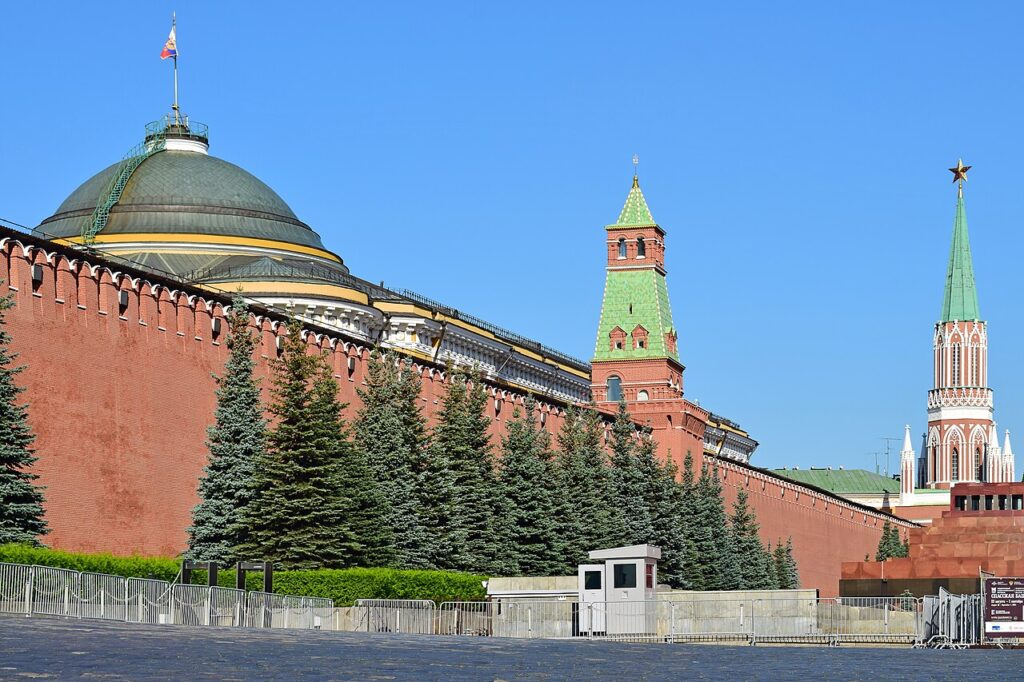
The Kremlin and Red Square, Moscow, inscribed by UNESCO in 1990, form the 28-hectare historic core of Russia’s capital — the medieval walled fortress (Kremlin, from the Russian kreml meaning “fortress”) rising above the Moscow River on a limestone promontory, and the 73,000-square-metre Red Square that functions as the symbolic centre of Russian statehood, Orthodox Christianity, and national memory. The inscription encompasses the Kremlin’s four cathedrals (the Cathedral of the Dormition, 1479 CE; the Cathedral of the Archangel, 1508 CE; the Cathedral of the Annunciation, 1489 CE; and the Cathedral of the Deposition of the Robe, 1486 CE), the Ivan the Great Bell Tower (1508 CE, 81 metres), the Grand Kremlin Palace (1849 CE), the State Armoury Museum (1851 CE), and on Red Square, the Cathedral of the Intercession (St Basil’s Cathedral, 1555–1561 CE) and the Lenin Mausoleum (1930 CE).
The Golden Ring: Vladimir, Suzdal and the medieval heritage cities northeast of Moscow White Monuments Vladimir · Golden Ring Suzdal · Trinity Lavra Sergiev Posad — 70 to 220 km
Seventy Kilometres northeast of Moscow by road (approximately 1 hour by car on the Yaroslavl Highway, or approximately 60 minutes by suburban train Aeroexpress from Yaroslavsky Station), Sergiev Posad — site of the Trinity Lavra of St. Sergius (Troitse-Sergiyeva Lavra, UNESCO 1993) — is the most important Russian Orthodox monastery and the founding institution of Russian monasticism. The Trinity Lavra was established in 1337 CE by St Sergius of Radonezh (Sergei Radonezhsky, 1314–1392 CE), the most revered Russian Orthodox saint, who left Moscow for the forests northeast of the capital to establish a hermit community on Makovets Hill. The monastery that grew from Sergius’s hermitage became the spiritual centre of the growing Muscovite state: Grand Prince Dmitry Donskoy received St Sergius’s blessing before the Battle of Kulikovo (1380 CE), the decisive Muscovite victory over the Tatars that is regarded as the foundation event of the Russian national consciousness; Tsar Ivan the Terrible was baptised here; Tsar Boris Godunov is buried in the monastery. The UNESCO-inscribed architectural ensemble — the Assumption Cathedral (Uspensky Sobor, 1559–1585 CE, built by Ivan the Terrible, with its distinctive blue domes with gold stars), the Trinity Cathedral (1422 CE, the oldest structure, containing the relics of St Sergius), and the Bell Tower (1741–1769 CE, the tallest structure in the ensemble at 88 metres) — represents the most complete surviving 15th–18th-century monastery complex in Russia. From the Moscow Kremlin, the Trinity Lavra is reached by suburban train (Elektrichka) from Yaroslavsky Station (approximately 1.5 hours, frequent service) or by tourist bus (approximately 2 hours from central Moscow).
One Hundred and Ninety Kilometres northeast of Moscow by Vladimir Highway (approximately 2 hours by high-speed Lastochka train from Kursky Station to Vladimir, or 2.5 hours by regular InterCity train), the White Monuments of Vladimir and Suzdal (UNESCO 1992) are the 12th-century architectural masterpieces of the Vladimir-Suzdal Principality — the medieval Russian state that, before Moscow’s rise to dominance in the 14th century, was the political and cultural capital of northeastern Rus. The Vladimir inscription encompasses the Cathedral of the Dormition (Uspensky Sobor, Vladimir, 1158–1189 CE) — the mother church of all Russian Orthodox cathedrals, where Vladimir princes were crowned and Russian metropolitans were enthroned before the 16th-century transfer of the metropolitanate to Moscow — and the Cathedral of St Demetrius (Dmitrievsky Sobor, 1191–1197 CE), covered on its exterior with 1,500 carved relief sculptures of saints, fantastic beasts, and Old Testament figures in the most complete surviving example of Vladimir-Suzdal carved stone ornamentation. The inscription extends to the Suzdal Kremlin (30 kilometres from Vladimir), the Cathedral of the Nativity of the Theotokos (Rozhdestvensky Sobor, 1222–1225 CE) with its distinctive dark-blue exterior domes decorated with golden stars, and the Church of the Intercession on the Nerl (Pokrova-na-Nerli, 1165 CE) — the solitary white limestone church in the water-meadows at the confluence of the Nerl and Klyazma rivers, built to commemorate Prince Andrei Bogolyubsky’s son killed in battle, considered the most perfect single structure in Russian medieval architecture. From Vladimir, Suzdal is reached by bus (approximately 40 minutes).
Two Hundred and Twenty Kilometres northeast of Moscow by road via Yaroslavl (approximately 3 hours by car or 2.5 hours by Sapsan high-speed train to Yaroslavl then local bus), the Cultural and Historic Ensemble of the Solovetsky Islands (UNESCO 1992) is 900 kilometres further north by sea from Arkhangelsk — but within the conceptual Golden Ring heritage circuit, the cities of the Golden Ring proper (Yaroslavl, Kostroma, Ivanovo, Rostov Velikiy, Pereslavl-Zalessky) are all within 300 kilometres of Moscow and form the most concentrated circuit of medieval Russian Orthodox church and monastery heritage in Russia. Yaroslavl’s Historic Centre (UNESCO 2005) — the best-preserved 17th-century merchant city in the Volga region, with 17 churches from the 1650s–1670s period and the unique Church of Elijah the Prophet (1647–1650 CE) whose frescoes (3,000 square metres painted 1680–1681 CE by the Yaroslavl school of fresco painters) are the finest surviving example of late-medieval Russian church painting — is 280 kilometres from Moscow by the Yaroslavl Highway (approximately 3 hours by car or 3.5 hours by train from Yaroslavsky Station). From the Moscow Kremlin, Yaroslavl is reached by Lastochka train from Yaroslavsky Station (approximately 3 hours).
Novgorod, St Petersburg and the great northwest heritage corridor Historic Novgorod · St Petersburg monuments · Pskov · Kizhi — 500 to 1,400 km
Five Hundred Kilometres northwest of Moscow by road (approximately 5 hours by car or 3 hours by Sapsan high-speed train from Leningradsky Station to St Petersburg, then 2.5 hours further south by bus or train), the Historic Monuments of Novgorod and Surroundings (UNESCO 1992) are the most extensive surviving medieval Russian architectural ensemble outside Moscow. Novgorod (Veliky Novgorod, “Great Novgorod”) was from the 9th to 15th century the northernmost and commercially most powerful city of medieval Rus — a city-state republic governed by a popular assembly (veche) rather than a hereditary prince, connected to the Hanseatic League trading network and at its peak the principal Russian exporter of fur, beeswax, and flax to Western Europe. The city’s 600 surviving medieval churches (of which 53 are inscribed as part of the UNESCO property) span from the Cathedral of St Sophia (Novgorodian Sofiysky Sobor, 1045–1052 CE, the oldest surviving building in Russia) through the 12th–15th-century parish churches of Novgorod’s merchant quarters, built in the distinctive Novgorodian style of white-washed limestone with distinctive rounded apses and kokoshnik decorative gable forms. From Moscow, Novgorod is reached by Sapsan to St Petersburg (approximately 3 hours) then Lastochka train to Novgorod (approximately 3 hours), or by direct bus (approximately 6 hours from Moscow Lubyanka area bus stations).
Practical information
The Kremlin and Red Square are in central Moscow, accessible by Moscow Metro (Borovitskaya, Biblioteka Imeni Lenina, Alexandrovsky Sad stations on the Circle Line and Line 1). The Kremlin museums complex (including the Armoury and Diamond Fund exhibitions) is open Tuesday–Sunday 10:00–17:00; Kremlin Cathedral grounds 10:00–17:00 (closed Thursdays). Tickets for the Cathedral complex (approximately 700 RUB for Russian citizens, variable for foreigners) and the separate Armoury Museum (approximately 1,000 RUB) are purchased at the ticket office near the Kutafya Tower on Alexandrovsky Garden. Photography is permitted in the cathedral interiors (without tripod). Red Square itself has no entry fee and is accessible at all hours; St Basil’s Cathedral (Museum of History branch) has separate admission (approximately 800 RUB). The Alexander Garden adjacent to the Kremlin wall, with the Tomb of the Unknown Soldier and Eternal Flame (the focus of Russian national commemoration), is freely accessible. The Historic Monuments of Novgorod and Surroundings are 530 kilometres from Moscow (3 hours by Sapsan to St Petersburg, then 3 hours by train to Novgorod, or approximately 6 hours by direct bus). Best season for Moscow: late May to early September (warm, long days, maximum museum opening hours). Late December to early January (New Year’s cultural programming and snow aesthetics) is popular for short visits.
Frequently Asked Questions
What is the history of the Moscow Kremlin and how did it become Russia’s political centre?
The Moscow Kremlin’s origins are as a 12th-century wooden fortification above the Moscow River: Prince Yuri Dolgoruky of Vladimir-Suzdal is credited with founding Moscow in 1147 CE (the date of the first documented mention of the city, in a chronicle recording a meeting between Yuri and Svyatoslav at the “lovely village of Moscow”), and a wooden kremlin (fortress) was established on the promontory above the Moscow River confluence with the Neglinnaya River during his reign. The white-stone Kremlin was built by Grand Prince Dmitry Donskoy in 1367–1368 CE — the first stone fortification in Moscow, constructed in the period of Muscovite political consolidation after the Battle of Kulikovo (1380 CE). The current brick Kremlin walls and towers were built 1485–1516 CE under Ivan III (Ivan the Great, 1462–1505 CE), who engaged Italian Renaissance architects (Antonio Fioravanti of Bologna, Pietro Antonio Solari, and Marco Ruffo) to rebuild the Kremlin in the latest Italian fortification and cathedral design. Fioravanti rebuilt the Cathedral of the Dormition (1475–1479 CE) using Vladimir’s 12th-century Dormition Cathedral as the template — a deliberate architectural act of claiming the sacred heritage of the older Vladimir-Suzdal culture for the rising Muscovite state. The Italian-designed towers (the Spasskaya Tower with its clock, the Nikolskaya, and the Borovitskaya towers among the 20 surviving towers) give the Kremlin its distinctive crenellated battlements with swallow-tail merlons — a form borrowed from north Italian fortifications (the same form seen on the Castello Sforzesco in Milan and the walls of Verona). The Kremlin became the seat of the Russian imperial government under Peter the Great in the early 18th century, then lost political importance after the 1703 founding of St Petersburg as capital; it returned to political primacy after Lenin moved the Soviet government from Petrograd to Moscow in March 1918, and has been the seat of Russian state power continuously since.
What is Red Square and what makes it UNESCO-significant?
Red Square (Krasnaya Ploshchad, where “krasnaya” in Old Russian means both “red” and “beautiful”) is the 73,000-square-metre public space between the eastern wall of the Kremlin and the GUM department store (State Universal Store, 1893 CE), bounded at the south by St Basil’s Cathedral and at the north by the State Historical Museum (1883 CE). The square’s function as the symbolic centre of Russian national life — executions were carried out here by Tsar Ivan the Terrible; revolutionary demonstrations occurred here in 1905 and 1917; Soviet military parades were held here annually on May 1 and November 7 — is inseparable from its UNESCO significance, which explicitly recognises the square as a living element of Russia’s political and cultural identity, not merely a collection of monuments. St Basil’s Cathedral (Cathedral of the Intercession of the Most Holy Theotokos on the Moat, 1555–1561 CE), built by Ivan the Terrible to commemorate the capture of Kazan from the Khanate of Kazan in 1552 CE, is the most recognisable single structure in Russia internationally: its nine domed chapels, each dedicated to a saint on whose feast day a Kazan battle was won, are topped by onion domes in spiralling coloured patterns (the polychrome decoration was added in the 17th century; the original 1561 domes were likely plain white). The architect or architects of St Basil’s are unknown — the tradition that Ivan the Terrible blinded the architects (Postnik Yakovlev and Barma) to prevent them from creating an equal structure elsewhere is a legend first recorded in the 17th century and has no contemporary documentation. The Lenin Mausoleum (1930 CE, designed by Alexei Shchusev in red and black Karelian granite and labradorite) was included in the UNESCO inscription as a 20th-century addition to the Red Square ensemble that reflects Soviet-period political ideology materialised in architecture.
What is the Golden Ring and which of its cities are UNESCO-inscribed?
The Golden Ring (Золотое кольцо) is a tourist itinerary concept introduced by journalist and art historian Yuri Bychkov in a 1967 Sovetskaya Kultura article, describing a circuit of medieval Russian cities northeast of Moscow that preserve the oldest surviving Orthodox churches, monasteries, and kremlin fortifications in Russia. The formal tourist circuit typically includes 8 principal cities — Sergiev Posad, Pereslavl-Zalessky, Rostov Velikiy, Yaroslavl, Kostroma, Ivanovo, Suzdal, and Vladimir — plus optional extensions to Alexandrov, Palekh (famous for lacquer miniature painting), and Plyos (Volga river town). Of these, three have UNESCO inscriptions: the White Monuments of Vladimir and Suzdal (UNESCO 1992) covering the Dormition Cathedral in Vladimir, St Demetrius Cathedral, Suzdal Kremlin, and the Church of the Intercession on the Nerl; the Historic Centre of the City of Yaroslavl (UNESCO 2005) covering the 17th-century merchant city centre and its 17 major churches; and the Trinity Lavra of St Sergius at Sergiev Posad (UNESCO 1993). The remaining Golden Ring cities — Pereslavl-Zalessky (with the Cathedral of the Transfiguration, 1157 CE, the oldest surviving church in northeastern Russia), Rostov Velikiy (with the Rostov Kremlin, 17th century, and Spaso-Yakovlevsky Monastery), Kostroma (with the Ipatievsky Monastery where Michael Romanov accepted the tsardom in 1613 CE) — are not separately inscribed but preserve medieval architectural ensembles of comparable quality. A complete Golden Ring circuit by road from Moscow (approximately 7–10 days) covers approximately 700 kilometres in a loop northeast then south back to Moscow, using Vladimir and Yaroslavl as overnight hubs.
EXCERPT: The Kremlin and Red Square, Moscow (UNESCO 1990) — Russia’s medieval fortress-capital and symbolic national centre — lie 70 km southwest of the Trinity Lavra of St Sergius, 190 km west of the White Monuments of Vladimir and Suzdal, and 500 km southeast of Novgorod’s 11th-century St Sophia Cathedral.
META: UNESCO World Heritage Sites near the Moscow Kremlin: Trinity Lavra of St Sergius 70 km, White Monuments of Vladimir and Suzdal 190 km, Historic Centre of Yaroslavl 280 km, Historic Monuments of Novgorod 530 km — Russia’s complete medieval Orthodox heritage circuit from the Golden Ring to the great northwest.
Sources
- S1 — UNESCO World Heritage Centre — Kremlin and Red Square, Moscow (Ref. 545) — https://web.archive.org/web/20230601000000/https://whc.unesco.org/en/list/545/
- S2 — Moscow Kremlin Museums Official Portal — https://www.kreml.ru/
Spotted an error? Write to [email protected] and we correct it the same day.