
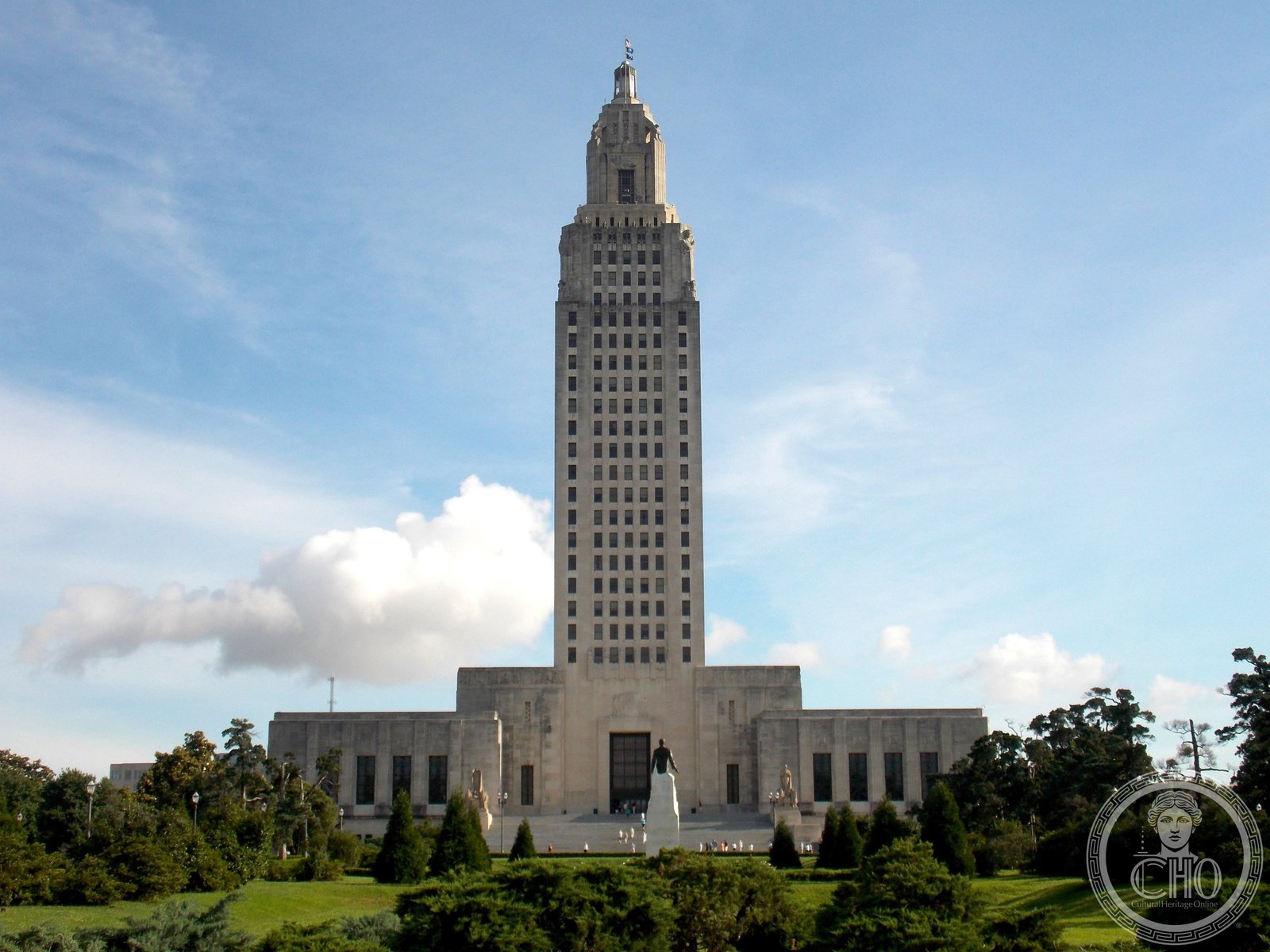

At 450 feet and 34 stories, the tallest state capitol in the United States — a skyscraper government tower commissioned by Governor Huey Long and completed in fourteen months at the height of the Depression.
At a glance
The Louisiana State Capitol is an Art Deco skyscraper that rises 450 feet above the Mississippi River floodplain in Baton Rouge, making it by far the tallest state capitol building in the United States. Completed in 1932 after a construction period of just fourteen months — a record pace even by Depression-era standards — the building was the signature project of Governor Huey P. Long, whose political ambitions and personal drive shaped both the commission and the speed of construction. Designed by the New Orleans firm of Weiss, Dreyfous and Seiferth, the tower represents a singular moment when American democratic architecture rejected the dome-and-column tradition entirely in favor of the commercial skyscraper as a form of governmental power.
Key facts
- Address: 900 North Third Street, Baton Rouge, Louisiana 70801
- Completed: 1932
- Architects: Weiss, Dreyfous and Seiferth (New Orleans)
- Governor who commissioned it: Huey P. Long
- Height: 450 feet (34 floors)
- Distinction: Tallest state capitol in the United States
- Designation: National Historic Landmark
- GPS: 30.4574°N, 91.1870°W
History
Louisiana’s previous state capitol was a Gothic Revival structure that had served since the 1880s. By the late 1920s, Huey Long — who had transformed Louisiana politics through a combination of populist infrastructure programs and ruthless political consolidation — saw the old building as an inadequate symbol for his ambitions. The commission for a new capitol was issued after Long’s election as governor in 1928, and the project moved with a speed that reflected his personal impatience: ground was broken in late 1930 and the building was dedicated in May 1932, roughly fourteen months later.
The architects chosen were Weiss, Dreyfous and Seiferth, a New Orleans firm experienced in civic work. Their design departed entirely from the domed-temple tradition that had governed state capitol design since the Federal period. Instead, they produced a skyscraper in the Art Deco idiom — a vertical tower with setback stories, limestone cladding, and an elaborate program of relief sculpture depicting Louisiana history, agriculture, industry, and wildlife. The choice was both practical (a tall building could accommodate far more office space than a spread-out classical structure) and symbolic: height as a measure of ambition.
Huey Long was assassinated in the building in September 1935, shot in the first-floor corridor by Dr. Carl Weiss. He was buried in the sunken garden at the base of the tower, where his bronze statue still stands. The assassination has made the Louisiana State Capitol one of the most historically charged buildings in the American South, layering political tragedy over its architectural ambitions.
What you see
The building’s exterior is a sustained exercise in Art Deco sculpture at architectural scale. The limestone tower rises from a broad base in a series of stepped setbacks, each transition marked by horizontal bands of carved relief depicting scenes from Louisiana’s past: Spanish and French explorers, Native American peoples, the plantation economy, river commerce, and the oil industry that would define twentieth-century Louisiana. The sculptures are densely detailed and cover far more of the exterior surface than was typical even in Deco buildings, giving the tower a textural richness unusual in its idiom.
The entrance foyer and legislative chambers inside continue the sculptural program, with bronze doors, marble floors, and carved stone panels that make the interior one of the most elaborately finished of any American state capitol. The observation deck on the twenty-seventh floor offers a panoramic view of Baton Rouge, the Mississippi River, and the industrial landscape of the petrochemical corridor that would grow along the river’s banks in the decades after the building’s completion. The sunken garden at the base, site of Huey Long’s tomb, is publicly accessible and formally designed as an extension of the building’s civic authority.
Practical information
- Hours: Monday–Friday 8 AM–4:30 PM; closed weekends and state holidays
- Admission: Free; tours of the building and observation deck available
- Observation deck: 27th floor; panoramic view of the Mississippi River and Baton Rouge
- Time needed: 1–2 hours including tour and observation deck
Getting there
The Louisiana State Capitol stands on North Third Street in the Capitol Park area of Baton Rouge, approximately one mile north of downtown along the river bluff. By car from Interstate 110, take the North Boulevard exit and follow Government Street or Third Street north to the capitol grounds; parking is available in surface lots adjacent to the building. Baton Rouge is served by Baton Rouge Metropolitan Airport, approximately ten miles east of the capitol. The building is within the Capitol Park historic district, which also includes the Old State Capitol, the Governor’s Mansion, and related civic buildings.
Nearby
- Old Louisiana State Capitol (1850, Gothic Revival) — one mile south on North Boulevard, now a museum
- Louisiana Governor’s Mansion — adjacent to the capitol grounds
- USS Kidd Veterans Museum — 1.5 miles south along the riverfront
- Rural Life Museum — five miles east on Essen Lane, LSU campus area
Sources
- National Historic Landmark nomination form, Louisiana State Capitol (National Park Service)
- State Library of Louisiana — construction records and architectural documentation (state.lib.la.us)
- Glen Jeansonne, Messiah of the Masses: Huey P. Long and the Great Depression — political context of the commission
- Louisiana Division of Historic Preservation, Capitol Park survey records
- Times-Picayune and Morning Advocate coverage of the dedication, May 1932 (ProQuest Historical Newspapers)
Find it on the map
See this place and what’s around it →Record researched and written by Luigi De Marchi for Cultural Heritage Online, 2026.
📷 Become a Cultural Heritage Online photographer
Share your photos of places: they stay published under your name as the author. The more they're seen, the more you get noticed — and soon a contest will reward the most appreciated photos.
Log in or sign up free to add a photoIs this page about you?
This page is read by travellers and heritage enthusiasts who find it on Google. Tell us how you are connected to this place and we will take it from there.